A Dubai-based COO collects three "AI consulting" proposals for the same enterprise rollout: one quotes AED 180,000 for a six-week diagnostic, another AED 900,000 for a 12-month transformation retainer, and the third refuses to give a number until after a two-hour "discovery workshop." All three claim to solve the same problem. None of them explain, in a way she can act on, what actually drives that spread, or which one is priced for real work versus priced to win the room.
Why is enterprise AI spending accelerating in the UAE specifically, right now?
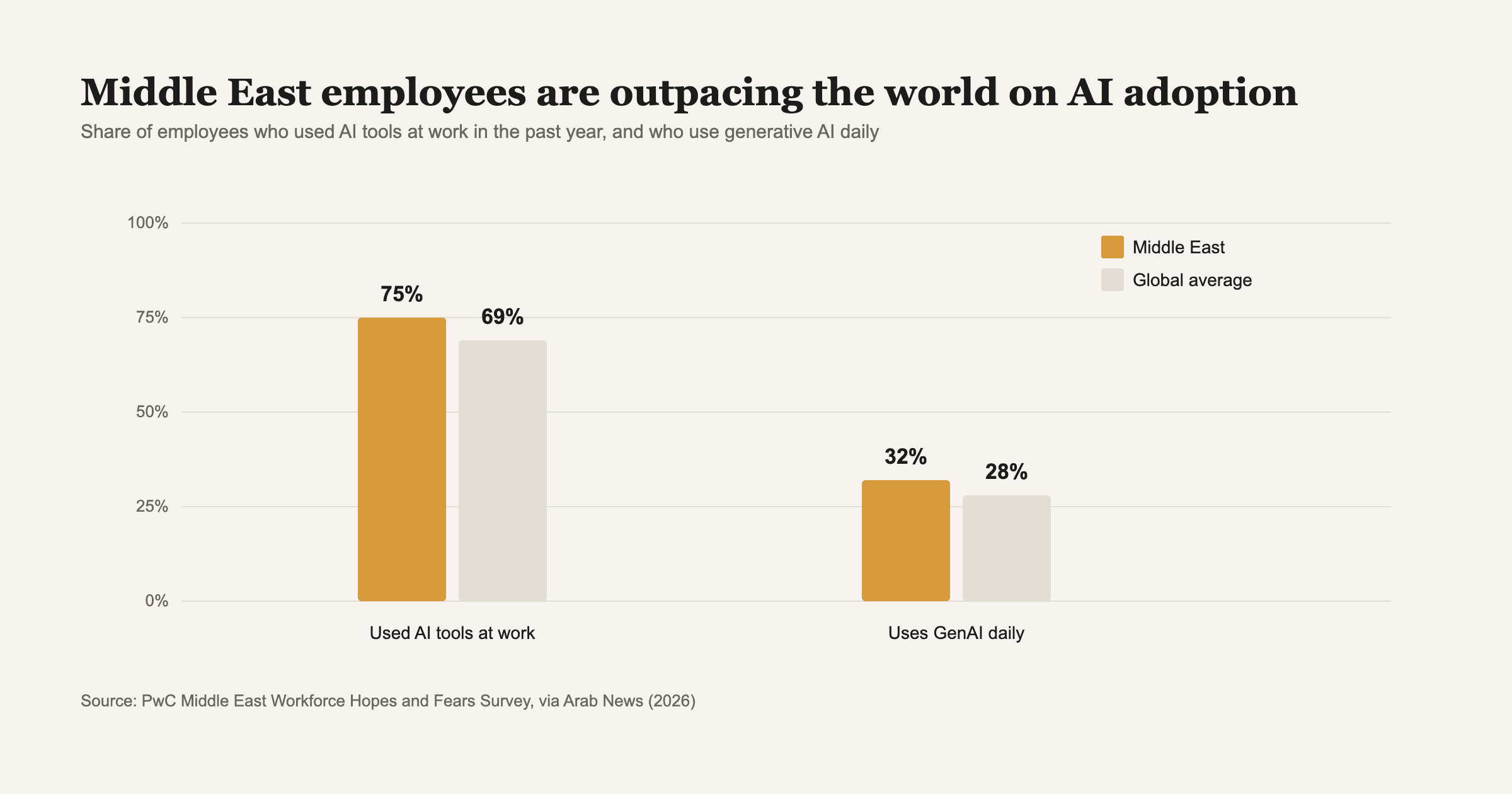
The demand curve is real, not hype. PwC's Middle East Workforce Hopes and Fears Survey found 75% of employees in the region used AI tools at work over the past year, above the 69% global average, with 32% using generative AI daily versus a 28% global average. Usage has already moved past the pilot stage for a majority of the region's workforce, the exact condition that pulls enterprise budget from "explore AI" into "operationalize AI."
The economic case behind that budget shift is specific too: PwC estimates AI could contribute US$320 billion to the Middle East economy by 2030, with the UAE seeing the largest relative impact in the region at close to 14% of 2030 GDP. Deloitte's 2026 State of AI in the Enterprise report for the Middle East found organizations are shifting from pilots to large-scale deployment, with two-thirds of organizations already reporting productivity gains from the AI they've deployed so far.
How is an AI consultancy engagement actually priced?
- Hourly advisory: pay-as-you-go strategic input, best suited to a narrow question ("should we build or buy this specific capability"), least suited to anything requiring sustained implementation work.
- Fixed-scope diagnostic or pilot: a defined deliverable, an audit, a readiness assessment, a single pilot build, for a fixed price and timeline. This is the right entry point for most enterprises that haven't yet proven a specific AI use case internally.
- Retainer for continuous optimization: an ongoing engagement once a use case is live, covering monitoring, iteration, and the next use case in the roadmap. This only makes sense after a fixed-scope engagement has proven the first use case actually works.
- The COO comparing three unlike quotes above was really comparing three different products: a diagnostic, a transformation retainer, and an undefined discovery process. None is inherently wrong, but they aren't substitutable, and a legitimate consultancy will tell you which one you actually need before quoting a number.
What actually moves the price up or down, beyond the engagement type?
Data readiness is the single biggest swing factor. An organization with clean, centralized data pays for implementation; an organization with data scattered across legacy systems pays for the integration work first, a materially different, and larger, scope than the AI layer sitting on top of it.
Custom model work versus off-the-shelf API integration is the second lever: a fine-tuned or custom-trained model costs meaningfully more to build and maintain than orchestrating an existing frontier model API against your own data, and most use cases don't need the former. Regulatory and compliance scope adds real cost when the use case touches consequential decisions, credit, healthcare, hiring, since that's where governance work, audit trails, human oversight, documentation, becomes part of the deliverable, not an afterthought.
What ROI timeline should an enterprise actually expect?
Deloitte's Middle East data shows the productivity payoff is already broad, not speculative: two-thirds of organizations that have deployed enterprise AI report measurable productivity and efficiency gains today, and agentic AI usage at meaningful scale is expected to roughly triple over the next two years as more of that value compounds.
The realistic planning window for a first enterprise use case, from signed scope to a working, adopted system, is closer to a single quarter for a well-scoped pilot than the multi-quarter timeline a broad "transformation" retainer implies. Scoping the first project against an ROI-prioritization framework before signing anything is what keeps that timeline realistic instead of aspirational.
How AIBOOTSTRAPPER solved this in the UAE for AI Doctor
For AI Doctor, a Dubai-based digital health startup, the challenge wasn't a lack of budget, it was that doctor availability couldn't scale with patient demand, and every hour of triage delay was a real cost. We built a clinically guarded AI assistant with safety guardrails and bilingual Arabic-English support, with a handoff workflow that hands a human doctor a complete pre-filled summary instead of a cold patient.
The result was 24/7 triage availability and a 68% cut in consultation prep time, delivered as a scoped build against a specific bottleneck, not an open-ended transformation program. That's the same principle behind every AI consultancy engagement worth paying for: price the specific problem, not the word "AI." If you're comparing quotes for a UAE rollout, book a call or see the full case study.
Want this done for you?
Book a free strategy call and we'll show you how to build and market your business with AI.