A UK operations director at a mid-market logistics firm gets a proposal: £15,000, a four-week build, fully automated purchase order matching. Good number, she signs off. Four weeks in, the vendor's engineer starts asking about the eleven ways a PO can arrive malformed, what happens when the ERP write-back times out mid-batch, and whether finance needs an audit trail for every auto-approved match. The scope call that follows produces a revised number: £150,000, twelve weeks. Nobody misled her. She priced a demo and is now paying for a production system, and the gap between those two things is one of the most well-documented, least-discussed line items in AI automation.
Why does the price of an AI automation project change so much between the pitch and the actual build?
It changes because a proof-of-concept and a production system are answering different questions. A POC has to prove the automation can work on the happy path: clean data in, correct action out, demoed once. A production system has to keep working on the small share of cases where the input is malformed, the downstream API times out, or two records need reconciling before the action can safely execute, every single day, unattended. CloudZero's 2026 AI cost guide, citing Gartner's research on the pilot-to-production gap, puts a concrete number on this: a $60,000 proof-of-concept can easily become a $250,000 production system once reliability engineering, monitoring, scaling and support are built in, a roughly four-times jump that has nothing to do with the vendor changing the deal.
The same report notes that pushing accuracy from 90% to 99%, the difference between 'usually works' and 'safe to run unattended on real customer data', can multiply implementation effort by three to five times on its own. Most demo automations are built and tuned to look good on a handful of test cases; getting the same workflow to hold up against every edge case a live business actually throws at it is a different, much longer engineering exercise, and that's the exercise the second quote is pricing.
What specifically drives cost from a single workflow to a production-grade agent?
- Exception handling for every malformed input, not just the ones in the demo, since a workflow that halts or silently drops records on bad data isn't safe to run unattended.
- Write-back reliability into the systems of record (CRM, ERP, finance tools), including retries, idempotency so a retried step never double-executes, and rollback logic when a downstream call fails partway through.
- Audit logging and a human-override path for any decision that touches money, compliance, or a customer-facing outcome, which most demos skip entirely because there's nothing yet to audit.
- Monitoring and alerting so a silent failure gets caught in minutes, not discovered three weeks later when finance reconciles the books and a batch of records never actually ran, the same failure mode covered in our piece on n8n's silent-failure problem.
- Integration depth: a workflow that reads from one system and writes to a spreadsheet is a different build to one that has to authenticate against, paginate through, and write consistently into three or four enterprise systems with their own rate limits and quirks.
Why is AI automation spend accelerating in the UK right now, and does that change the calculus?
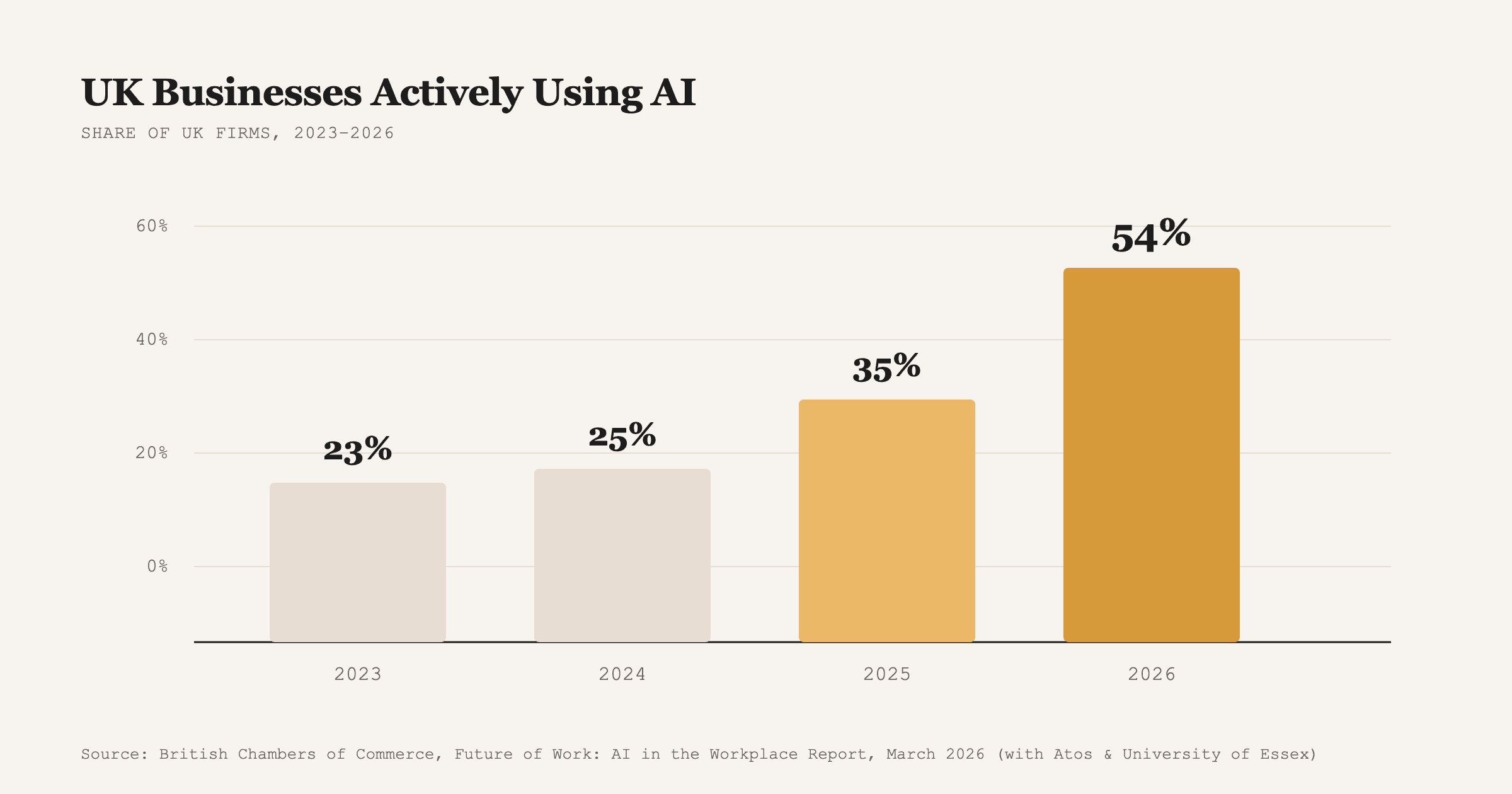
It changes the urgency, not the arithmetic. The British Chambers of Commerce's Future of Work report, produced with Atos and the University of Essex's ESRC Centre for Micro-Social Change, found that 54% of UK firms are now actively using AI in 2026, up from 35% in 2025, 25% in 2024 and 23% in 2023, a genuinely fast curve for enterprise technology adoption. The same report found 95% of SMEs using AI reported no reduction in headcount over the past year, which matters for the budgeting conversation: the business case for most of these projects is reclaiming hours currently lost to manual matching, chasing, and re-keying, not replacing people.
That adoption curve means competitors are further along the same cost curve than they were twelve months ago, which is exactly why scoping the exception paths honestly before signing, rather than discovering them mid-build, is the difference between a project that lands on budget and one that doesn't.
How should a UK business actually budget for this before signing a contract?
- Ask the vendor to price the pilot and the production hardening as two separate line items, not one bundled number, so you can see exactly what the reliability work costs before you commit to it.
- Start with the single highest-volume, most rule-based workflow in the business, not the most ambitious one; our ROI prioritization framework for picking a first AI automation project walks through why volume and rule-clarity, not novelty, should decide what goes first.
- Get the exception paths listed in writing during scoping, in plain business language, for example what happens if the invoice number doesn't match any PO, before a single line of the workflow gets built, since every unlisted exception found mid-build is a change order.
- Budget separately for the model API cost of running the production workflow every month, not just the one-time build fee; our AI agent development cost breakdown covers how those ongoing per-task costs are typically structured.
How AIBOOTSTRAPPER helps
When we built PropLock for a UK real estate firm, the brief wasn't a demo, it was a production system: an AI engine that auto-writes SEO/GEO optimized listings, scores and routes leads in real time, and records ownership data on chain for verifiable trust, live, handling real buyer traffic from day one. The firm saw 12,000 organic visitors a month within 90 days and 47% more qualified viewings, numbers that only mean anything because the underlying automation was scoped and built to survive contact with real, messy data rather than tuned to look good in a demo.
If you're scoping an AI automation project in the UK and want an honest split between pilot cost and production cost before you sign anything, book a call and we'll walk through where your specific workflow sits on that curve.
Want this done for you?
Book a free strategy call and we'll show you how to build and market your business with AI.