
A Dubai enterprise greenlights an AI pilot after a demo that ran beautifully on a curated dataset in a sandbox. Six months later, the rollout across departments is still stuck: the CRM lives in one system, the ERP in another, contracts sit in SharePoint, and call records live in a telephony platform that doesn't talk to any of it. The team ends up doing what the AI was supposed to eliminate, manually copying data between systems so the agent has something coherent to work with. The model was never the bottleneck. The data underneath it was.
Why do UAE AI pilots stall even as investment surges 105%?
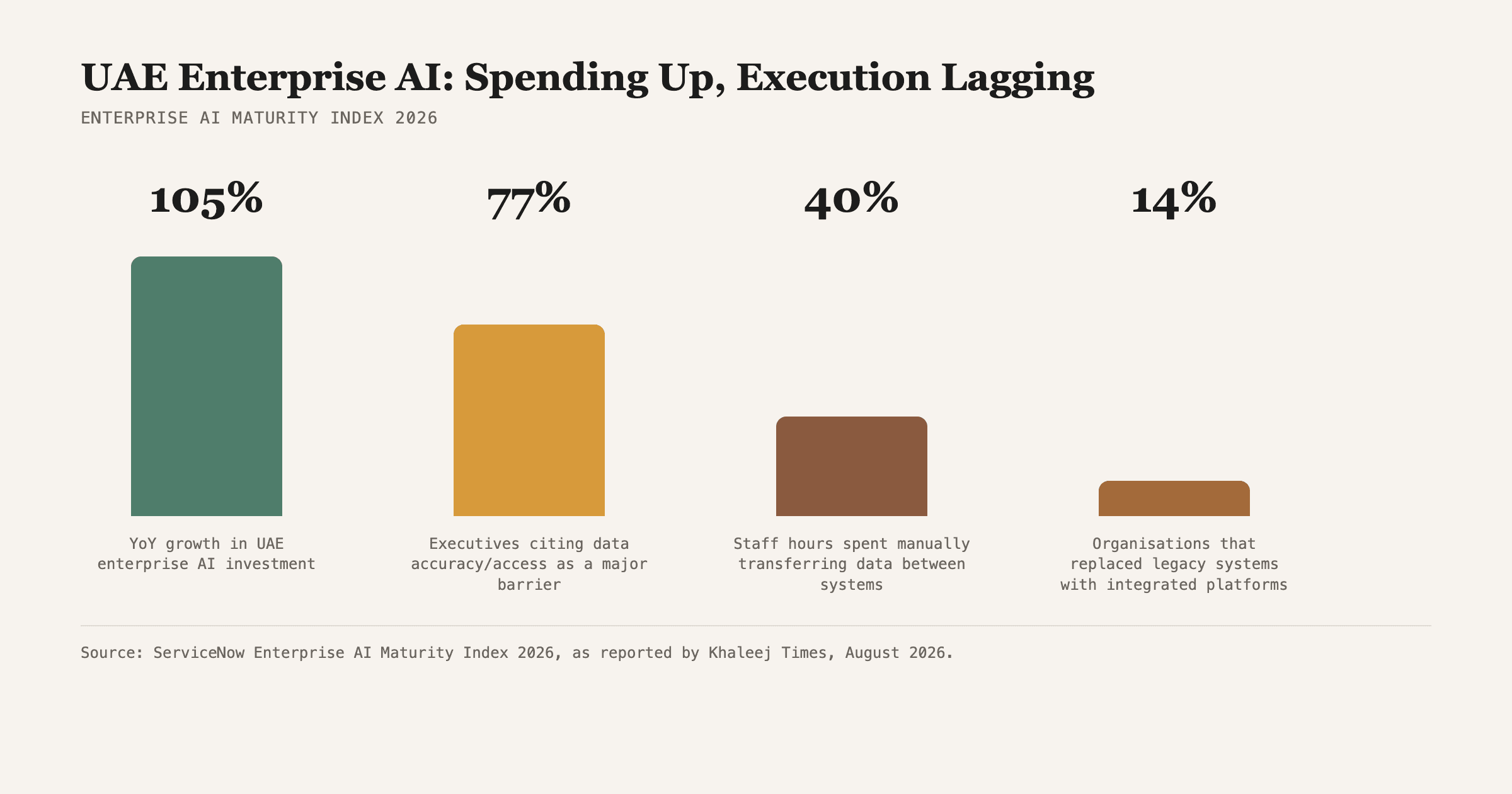
AI spending among UAE organisations rose 105% year on year, according to ServiceNow's Enterprise AI Maturity Index 2026, as reported by Khaleej Times, yet the same study found 77% of UAE executives cite inadequate data accuracy, access and management as a major barrier to adoption. Money going in and pilots reaching production are two different curves, and in the UAE right now they've decoupled.
The reason is structural, not budgetary: an AI agent is only as reliable as what it can read and write against. A model can reason perfectly and still produce a wrong answer if the customer record it retrieved is stale, duplicated across three systems, or missing the field the agent needed. That failure looks like a hallucination to the business, but the mechanism is bad retrieval, not a bad model.
What does 'the data problem' actually look like at the architecture level?
Only 14% of UAE organisations have replaced legacy systems with integrated platforms, which leaves most enterprise AI initiatives deploying against fragmented applications and disconnected workflows rather than a clean data layer. The operational consequence is direct: skilled staff spend up to 40% of their work hours manually transferring data across disconnected enterprise systems, the exact busywork an AI agent was meant to remove, and that manual bridging is what most 'AI pilots' quietly turn into once they leave the sandbox.
The majority of enterprise AI projects never make it out of pilot, and the failure points are almost always integration, data and governance rather than the model itself. That's consistent with what we see building for founders across markets: a chatbot demo on ten clean example records tells you nothing about whether an agent can operate reliably against a live CRM with duplicate customer IDs and three different date formats.
What does the integration layer need to look like before you add an agent on top?
- A canonical data model with a single master identifier per customer, order or record, so an agent tool call doesn't return three conflicting versions of the same entity.
- An integration or normalization layer that reconciles schema differences across CRM, ERP and telephony systems before an agent ever touches the data, not a prompt instructed to 'figure it out.'
- Event-driven sync instead of manual or nightly-batch updates, so the agent is working against current state rather than data that's hours or days stale.
- A data quality monitoring discipline that runs continuously, since a one-time cleanup degrades again the moment new records enter through an unreconciled source.
- Access and lineage controls mapped to a recognized governance framework, so the integration layer is auditable, not just functional.
Where do PDPL and ISO/IEC 42001 fit into this?
Enterprise AI adoption in the UAE has to satisfy the UAE's Personal Data Protection Law on data sovereignty and handling, alongside international benchmarks like ISO/IEC 42001, the first international management system standard specifically for AI and the NIST AI Risk Management Framework. These aren't paperwork layered on after the integration work is done, an AIMS built to ISO/IEC 42001 requires the same clean data lineage, access controls and auditability that a working agent architecture needs anyway.
That overlap between good architecture and regulatory compliance is the same pattern we cover for other jurisdictions in our guides to GDPR compliance for AI agents and EU AI Act risk classification: if you build the integration and governance layer correctly once, most of the compliance paperwork documents work you already had to do, rather than adding new work.
How AIBOOTSTRAPPER helps
This is the same discipline behind ComplyNexus, the RAG-powered compliance platform we built for a Hong Kong client: before any LLM reasoning happened, the system had to continuously ingest regulatory updates and map them cleanly to the client's own control library, replacing a spreadsheet-based process that couldn't keep pace with changing rules. The AI layer only works because the data layer underneath it is coherent and current, which cut regulatory change turnaround from three weeks to two hours.
If your AI pilot is stuck between a great demo and a production rollout, the gap is almost always here. Book a call and we'll audit whether the blocker is your model choice or your data architecture, most of the time it's the second one.
Want this done for you?
Book a free strategy call and we'll show you how to build and market your business with AI.