A founder walks into an automation kickoff certain about where to start: the process that annoys them personally the most, usually something like cross-department approvals or a reporting workflow that touches six people and needs judgment calls at every step. Three months and a chunk of budget later, the build is half-finished, the edge cases keep multiplying, and the team's first experience with AI automation is watching an ambitious project stall instead of watching a boring one quietly save ten hours a week. The process wasn't wrong to want fixed, it was wrong to go first.
Why the obvious first pick is usually the worst one
The instinct to automate whatever hurts the most right now feels rational and is structurally the wrong starting point, because the processes that generate the loudest frustration are frequently the ones that are also the most complex: they touch multiple departments, require human judgment at several steps, and have inconsistent inputs. That combination, high visibility plus high complexity, is exactly the profile of a project that takes too long, costs too much relative to what it saves, and burns the internal goodwill needed to fund the next one.
The processes that actually deliver fast, visible ROI share a different, less exciting profile: high frequency, consistent inputs, clear decision logic, and a real cost to getting them wrong or leaving them manual. Invoice approvals, lead qualification, document intake, expense processing, they're rarely anyone's biggest complaint, but they're where the return shows up fastest because there's little ambiguity left for the automation to trip over.
The impact-vs-feasibility scoring matrix
- Impact axis: how much time does this process cost weekly across everyone involved, what's the error rate today, and what does a mistake actually cost when it happens (a missed invoice due date is a different order of impact than a slightly late internal report).
- Feasibility axis: how clean and consistent is the input data, how many systems does the workflow have to integrate with, and what share of the decision is rule-based versus genuine human judgment.
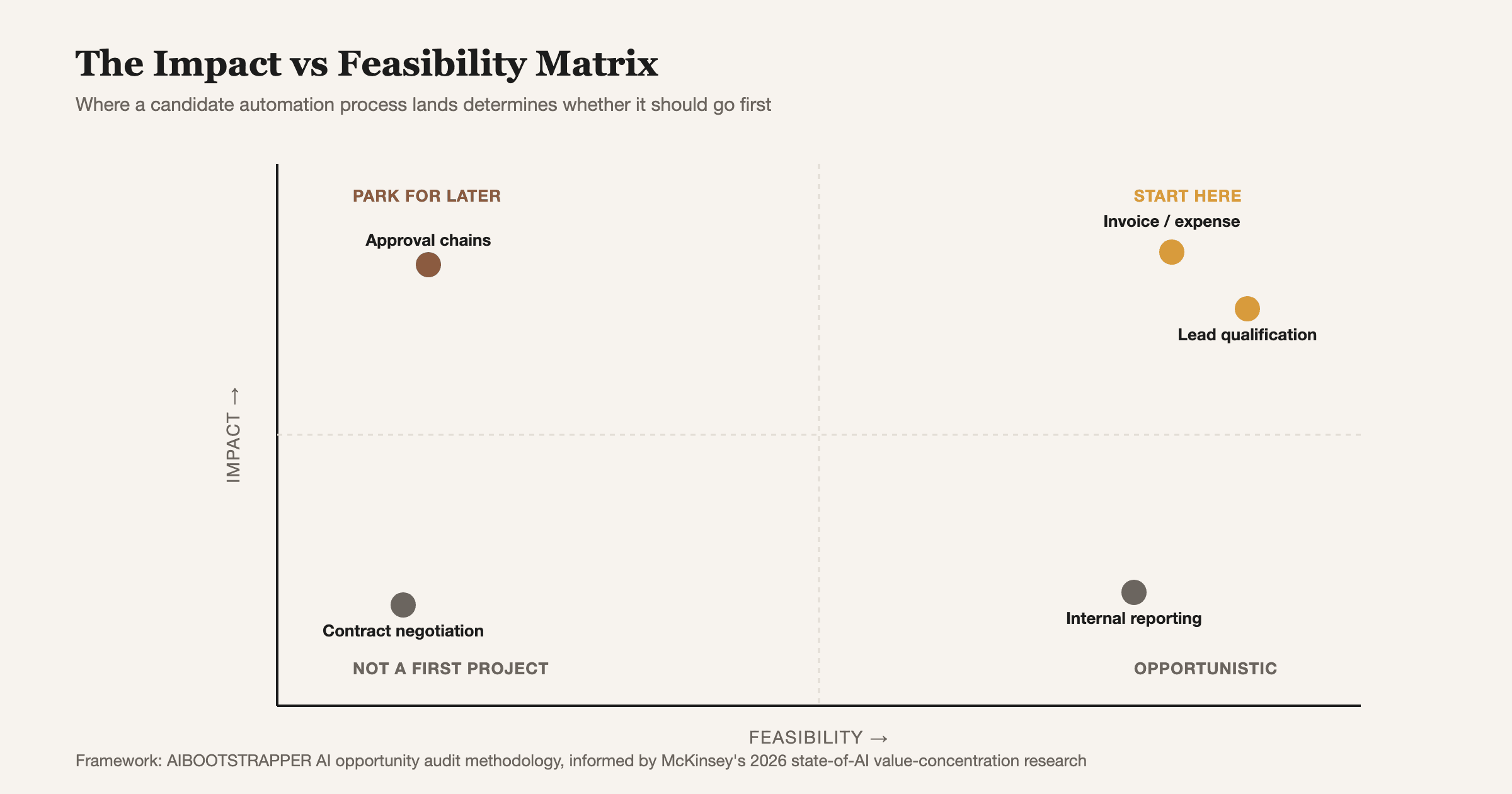
- The sweet spot for a first project sits at high impact and high feasibility: painful enough that finishing it proves the investment was worth it, simple enough that a small team can actually ship it in weeks, not quarters.
- Processes that are high impact but low feasibility (that six-department approval chain) are real projects, they're just not the first one; park them for after the team has a shipped win to build momentum from.
- Processes that are low impact regardless of feasibility aren't worth the build cycle yet, however easy they'd be to automate, the ROI conversation with stakeholders needs a number worth defending.
What the data says about where the value actually concentrates
McKinsey's analysis of 63 generative AI use cases across 16 business functions found that roughly 75% of the total value on offer concentrates in just four functions: customer operations, marketing and sales, software engineering and R&D, which is a useful sanity check before picking a starting process outside those areas and expecting outsized returns.
On the return side, Forrester's Total Economic Impact study of Microsoft Power Automate found a 248% ROI and $39.85 million in net present value over three years for the composite organization studied, with payback inside the first year, numbers broadly consistent with what well-scoped automation projects return once they clear the pilot stage. The gap between projects that hit numbers like that and ones that stall almost always traces back to the scoping decision made in week one, not the tooling.
The prioritization matrix, mapped
| Process type | Impact | Feasibility | Verdict |
|---|---|---|---|
| Invoice / expense processing | High (frequent, error-costly) | High (structured inputs, clear rules) | Start here |
| Lead qualification & routing | High (revenue-linked) | High (rule-based scoring logic) | Start here |
| Cross-department approval chains | High (visible pain) | Low (many judgment calls, many stakeholders) | Park for later |
| Internal status reporting | Low-medium (annoying, not costly) | High (easy to automate) | Low priority, do opportunistically |
| Complex contract negotiation support | High (high stakes) | Low (heavy judgment, low consistency) | Not a first project |
A worked example of the matrix applied to common candidate processes; specifics vary by business, the axes don't.
How AIBOOTSTRAPPER solved this for a client
Expensorr, an expense management product we built end to end, is a clean example of what a high-impact, high-feasibility first process looks like: expense tracking is high frequency, the inputs (receipts, categories, amounts) are structured enough to automate reliably, and the manual alternative has a real, measurable cost, the product now saves users more than 12 hours a month that used to go into manual expense tracking, with a 5-week concept-to-launch timeline precisely because the process didn't require solving ambiguous judgment calls before the automation could work.
AIBOOTSTRAPPER's AI consultancy team runs this exact impact-vs-feasibility audit across your operations before recommending a build, so your first AI automation project is the one that proves ROI fast, not the one that's loudest in the room. Book a call and we'll map your processes against this matrix together.
Want this done for you?
Book a free strategy call and we'll show you how to build and market your business with AI.