A COO stands up in Q1 and announces the company's first AI agent pilot to applause. It automates a real workflow, the demo goes well, budget gets approved for a wider rollout. By Q3, the project is quietly off the roadmap, not because the model failed a benchmark, but because nobody could agree who owned the exceptions it kept surfacing, and the integration work kept sliding into someone else's sprint. That story is not the exception in 2026. It is, statistically, closer to the norm.
How many enterprises actually have an AI agent in production right now?
Fewer than the pilot announcements would suggest. 80% of enterprise applications now embed at least one AI agent in some form, but only 31% of enterprises have at least one agent actually live in production as of Q1 2026, a figure sourced from S&P Global 451 Research's enterprise AI panel and McKinsey.
The gap between those two numbers is stark on its own, but the pilot-to-production data is starker still: 88% of agent pilots never reach production at all. That tracks with the broader pattern other 2026 research has found, that only about a third of organizations have moved past proof-of-concept into real scaling, with two-thirds still stuck in experimentation. This isn't a story about AI not working. It's a story about most of the budget going toward getting an agent to work in a demo, and comparatively little going toward the unglamorous work of getting it to survive contact with production.
Which industries are actually scaling agents, and which are stuck at the pilot stage?
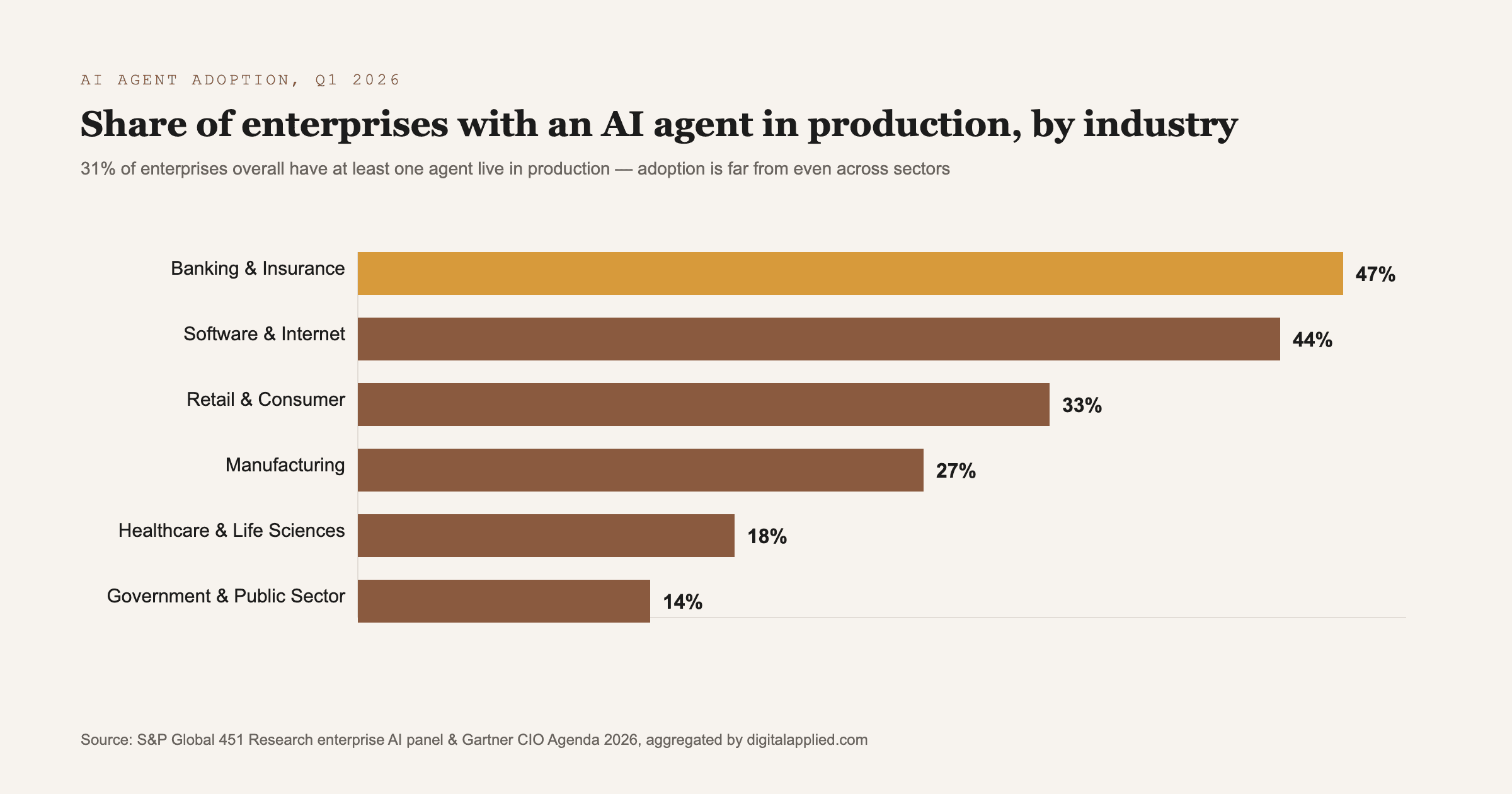
Production adoption is far from evenly spread. Banking and insurance lead at 47%, followed by software and internet companies at 44%, retail and consumer at 33%, and manufacturing at 27%. Healthcare and life sciences trail at 18%, and government and public sector lags furthest behind at 14%, per the S&P Global 451 Research panel and Gartner's CIO Agenda 2026.
The pattern isn't random. The leading sectors share high-volume, well-bounded, digitally-native workflows, fraud triage, claims intake, code review, where an agent's decision space is narrow enough to scope cleanly and audit easily. The trailing sectors share the opposite: workflows entangled with regulatory approval cycles, legacy systems that resist clean API access, or decisions where a wrong answer carries outsized human or legal cost. That's a scoping and infrastructure gap, not a sign AI doesn't work in healthcare or government.
Why does time-to-value swing so wildly by agent type?
- **SDR and outbound agents pay back fastest, a median of 3.4 months**, because the task is narrow, high-volume, and easy to A/B test against a human baseline.
- **Customer service agents follow at 4.7 months**, similarly bounded but with more edge cases requiring escalation logic.
- **Data and analytics agents take 5.8 months**, and **software engineering agents 6.2 months**, both requiring deeper integration with existing tooling before they earn trust.
- **Finance and operations agents run 8.9 months**, and **legal and compliance agents slowest at 11.2 months**, both domains where every output needs a human sign-off loop and the cost of an error is measured in audit findings, not a refunded order.
- The median payback across all agent types sits at 5.1 months, according to 2026 BCG and Forrester survey data, but that median hides a nearly 8-month spread between the fastest and slowest categories, which is exactly why treating "AI agent ROI" as one number is a mistake.
So what actually separates the deployments that pay back from the ones that get shelved?
41% of deployments report positive payback within 12 months, but 22% report negative ROI in the same window, and the attribution for that negative group is consistent across the 2026 data: scoping and ownership problems, not model capability. That lines up with a separate finding from a different 2026 dataset, where only 25% of AI initiatives delivered the ROI expected of them and just 16% scaled enterprise-wide, an IBM-sourced figure, reinforcing that the bottleneck sits well upstream of the model itself.
In practice, the deployments that scale share three traits the shelved ones lack: a single named owner accountable for the agent's outcomes past launch day, not just its build; a workflow narrow enough that "done correctly" has a clear, testable definition instead of an open-ended judgment call; and a plan for the exceptions from day one, because the exceptions are where every stalled pilot we've seen actually dies, not in the happy path the demo showed.
How AIBOOTSTRAPPER helps
The 5.1-month median payback is an enterprise-wide average across agents built on top of legacy systems and long approval chains. It's not a law of physics. When we built Expensorr, an AI-powered expense management product, end to end, data model, core tracking, GEO-optimized site, it went from concept to production launch in 5 weeks, saving users 12+ hours of manual expense tracking a month from day one. AudioBolo, an AI audio platform we also built end to end, shipped in 6 weeks at 99.5% uptime. Neither number is a coincidence, both came from scoping the build narrowly and owning it through launch, the exact two variables the 2026 data says separate a scaled agent from a shelved pilot.
If you're trying to figure out whether your next AI agent project is scoped to actually reach production, book a call with us, or see how we approach builds like this at our AI product development and consultancy services.
Want this done for you?
Book a free strategy call and we'll show you how to build and market your business with AI.