A COO opens the quarterly ops review and the AI adoption slide looks great: copilots in every department, a chatbot on the support site, an agent drafting first-pass contracts. Then the CFO asks the only question that matters, what did any of it do to EBIT this quarter, and the room goes quiet. That gap between 'we use AI everywhere' and 'AI moved a number leadership cares about' isn't a rounding error. A 2026 global survey found 73% of enterprises say AI is used regularly or across most business processes, but only 10% say it's core to how the business actually operates, and a separate PwC study of over a thousand executives put a hard number on what that gap costs: 74% of AI's economic value is being captured by just 20% of companies.
How wide is the gap between using AI and getting value from it?
Publicis Sapient's 2026 Global Enterprise AI Report, based on a survey of 1,550 AI decision-makers across the US, UK, France, Germany, Australia and the UAE, found that 73% say AI is used regularly or across most business processes, but only 10% say it's core to how their business operates, a 63-point gap between deployment and actual transformation. Adoption, in other words, is nearly universal. Depth is rare.
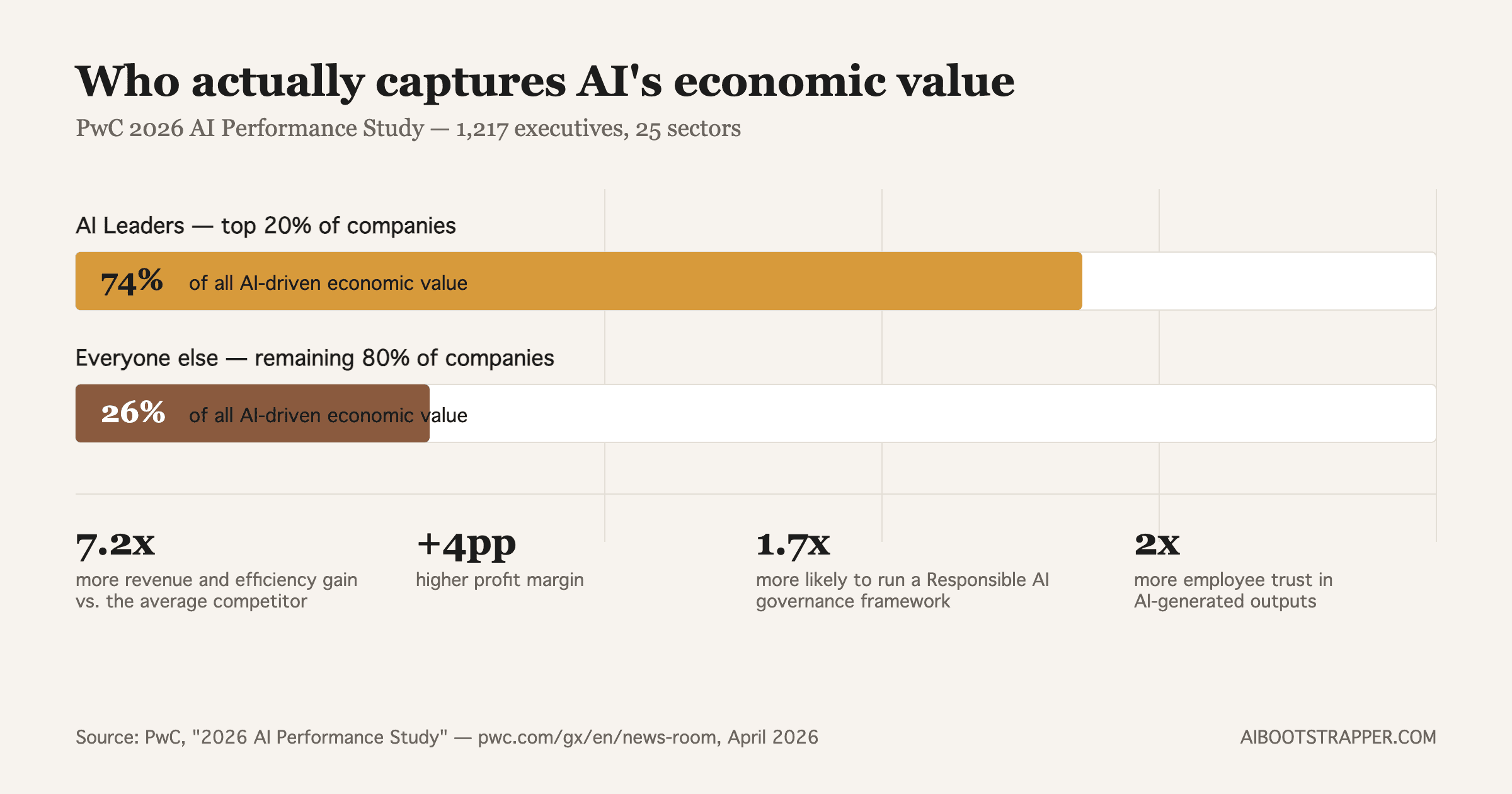
PwC's 2026 AI Performance Study, surveying 1,217 senior executives across 25 sectors, quantified what that shallow adoption costs relative to the companies that went deep: 74% of all AI-driven economic value is captured by just 20% of companies, the 'AI leaders.' Those leaders generate 7.2x more revenue and efficiency gains than the average competitor, with profit margins running 4 percentage points higher. The remaining 80% of companies split the leftover 26%.
What do the top 20% actually do differently?
It isn't a bigger model budget. PwC found AI leaders are 1.7x as likely to run a formal Responsible AI framework and 1.5x as likely to have a cross-functional AI governance board, and as a direct result, their employees are twice as likely to trust AI-generated outputs. PwC calls this 'trust at scale': structured governance produces employee trust, trust unlocks broader autonomous use, and broader use is what actually compounds into the 7.2x revenue and efficiency gap.
That ordering matters because most companies try to skip straight to the last step. Rolling out an agent to more workflows without governance behind it doesn't scale trust, it scales the blast radius of the first bad decision the agent makes unsupervised, which is exactly the pattern that gets a pilot quietly shelved after one incident.
Why does governance infrastructure turn into revenue instead of just risk reduction?
- It defines what an agent can act on autonomously versus what needs human sign-off, which is what actually lets a team extend an agent's scope with confidence instead of freezing it at 'safe but narrow' forever, the same discipline covered in why most AI pilots never reach production.
- It builds the audit trail and explainability layer once, so it does double duty for every regulatory regime that shows up later, EU AI Act, UAE PDPL, India's DPDP Act, rather than requiring a separate compliance sprint per jurisdiction; see our breakdown of EU AI Act risk classification for business AI agents.
- It gives leadership a real answer when a board member asks who owns an AI decision that went wrong, which is the single biggest reason executives cite for keeping agents on a short leash, per PwC's own findings on trust.
- It turns 'AI readiness' from a vibe into a measurable score, so a company can find out which side of the 20/80 split it's actually on before committing budget, rather than after a failed rollout; AIBOOTSTRAPPER's own AI Readiness Score is built for exactly this diagnostic step.
How AIBOOTSTRAPPER helps
Governance infrastructure is a phrase that sounds abstract until you've had to build one. For ComplyNexus, a Hong Kong compliance platform, the client's team was tracking regulatory obligations manually across spreadsheets, with constant risk of a missed rule. We built a RAG-powered compliance engine that continuously ingests regulatory updates, maps them to the client's own control library, and surfaces gaps with full audit trails, cutting regulatory change turnaround from three weeks to two hours and giving auditors traceability they could actually trust. That's what governance infrastructure looks like in production: not a policy document, a system that makes every AI-assisted decision explainable after the fact.
If you're not sure which side of the 74/20 split your business is on, take the AI Readiness Score or book a call and we'll show you exactly where the governance gap is before you spend another quarter scaling AI use without scaling the trust underneath it.
Want this done for you?
Book a free strategy call and we'll show you how to build and market your business with AI.