A leadership team greenlights an AI pilot, watches a demo that works beautifully on a curated set of examples, and approves a budget to build on it. Six months later, the pilot is quietly shelved, not because the demo lied, but because nobody scoped what it would take to hold up against messy real data, real edge cases and a real handoff to production. This is not a rare story. It is, according to the data, the default outcome.
How common is it for an AI pilot to actually fail?
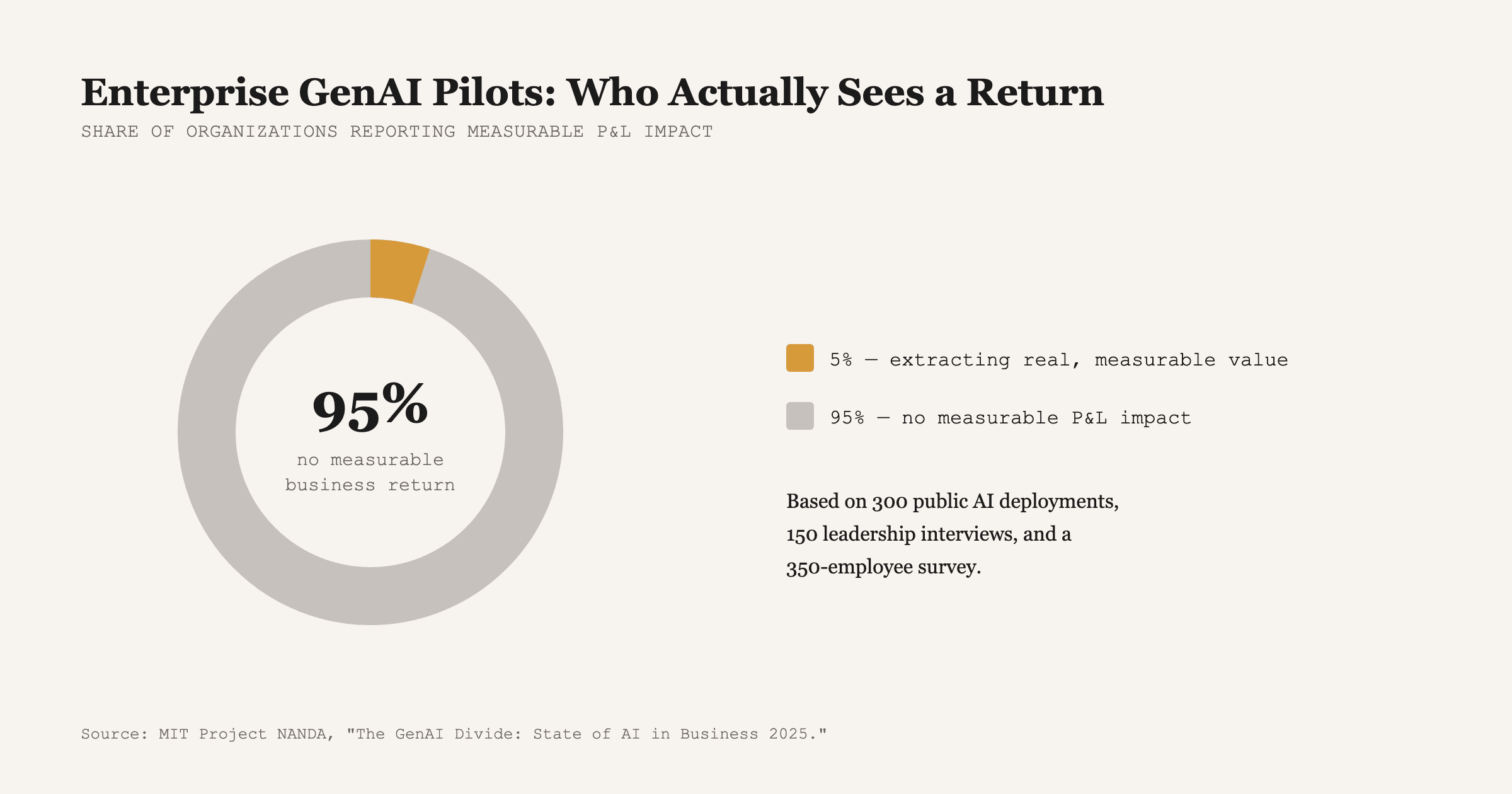
Extremely common. MIT's Project NANDA studied 300 public AI deployments, 150 leadership interviews and a 350-employee survey, and found that despite $30 to $40 billion in enterprise generative AI spending, 95% of organizations are seeing no measurable business return. Just 5% of integrated pilots are extracting real, measurable value; the rest remain stuck with no P&L impact at all.
This is not a fringe result. It lines up with a broader pattern across 2026 industry data: a large share of AI projects are abandoned before reaching production, and among the ones that do reach production, many complete but underdeliver against what was promised in the pilot demo.
Why does a pilot that works in the demo fail to reach production?
The core issue MIT's research identifies is organizational, not technological: companies struggle to integrate AI into workflows in ways that learn, adapt and deliver sustained value, not to get a model to produce a correct output once. A demo is built on a small, hand-picked set of examples chosen because they work well. Production means the same system has to hold up against every messy, ambiguous, edge-case input a real user will actually send it, day after day, without someone quietly fixing it behind the scenes.
Cost is the other structural trap. Production GenAI deployments commonly run three to five times the initial budget projection once real infrastructure, monitoring and evaluation get added, which is enough on its own to kill the ROI case for a project that was only ever pitched on the pilot's numbers.
What actually separates the 5% that succeed?
- They scope the pilot around one specific, high-frequency bottleneck, not a broad "transform the department with AI" mandate that has no clear finish line.
- They build evaluation into the project from day one, a way to measure whether a change to the system made it better or worse, instead of relying on "it felt right in testing."
- They budget for the real production cost up front (typically 3 to 5x the pilot's number), so the project isn't cancelled the moment infrastructure and monitoring costs appear.
- They put a human in the loop for any high-stakes decision, since the absence of this is one of the most repeated causes of stalled AI rollouts.
- They treat the handoff from pilot to production as its own project phase with its own scope and budget, not an afterthought once the demo gets a round of applause.
How AIBOOTSTRAPPER helps
This is exactly the gap our AI Doctor build for a Dubai digital health startup was scoped to avoid. Rather than a symptom-triage demo that looked good in a boardroom, we engineered clinically guarded safety guardrails and a real human handoff workflow from day one, the piece most pilots skip, so the assistant could run 24/7 in actual patient triage, not a sandbox. It cut consultation prep time by 68% because the escalation path to a doctor was part of the original scope, not bolted on after the pilot stalled.
If you're weighing an AI pilot and want it scoped to actually reach production instead of joining the other 95%, an AI readiness assessment before you build is the cheapest insurance you can buy. Book a call and we'll help you scope it right the first time.
Want this done for you?
Book a free strategy call and we'll show you how to build and market your business with AI.