A COO gets two proposals for the same agent, one that reads support tickets and drafts a reply: a vendor platform quoting five figures and a two-week rollout, and an in-house build quoting six figures and four months. Leadership picks the vendor for speed, ships it, and eighteen months later is paying escalating per-seat fees for a tool that cannot touch the one internal system that actually matters, while a competitor who built the narrow, ugly, custom version owns the workflow outright. Neither path is wrong by default. The mistake is picking one path for every agent, instead of asking the question workflow by workflow.
Why does Gartner predict over 40% of agentic AI projects will be canceled?
Not because the models are not good enough. Gartner's June 2025 prediction attributes the coming wave of cancellations to escalating costs, unclear business value, and inadequate risk controls, and singles out 'agent washing,' vendors rebranding existing chatbots and RPA tools as agentic AI without the underlying capability to back it up.
Gartner estimates only around 130 of the thousands of vendors calling themselves agentic AI companies actually build agentic capability, which means a meaningful share of 'buy' decisions are buying a repackaged chatbot, not an agent, and a meaningful share of 'build' decisions are scoped by hype rather than by which workflows genuinely need autonomy.
How are companies actually splitting their agentic AI investment right now?
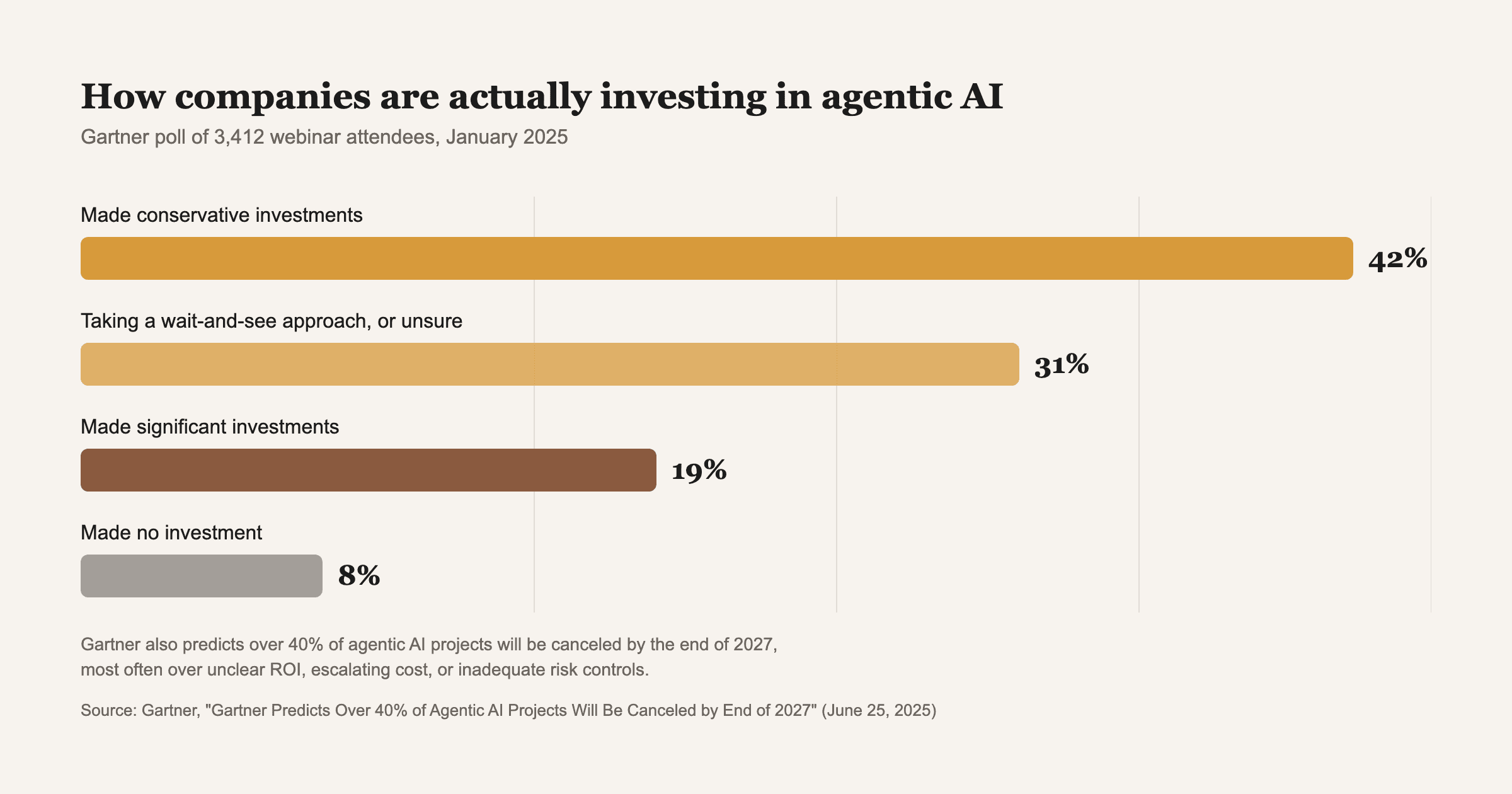
Cautiously. In Gartner's own poll of 3,412 webinar attendees from January 2025, only 19% reported significant investment in agentic AI, 42% called their investment conservative, and 31% were still taking a wait-and-see approach or were unsure, a wide gap between the hype cycle and what companies are actually committing budget to.
That caution is rational given the failure rate, not a sign companies are behind. The workflows worth real investment are a small, specific subset of what a vendor demo makes every workflow look like.
What five factors should actually decide build vs buy, per workflow?
- Complexity: a narrow, well-defined task (triage, lookup, summarization) fits a vendor platform's pre-built patterns; a workflow with many conditional branches specific to your business logic pushes toward a custom build.
- Time-to-value: if the workflow needs to be live in weeks, buying a vendor platform wins almost by default, since a custom build carries real months of integration and testing time before it earns anything back.
- Risk profile: anything touching money, health data, or legal exposure needs the audit trail and guardrail depth a custom build can enforce end to end; a vendor's generic compliance layer was not built for your specific regulatory obligations.
- Integration footprint: a workflow that only reads from one common system (a CRM, a help desk) is exactly what vendor platforms are built to plug into; a workflow that reads and writes across three or more internal, non-standard systems is where vendor connectors break down and custom integration work becomes unavoidable.
- Long-term strategic value: if the agent's output is a genuine differentiator, the thing that makes your product or service better than a competitor's, owning the build protects that edge; if the workflow is table stakes every company in your category needs (basic support triage), there is little strategic upside in owning it, so buy.
What does the framework KPMG and Gartner both point to actually recommend?
Hybrid, not a company-wide pick. KPMG's 2026 build, buy, or borrow framework frames this explicitly as a per-use-case decision, not an enterprise-wide policy, and the pattern showing up in mature 2026 deployments is buying for speed and standardization on generic workflows, and building only where data control or differentiation genuinely justifies the extra months.
Run the five factors above against each candidate workflow separately before writing a single line of code or signing a single vendor contract. A company that decides 'we buy' or 'we build' once, for everything, is the same mistake in either direction, and it is the pattern behind a large share of the cancellations Gartner is projecting.
How AIBOOTSTRAPPER solved this for a client
ComplyNexus, the Hong Kong RegTech platform AIBOOTSTRAPPER built, is a build decision that held up under this exact framework: a generic compliance chatbot could answer questions about regulations in the abstract, but it could not map a new regulatory change to this specific client's internal control library, because that library and its structure exist nowhere outside the client's own systems.
That single factor, data control tied to a proprietary control library no vendor platform has access to, was enough to justify a custom RAG-powered build, and it cut regulatory change turnaround from three weeks to two hours. The same client would have been right to buy a generic tool for something lower-stakes and more standardized, like meeting scheduling or general document search. Full results are on the case studies page.
How AIBOOTSTRAPPER helps
Before recommending a build or a vendor, AIBOOTSTRAPPER's AI consultancy team runs each candidate workflow through the same complexity, risk, integration and strategic-value factors above, so the decision is scoped to the workflow, not defaulted to whichever pitch was more persuasive.
If you already have an agent proposal on the table and are not sure whether it should be built or bought, book a call and we will pressure-test it against your actual systems before you commit budget either way.
Want this done for you?
Book a free strategy call and we'll show you how to build and market your business with AI.