A clinic owner in Indore checks their ranking the way they always have: search their category, see themselves sitting first in the three-pack under the map, and move on satisfied. Then a patient mentions they asked Google's AI overview which clinic to visit for the same thing, and a different clinic, with fewer reviews and a less complete listing, got named instead. The owner never sees that answer happen, because AI overviews don't show up in a rank tracker built for blue links and map pins, they show up in a conversational answer that either names a business or doesn't, and increasingly, ranking first in the traditional local pack has stopped being a reliable predictor of which one it names.
Why the map pack and AI Overviews disagree on the same search
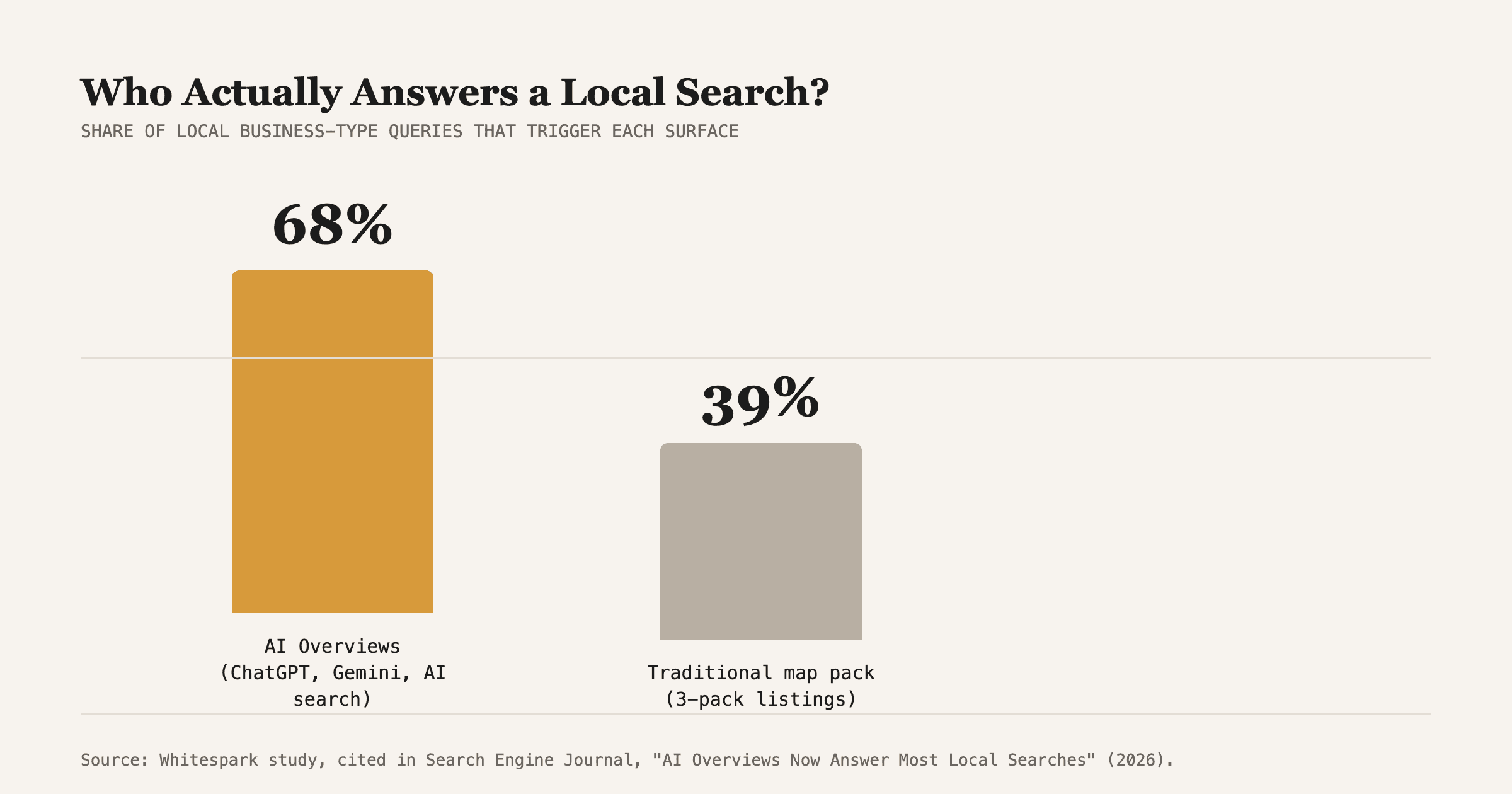
A Whitespark study cited by Search Engine Journal found AI Overviews now appear for 68% of local business-type queries, while the traditional map pack appears for only 39% of those same queries, a 29-point gap where a majority of searchers get an AI-generated answer with no map pack in sight at all. For price and cost-related local queries specifically, that gap widens further: over 80% trigger an AI Overview.
The two surfaces aren't just different placements on the same page, they're built from different evidence. The map pack ranks primarily on proximity, category match and review signals tied to a verified Google Business Profile. AI Overviews pull from a broader evidence base, structured data, semantic relevance to the specific question asked, and how fresh the underlying information is, which is exactly why a business can dominate the map pack and still be invisible the moment the same intent gets typed as a question into an AI assistant instead of a map search.
What AI Overviews are actually citing when they answer a local question
Most of what gets cited for a local answer isn't the business's own website copy. An analysis of over 23,000 citations by Omniscient Digital, reported by Search Engine Journal, found owned content accounts for only about 23% of citations on branded queries, with the remaining 77% coming from off-page sources, review platforms, directories, and third-party mentions the business doesn't directly control.
That's a structurally different problem from classic local SEO, where owning a well-optimized page was most of the battle. For AI Overviews, a business needs both: a website with structured data clean enough for a model to extract facts from confidently, and a footprint of off-page mentions and reviews consistent enough that those facts get corroborated, not contradicted, across sources.
The structured data fix: LocalBusiness and FAQPage schema, specifically
- LocalBusiness schema (JSON-LD) on the business's core pages: name, address, phone, hours, category and geo-coordinates in a machine-readable format, following Google's structured data guidelines for local businesses, so an AI system doesn't have to infer these facts from prose and risk getting them wrong.
- FAQPage schema answering the actual questions customers ask in their own words ('do you accept walk-ins,' 'how much does X cost'), not just service descriptions, since AI Overviews are answering questions, not matching keywords.
- Consistent name, address and phone details (NAP) across the website, Google Business Profile, and every directory listing, inconsistency across sources is one of the fastest ways to get an AI system to distrust or simply skip a business's facts in favor of a competitor's.
- A refresh cadence on key facts (pricing, hours, service list) rather than a page frozen since launch: Ahrefs' analysis of 17 million citations found AI-cited content averages 25.7% fresher than content that ranks well but isn't cited, which lines up with how content freshness affects citation odds more broadly.
How AIBOOTSTRAPPER solved this for PropLock
AIBOOTSTRAPPER built exactly this local-intent discovery layer for PropLock, a UK real estate platform that needed to win buyers who were searching and asking AI assistants about specific properties and neighborhoods, not just ranking for generic real estate terms. The build combined a GEO-optimized site engineered for local and property-specific intent with structured listing data and an AI matching engine, replacing a manual, gut-feel process that was leaking high-intent buyers to faster competitors.
The result was 12,000 organic visitors a month within 90 days and 47% more qualified viewings, driven by search and AI-assisted discovery actually surfacing the right listings for the right local queries, not just a page that ranked but never got read. Full numbers are on the case studies page.
How AIBOOTSTRAPPER helps
AIBOOTSTRAPPER's GEO and AEO work for local and India-based businesses starts with an audit most agencies skip: checking not whether a business ranks, but whether it actually gets named when someone asks ChatGPT, Gemini or Perplexity the question a real customer would ask. That usually surfaces a structured data and NAP-consistency gap long before it surfaces a content quality problem.
If you rank well in Maps but don't know whether AI assistants are actually citing your business, book a call and we'll run that specific check before recommending anything.
Want this done for you?
Book a free strategy call and we'll show you how to build and market your business with AI.