A founder publishes a genuinely thorough 2,500-word guide, well researched, properly formatted with H2s, and watches a competitor's much thinner 600-word page get quoted directly inside a ChatGPT answer while theirs never shows up. The instinct is to assume length or depth lost, but AI engines don't read a page the way a person does, they extract discrete, self-contained chunks of text, and a page built for a human reader to scroll through top to bottom is frequently unreadable to the exact extraction process deciding who gets cited.
AI engines don't read pages, they extract chunks
When an AI system answers a query, it isn't summarizing your whole page, it's pulling out the specific passage that best answers the question and dropping it into its response, often with the surrounding context stripped away entirely. That means a paragraph has to make complete sense on its own, with no dependency on the sentence before it or the heading three sections up, or it simply won't survive being lifted out and reused.
This is the structural reason 'depth' alone doesn't win citations. A page can be comprehensive and still be built as one long, interdependent argument where paragraph six only makes sense after reading paragraphs one through five, which is exactly the shape an AI extractor can't use.
The answer-first paragraph: what actually gets extracted
Discovered Labs' GEO content strategy guide is specific about the shape that works: 'lead with the answer in the first 40-60 words,' a Bottom Line Up Front structure, and write in '40-60 word modular paragraphs that can stand alone contextually.' The logic is direct, if the first sentence or two of a section already contains the full answer, an extractor doesn't need anything else from the page to quote it accurately.
The same guidance extends to headings: phrasing an H2 as the actual question someone would type ("How long does AI training take to show ROI" rather than "ROI Timeline") gives the extraction process an explicit signal that the paragraph beneath it answers exactly that question, which is the same question-format structure this post and every AIBOOTSTRAPPER blog post now follows deliberately.
Why speed to index still matters, even with perfect structure
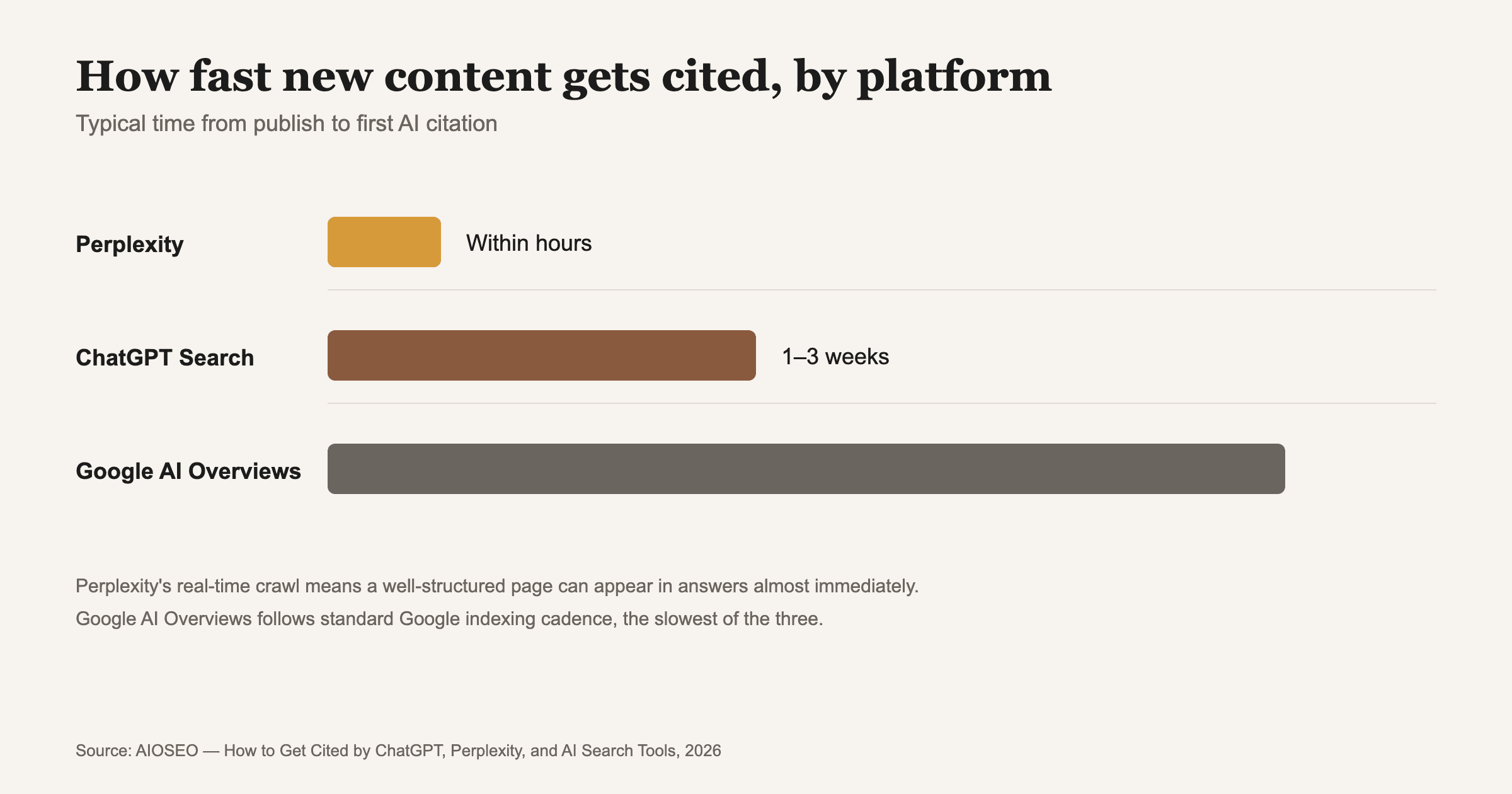
- Perplexity indexes new content the fastest, often citing pages within hours of crawling them, so a well-structured page can start appearing in Perplexity answers almost immediately after publishing.
- ChatGPT Search, which layers Bing-powered retrieval on top of static training data, typically takes 1 to 3 weeks for new content to start surfacing in responses, according to AIOSEO's breakdown of how to get cited by AI search tools.
- Google AI Overviews follows Google's standard indexing cadence, generally 4 to 8 weeks for newly published or significantly updated pages to appear, the slowest of the three major platforms.
- Structure and speed compound: a page that's both crawlable fast and shaped for extraction gets a real head start over a page that only has one of the two, since a perfectly structured page an AI engine hasn't indexed yet can't be cited, and a fast-indexed page with no extractable answer paragraph won't be either.
How fast each platform actually surfaces new content
This is also why freshness signals compound with structure rather than replacing it: our guide to how often you need to update content to stay cited and this post's answer-first framework are solving two halves of the same problem, getting indexed fast and being extractable once you are.
How AIBOOTSTRAPPER helps
AIBOOTSTRAPPER rebuilt PropLock, a UK real estate platform, around exactly this discipline: an AI engine that writes SEO and GEO optimized listings with answer-first structure baked in from the first draft, on a site engineered for AI crawler access from launch. The result was 12,000 organic visitors a month within 90 days and 47% more qualified viewings, not from writing more content, but from writing content shaped to be extracted and cited correctly the first time.
If your content is thorough but invisible to AI Overviews and ChatGPT, the fix is usually structural, not volume. Book a call and we'll audit how your top pages are (or aren't) shaped for extraction, alongside our broader GEO and AEO work.
Want this done for you?
Book a free strategy call and we'll show you how to build and market your business with AI.