A founder gets cited by ChatGPT for a product launch post in March, screenshots it, shares it with the team. In June they check again out of curiosity and the brand no longer shows up in the same answer, even though the page still ranks fine on Google, nothing was penalized, and nothing on the page was ever touched. This isn't a glitch and it isn't a ranking drop in the traditional sense. It's a structural feature of how AI answer engines decide which sources to surface right now, and it means a page that was cited once needs a plan to stay cited, not a one-time optimization pass.
Why do AI citations disappear even when Google rankings hold steady?
Because traditional search ranking and AI answer generation pull from different signals. A page's position in Google's blue links is driven heavily by accumulated authority, backlinks and historical relevance, all of which decay slowly. An AI assistant instead re-generates its answer close to the moment a question is asked by retrieving and re-ranking a fresh set of candidate sources, and that re-ranking step weights recency far more heavily than traditional search does.
The practical result is that a page can keep its Google position untouched for months while quietly sliding out of the fresh candidate set an AI engine draws from to build its next answer, since nothing about the page's authority changed but its recency signal kept aging.
How fast do AI citations actually decay?
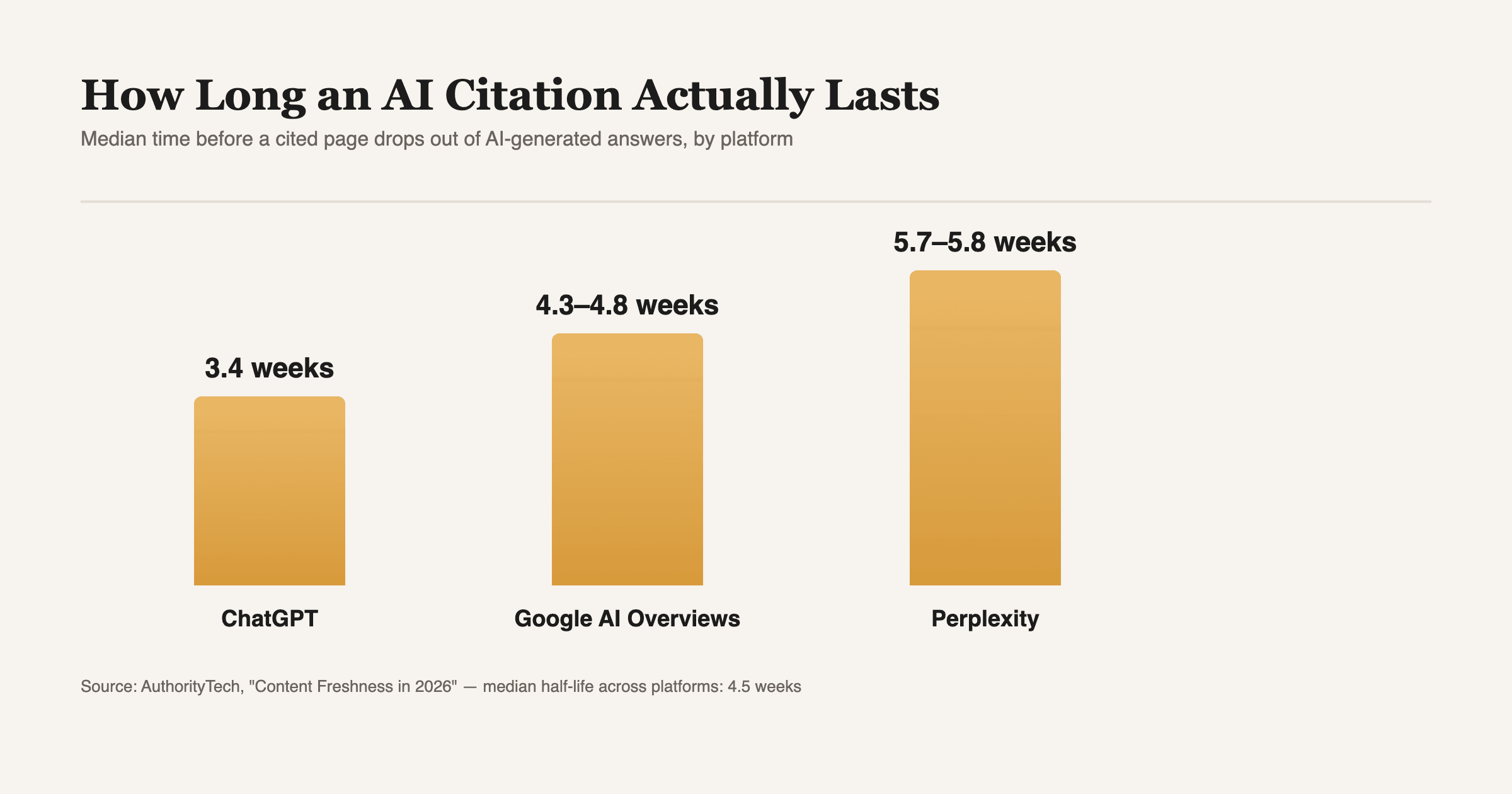
Faster than most content calendars assume. Research tracking citation turnover across AI platforms found a median half-life across platforms of roughly 4.5 weeks, the point at which half of a set of previously cited pages have dropped out of AI answers. ChatGPT churns fastest, with citations decaying in roughly 3.4 weeks, Google's AI surfaces cluster around 4.3 to 4.8 weeks, and Perplexity holds citations longest at roughly 5.7 to 5.8 weeks.
The upside data points the same direction: content updated within the last 30 days earns roughly 3.2x more AI citations than older pages, and 76.4% of ChatGPT's most-cited pages had been updated within the previous 30 days, the most aggressive recency bias of the three major platforms.
What actually counts as an update, for a freshness signal to register?
- A substantive content change, an added data point, an updated statistic, a new example or section, not a cosmetic typo fix that leaves the page's actual information untouched.
- A corresponding change to the page's declared modified date in its structured data, since re-ranking pipelines and crawlers key off both the visible content diff and the timestamp the page itself reports.
- Something worth re-crawling for, which in practice means the update has to be real enough that a human reader would notice it too, not a change made purely to trigger a freshness signal.
What's a realistic update cadence for a small team?
- Pages actively targeting ChatGPT-driven queries: a light refresh roughly every two weeks, an updated stat, a new example, a tightened FAQ answer, given ChatGPT's roughly 3.4-week citation half-life.
- Pages primarily targeting Google AI Overviews: monthly is close to sufficient, since AI Overviews shows a meaningfully weaker recency bias than ChatGPT or Perplexity.
- Pages primarily targeting Perplexity: a six-week cycle holds up reasonably well given its longer citation half-life.
- If running three separate cadences isn't realistic, quarterly is a safe floor across all three platforms, and monthly is the better default if ChatGPT or Perplexity visibility specifically matters most to the business.
How AIBOOTSTRAPPER solved this for a client
PropLock, the UK real estate platform AIBOOTSTRAPPER built with a GEO-optimized site from the ground up, generated 12,000 organic visitors a month within 90 days of launch precisely because the site wasn't built as a one-time SEO project, it was engineered with structured, regularly updated listing data that AI systems could keep re-surfacing as current, not a static page left to age after launch.
That's the same discipline behind tracking which pages are actually still earning AI citations: knowing which pages are decaying tells you where to spend a refresh, instead of guessing across an entire content library.
How AIBOOTSTRAPPER helps
A page that got cited once and was never touched again is on a decay clock, not a permanent win. AIBOOTSTRAPPER's GEO and content team builds refresh cadences into every GEO-optimized site and blog program we run, based on which platforms actually matter for the client, not a generic quarterly checklist.
If you were cited by ChatGPT or Perplexity once and want to know whether you still are, book a call and we'll show you what's decaying and what to refresh first.
Want this done for you?
Book a free strategy call and we'll show you how to build and market your business with AI.