An engineering team ships a RAG chatbot that nails every question in the demo: ask it about the refund policy, it retrieves the right clause and answers cleanly. Then they wire the same retrieval pipeline into an agent that has to actually do something, check the order status, cross reference it against the refund policy, look up whether the customer already has an open ticket, then draft a response. Two tool calls in, it forgets what it found in the first one. Four calls in, it retrieves the same chunk of the policy document a third time and still gets the exception clause wrong. The retrieval pipeline didn't get worse. The traffic pattern hitting it changed completely, and nobody redesigned it for that.
Why does a RAG pipeline that works for chatbots fall apart inside an agent?
Classic retrieval-augmented generation was engineered for a specific traffic pattern: one human types one question, the system embeds that question, runs a similarity search against a pre-chunked, pre-embedded vector index, pulls back the top few matching chunks, and stuffs them into the prompt alongside the question. That pipeline, chunk, embed, retrieve by cosine similarity, generate, is exactly what we've broken down in detail elsewhere on this blog, and it works well for exactly the load it was designed for: one question in, one grounded answer out.
An AI agent doesn't produce that traffic pattern. A single task, resolve this support ticket, qualify this lead, process this claim, can trigger a dozen or more retrieval calls in sequence, each one needing a different, narrower slice of data than the last. VentureBeat's reporting on this shift puts it plainly: agents make orders of magnitude more data requests than human users, but most retrieval layers were built for the human-scale problem. A pipeline tuned to serve one lookup per conversation turn simply wasn't built to serve fifteen.
What does 'context architecture' actually change about how retrieval works?
The fix isn't a bigger vector index or a better embedding model, it's inverting when and how data gets pulled. Traditional RAG pre-loads: it decides what the agent might need before the task starts and stuffs it into the prompt up front. Context architecture flips that. The agent pulls what it needs at the moment it needs it, through a tool call, based on where the task actually is right now, not a guess made before execution started.
As one infrastructure vendor's CEO put it to VentureBeat, describing the same shift, it's "a flip to let the agent pull the data instead of presupposing and stuffing it into the pipeline." The data layer stops being a static payload attached to the prompt and becomes a live, governed resource the agent queries on demand, the same way an employee doesn't memorize the entire policy handbook before a shift starts, they look up the specific clause that applies to the ticket in front of them.
Why is this shift showing up in enterprise buying data right now?
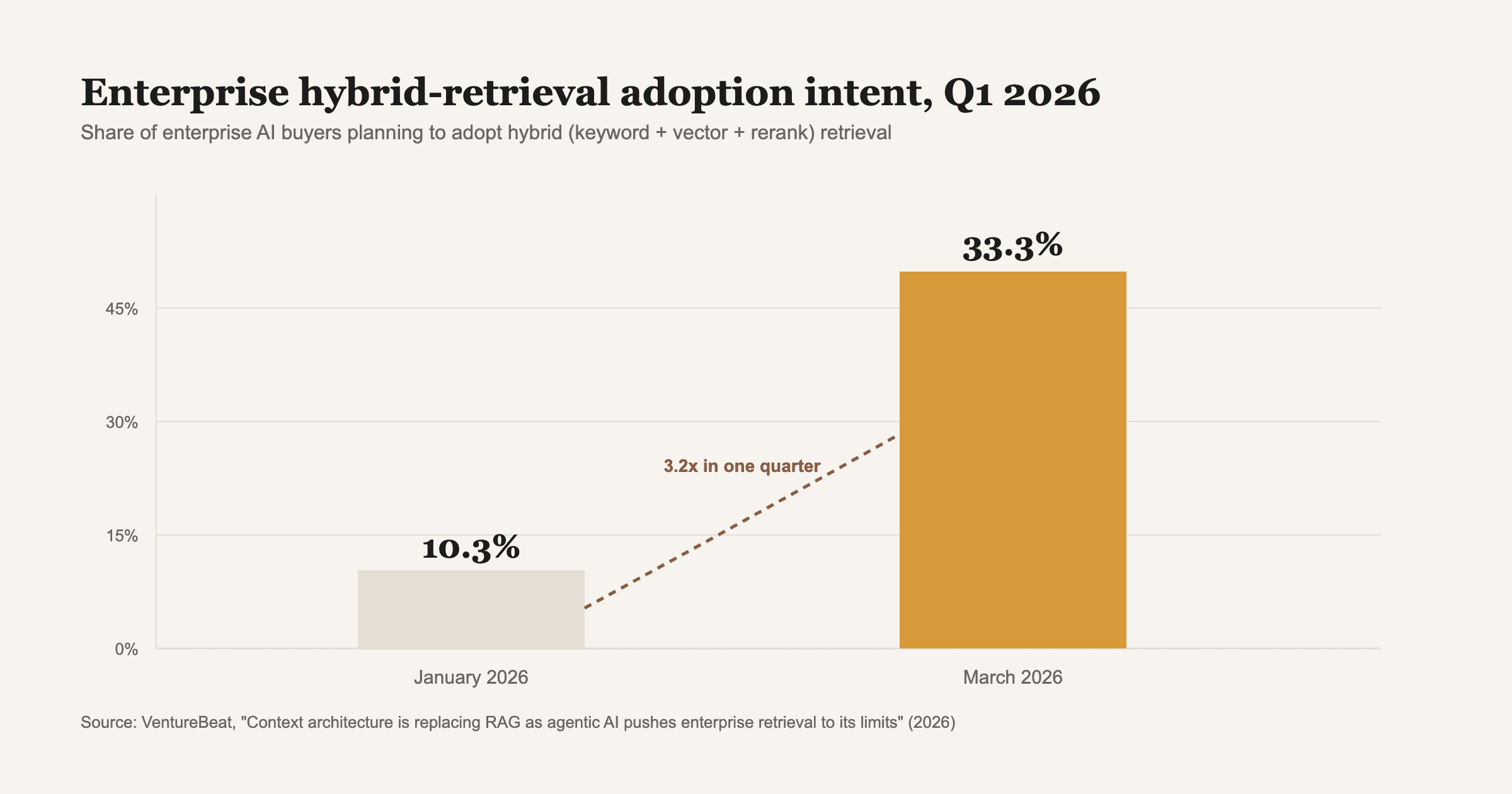
This isn't a theoretical argument, it's already visible in what enterprises are buying. Intent to adopt hybrid retrieval, combining keyword search, vector search and reranking rather than vector search alone, tripled from 10.3% to 33.3% in a single quarter of 2026, and the share of enterprises building custom, in-house retrieval stacks instead of buying an off-the-shelf vector database rose from 24.1% to 35.6% over the same period, according to VentureBeat's analysis. Teams that shipped a working RAG chatbot in 2025 are the ones hitting this wall first in 2026, because their agent's task complexity outgrew a retrieval layer that was never rebuilt for it.
What does a working multi-step retrieval architecture actually look like?
Three things change in practice. First, retrieval becomes a tool the agent calls explicitly and repeatedly during a task, not a block of context injected once at the start, so hybrid search, BM25 keyword matching plus vector similarity plus a reranking pass, gets invoked fresh for each narrower question the agent asks along the way. Second, the agent needs working memory that survives across those calls, a running record of what it already retrieved and concluded, so it doesn't re-fetch the same clause or contradict its own earlier finding, which is the same failure mode covered in why AI agents forget context mid-task.
Third, and this is the part teams skip, someone has to actively curate what stays in the token window versus what gets re-fetched on demand instead of held permanently, the discipline we've called context engineering elsewhere on this blog. Skip that curation step and you get the opposite failure: an agent that never forgets anything and drowns its own reasoning in stale context instead.
How AIBOOTSTRAPPER solved this for ComplyNexus
For ComplyNexus, a Hong Kong compliance platform, the old process was a compliance team manually tracking shifting regulations across jurisdictions in spreadsheets, a static, point-in-time way of working that's the exact opposite of what multi-step retrieval requires. We built a RAG-powered compliance engine that continuously monitors regulatory sources and pulls fresh information the moment a new rule appears, maps it against the client's control library, and surfaces the gap, rather than relying on a retrieval index that only gets refreshed when someone remembers to rebuild it.
That's context architecture in practice: the retrieval layer treated as a live resource the system queries on an ongoing basis, not a snapshot loaded once and trusted indefinitely. It cut manual review time by 92% and turned a three-week regulatory turnaround into two hours. If your own agent is stalling out past the first retrieval call, book a call or see the full build in our case studies.
Want this done for you?
Book a free strategy call and we'll show you how to build and market your business with AI.