A support engineer at a SaaS company types "error code E-4471" into the company's new AI chatbot, expecting the exact troubleshooting steps that are sitting, word for word, in the knowledge base the bot was built on. Instead the bot returns a vague summary about error handling in general, never mentioning E-4471 at all. The engineer assumes the bot is broken or the docs weren't ingested properly. Neither is true. The chatbot is a pure vector search system, and vector search was never built to find an exact string, it was built to find meaning, and a five-character error code doesn't carry much of that.
Why does a vector-search chatbot miss an exact match that's sitting right in the source document?
An embedding model turns text into a point in high-dimensional space based on meaning, not exact characters, so "error code E-4471" and "error code E-4489" land close together in that space because they're both about error codes, not because the model can tell one apart from the other the way a human reading the literal string can. Cosine similarity search then returns whichever chunks are semantically closest to the query, and a chunk containing the exact code the user typed has no structural advantage over a chunk that just talks about error codes generally.
This is the same failure mode covered in why RAG chatbots give wrong answers: the retrieval step, not the language model, decides what the bot even gets to see, and rare exact-match tokens, product codes, SKUs, part numbers, legal clause numbers, are exactly the class of query embeddings handle worst.
What is BM25, and why does a 2026 production RAG stack still need a keyword algorithm from the 1990s?
BM25 (Best Matching 25) scores a document against a query using term frequency and inverse document frequency, essentially how often the query's exact words appear in a document, weighted down for words that are common everywhere and weighted up for words that are rare and distinctive. It has no notion of meaning at all, which is precisely its advantage here: BM25 excels at exact-match queries, product codes, named entities, rare technical terms, because it's counting literal token matches, not measuring semantic distance in embedding space.
The two methods fail on opposite ends of the same spectrum. Dense vector retrieval handles conceptual and paraphrase queries but may underweight exact rare-term matches, while a sparse keyword index does the reverse: it finds the exact string instantly but has no way to know that "cancel my subscription" and "how do I stop being billed" mean the same thing.
How do you combine BM25 and vector search without one score drowning out the other?
The naive approach, averaging a BM25 score and a cosine similarity score, breaks immediately because the two numbers aren't on comparable scales and don't mean the same thing, so a system tuned this way ends up arbitrarily favoring whichever score happens to have a wider numeric range that week. Production hybrid search instead uses Reciprocal Rank Fusion (RRF), and Elastic's own RRF documentation describes it precisely: RRF requires no tuning, and the different relevance indicators do not have to be related to each other to achieve high-quality results, because it fuses result lists using rank position alone, not raw scores.
In practice, this means a document that lands in the top 3 of both the BM25 list and the vector list gets a strong combined score even though the two underlying numbers were never comparable to begin with, and a document that only one retriever found still gets a fair chance to surface. Pinecone's hybrid search documentation confirms the same architecture from the vector database side, running sparse (BM25) and dense vectors through the same index and letting a weighting parameter control how much each contributes.
Does hybrid search actually move the needle, or is it a marginal tweak?
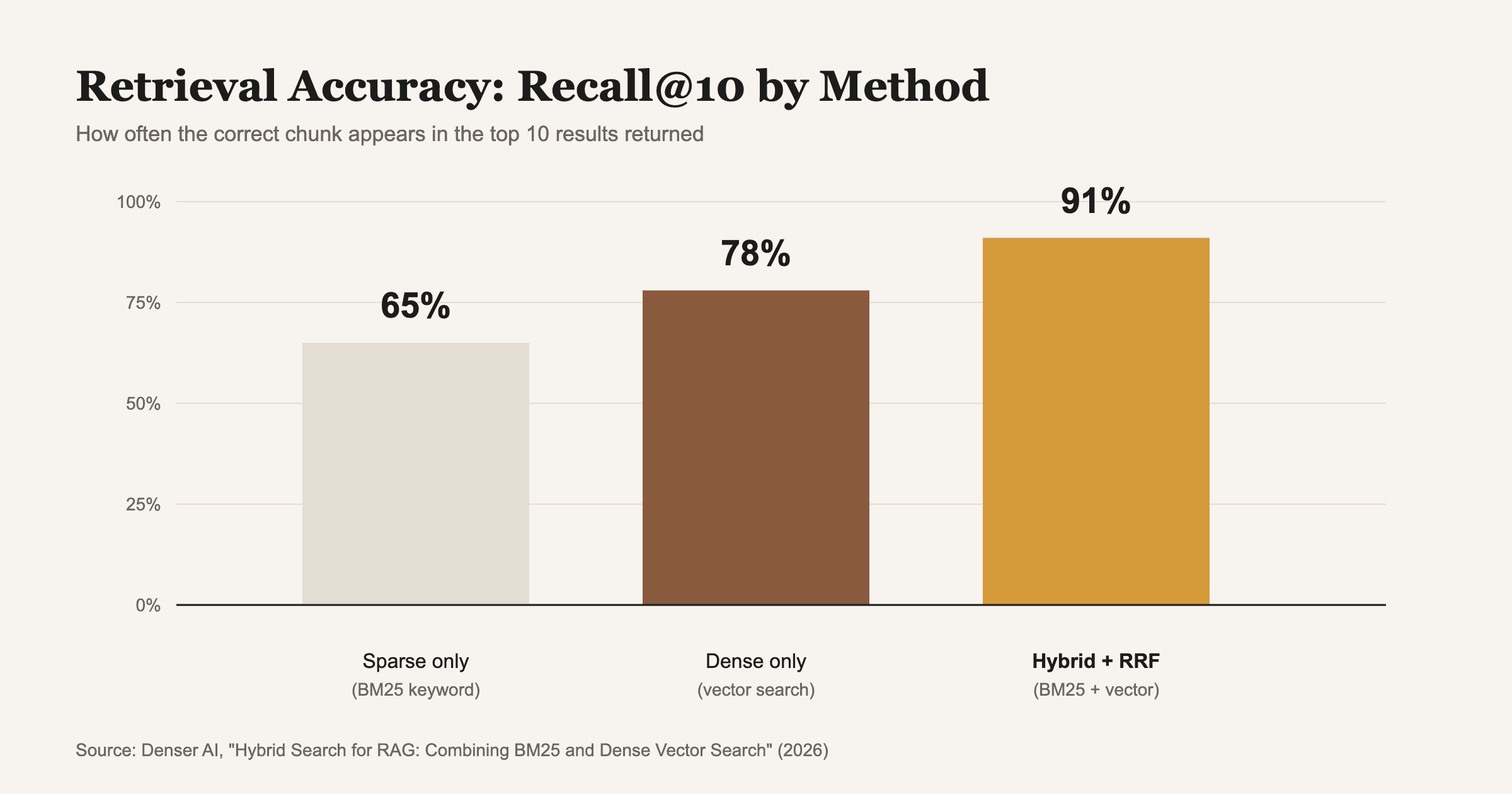
It's not marginal. Recent benchmark data shows hybrid retrieval with RRF hitting 91% recall@10 versus 78% for dense-only or 65% for sparse-only, according to a 2026 hybrid search benchmark from Denser AI. That's not a rounding error, it's the difference between a chatbot that reliably surfaces the right chunk and one that misses it roughly one time in three or one time in five, depending on which single method it was running alone.
The gap matters most exactly where it hurts a business the most: support tickets that reference an exact error code, order number or model number, the queries where a wrong or absent answer is most visibly a failure to both the customer and whoever's reviewing chatbot performance.
What does a reranking stage add on top of hybrid retrieval?
Hybrid search with RRF produces a fused candidate list fast, but it's still a first pass built for speed across a whole corpus, not maximum precision on a handful of results. A cross-encoder reranker takes that shortlist, typically the top 20-50 candidates, and scores the query against each candidate document together, in one pass, rather than comparing two independently-computed embeddings, which is far more accurate but too slow to run against an entire index.
The production pattern, confirmed across multiple 2026 retrieval benchmarks, layers all three stages: BM25 plus vector search fused with RRF, optionally followed by a cross-encoder reranking stage for final relevance gains on a small candidate set. Each stage trades a bit more latency for a lot more precision, which is why reranking runs last, on the smallest possible set of candidates, not first.
How AIBOOTSTRAPPER solved this for ComplyNexus
AIBOOTSTRAPPER built ComplyNexus, a compliance platform where retrieval accuracy isn't a nice-to-have, a missed regulatory clause is a missed obligation. The RAG-powered compliance engine has to find both exact regulatory citations, specific clause numbers, section references, and the broader conceptual context around a rule change, which is exactly the two-sided retrieval problem hybrid search and reranking solve together.
That retrieval architecture, not just the language model on top of it, is a meaningful part of why the platform cut manual compliance review time by 92% and turned a three-week regulatory turnaround into two hours, with full audit trail traceability. Full results are on the case studies page.
How AIBOOTSTRAPPER helps
AIBOOTSTRAPPER's AI product development team builds hybrid retrieval, BM25 plus vector search fused with RRF, with a reranking stage on top, into every RAG system from day one, instead of shipping vector-only search and discovering the exact-match gap after customers start complaining that the bot "can't find anything."
If your AI chatbot or internal search tool is missing exact matches that are clearly in your own documents, book a call and we'll audit the retrieval pipeline.
Want this done for you?
Book a free strategy call and we'll show you how to build and market your business with AI.