A team ships an AI support agent. In testing it's five clean questions, one tool, a short conversation, and it nails every one. Two weeks after launch, it's confidently telling a customer their refund was approved when it wasn't, ignoring a formatting instruction from turn one, calling the wrong tool halfway through a ten-message conversation. Nobody touched the prompt. What changed is everything else the model is now reading on every single turn, and that's the part almost nobody was engineering.
What actually is context engineering, and how is it different from prompt engineering?
Prompt engineering optimizes the fixed instruction you write once: the system prompt, the few-shot examples, the exact wording of a question. Context engineering optimizes something bigger and constantly changing, the entire set of tokens the model sees on a given inference call, instructions, tool definitions, retrieved documents, conversation history, and prior tool outputs, per Anthropic's own engineering write-up on effective context engineering for AI agents.
A single well-crafted prompt is a fixed asset. An agent running for twenty turns accumulates a different context on every one of those turns, so treating context as 'the prompt, but longer' is exactly the assumption that breaks agents once they leave the demo.
Why does context get worse, not better, the longer an agent runs?
Every model has a finite context window, a hard cap on tokens it can attend to at once, and stuffing that window past a certain point doesn't just cost more, it measurably degrades output quality, a pattern practitioners now call context rot: relevant instructions get diluted by accumulated noise, and the model starts contradicting earlier turns or losing track of what it already tried.
This is the same underlying issue explored in why AI agents forget context mid-conversation: the fix isn't a bigger context window, it's being deliberate about what earns a seat in that window on every turn, since more tokens doesn't reliably mean more signal.
What does context engineering actually look like in practice?
| Technique | What it solves |
|---|---|
| Just-in-time retrieval | Pull only the specific documents relevant to the current step instead of loading an entire knowledge base upfront, the same principle behind hybrid search and reranking in RAG pipelines, see hybrid search, BM25, and reranking explained |
| Context compaction | Summarize older conversation turns into a condensed form once they stop being immediately relevant, freeing token budget without discarding the information entirely |
| Tool loadout curation | Expose only the tools relevant to the current task instead of every tool the agent could theoretically call, since a wider function-calling surface increases the odds of the wrong tool getting picked |
| Structured scratchpads | Have the agent write its own working notes to a persistent file or memory object outside the context window, then re-read only what's needed later |
| Sub-agent isolation | Hand a narrow sub-task to a separate agent with its own clean context window, then return only the distilled result to the main agent's context |
Source: Anthropic, Effective Context Engineering for AI Agents; LangChain, Context Engineering for Agents.
Is this actually a widespread shift, or a rebrand of prompt engineering?
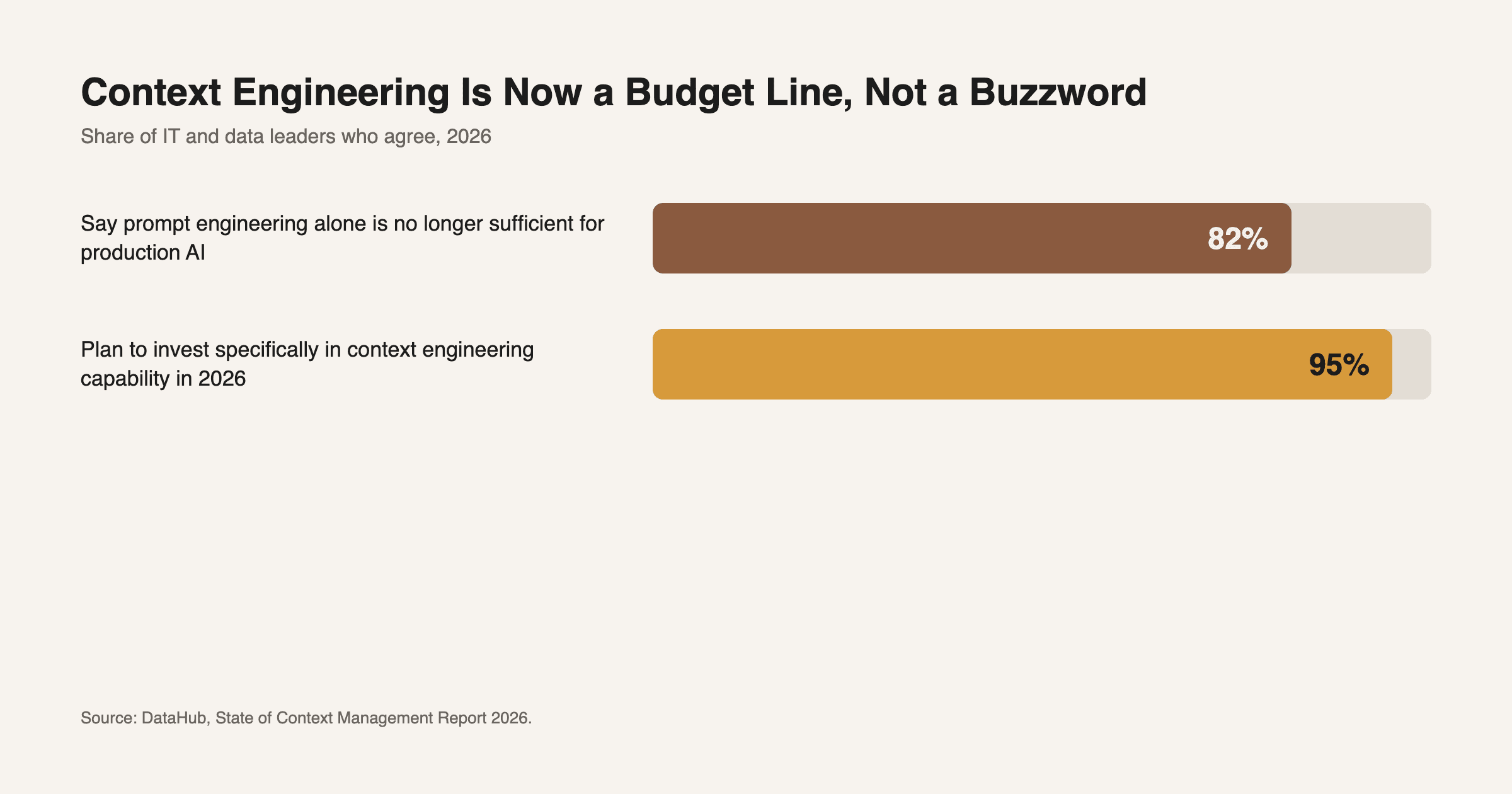
It's a measurable shift in where teams are putting their engineering budget, not a rebrand. DataHub's State of Context Management Report 2026 found 82% of IT and data leaders now agree that prompt engineering alone is no longer sufficient for production AI, with 95% of data teams planning to invest specifically in context engineering capability in 2026.
That tracks with what happens once an AI product moves from a single well-tested prompt to an agent that calls tools and holds a multi-turn conversation: the failure mode shifts from 'the model misunderstood the question' to 'the model was reading the wrong set of tokens when it answered.'
How AIBOOTSTRAPPER solved this for ComplySpark
ComplySpark, AIBOOTSTRAPPER's AI compliance document writer, is a working example of context engineering, not prompt engineering, solving a reliability problem. The client's legal team needed policy documents drafted in-house language, grounded strictly in their own approved policy library, with zero tolerance for the model inventing language that wasn't already sanctioned.
Prompt engineering alone can't guarantee that, wording alone can't stop a model from drifting once a document gets long. AIBOOTSTRAPPER built a document copilot that curates exactly which policy source material enters the model's context for each section being drafted, version-controls it, and keeps a human in the loop before anything ships, taking drafting time down 10x with zero off-policy language slip-ups.
How AIBOOTSTRAPPER helps
AIBOOTSTRAPPER's AI product development team builds agents around context architecture, not prompt tweaks, deciding what an agent retrieves, remembers, forgets, and is allowed to see on every turn, so reliability doesn't collapse the moment a real conversation gets longer than a demo.
If your AI agent works in testing but drifts in production, book a call and we'll show you where the context, not the prompt, is actually breaking.
Want this done for you?
Book a free strategy call and we'll show you how to build and market your business with AI.