A finance manager at a mid-size manufacturer pastes next quarter's unreleased pricing sheet into ChatGPT to get help reformatting it into a clean table. Nobody told them not to, there's no company AI tool and no written policy, and the free ChatGPT tab has been sitting open next to their spreadsheet for months. IT has no idea it happened, there's no log and no alert. This is what security researchers call 'shadow AI,' AI tools employees adopt on their own, doing real work, completely outside whatever the company thinks it has approved, and it is already happening inside most businesses whether anyone has noticed yet or not.
What is 'shadow AI,' exactly?
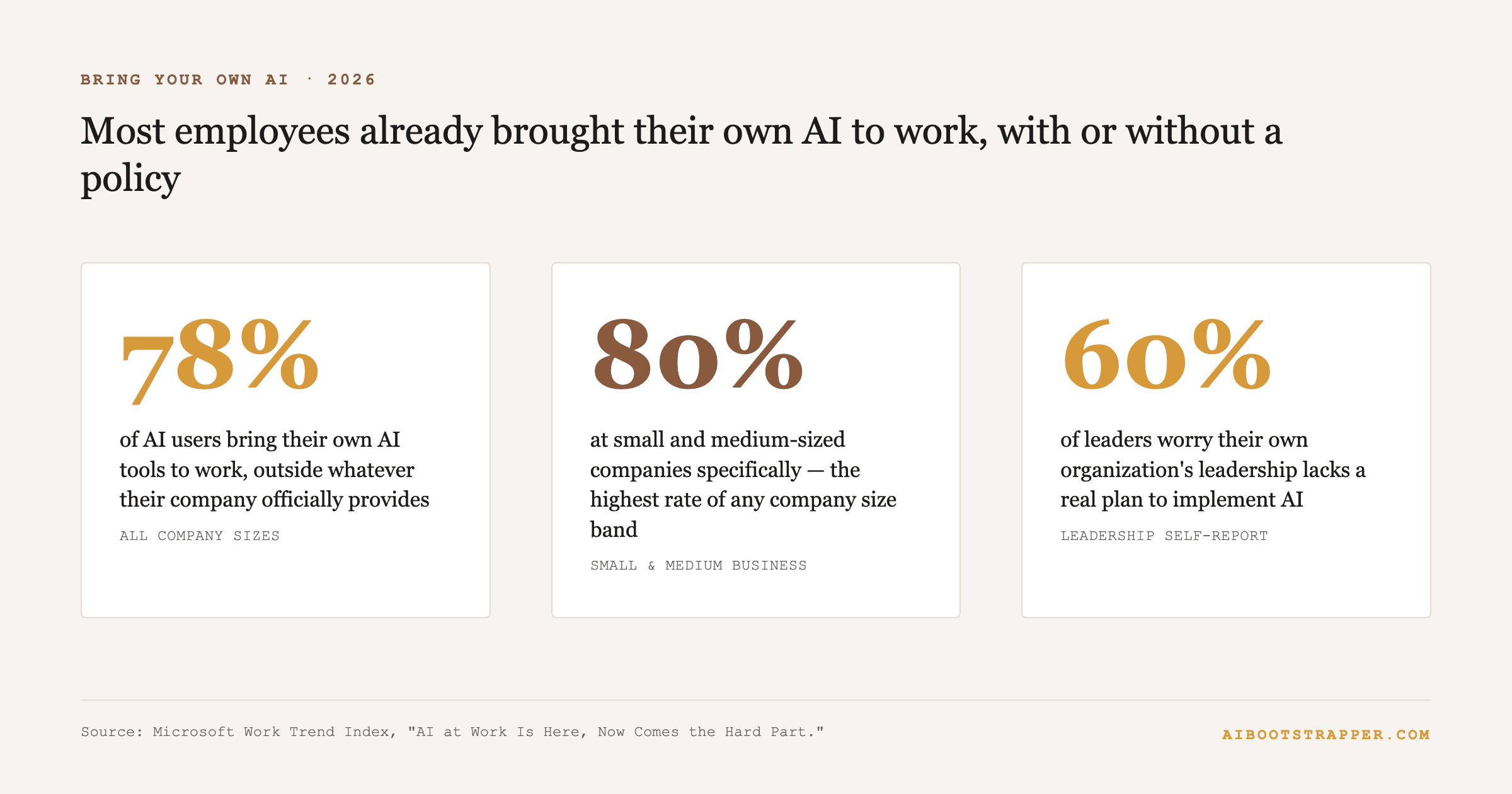
Shadow AI is the AI-era version of shadow IT: employees adopting consumer-grade AI tools, ChatGPT, Gemini, browser extensions, for real work tasks without the company provisioning, approving, or even knowing about the tool. It isn't a fringe behavior. Per Microsoft's own Work Trend Index, 78% of AI users bring their own AI tools to work, outside whatever their employer officially provides, and that rate climbs to 80% specifically at small and medium-sized companies, the exact size band most Indore and India-based businesses fall into.
This sits right next to the gap covered in why most AI pilots never reach production: companies are simultaneously slow to roll out sanctioned AI tools and unable to stop employees from using unsanctioned ones in the meantime, which is precisely the combination that produces shadow AI at scale.
Why does shadow AI happen even at companies that are rolling out official AI tools?
Because official rollouts are slow, and a free public tool an employee already knows how to use is one browser tab away. Procurement, security review and training for a sanctioned enterprise AI tool typically take months; the pressure to hit a deadline this week does not wait. Per the same Microsoft research, 60% of leaders worry their own organization's leadership lacks a real plan and vision to implement AI, and that governance vacuum is exactly what employees fill on their own, not out of recklessness, but because nobody gave them a faster, sanctioned option or a clear line on what's off-limits.
What kind of data is actually leaking, and how much?
| What's happening | Measured rate |
|---|---|
| Employees who have pasted company data into ChatGPT at least once | 8.6% |
| Share of everything pasted into ChatGPT that's actually confidential or sensitive | 11% |
| Growth in confidential-data-to-ChatGPT incidents over a single 6-week window | +60.4% |
| Share of all leak incidents caused by a small, repeat group of employees | Just 0.9% of employees responsible for 80% of egress events |
Source: Cyberhaven, enterprise browser telemetry across client companies.
So is the fix just banning it?
- No, on its own a ban just pushes usage further underground: employees still need the productivity gain and will use a personal device or a personal account instead, where there is zero visibility at all.
- Provide at least one sanctioned, paid-tier AI tool with an enterprise data-handling agreement before restricting anything, since 'use nothing' is not a real option most employees will actually follow.
- Write a short, specific usage policy naming what's fine (drafting, brainstorming, formatting) and what's never fine (pasting unreleased financials, client PII, source code), instead of a vague 'be careful with AI' memo nobody can act on.
- Turn on whatever admin-level visibility the sanctioned tool offers, workspace logs, DLP integration, so usage is at least visible instead of invisible, since Cyberhaven's own data shows the risk concentrates in a small number of repeat, unmonitored patterns, not a diffuse threat from everyone at once.
- Treat this as a genuine compliance question, not just a security one, the moment any personal data touches an unsanctioned AI tool, it falls under India's DPDP Act obligations whether the company chose that tool or not.
How AIBOOTSTRAPPER helps
This is exactly the gap AIBOOTSTRAPPER's AI consultancy work is built to close: not a generic AI strategy deck, but an honest audit of what AI tools your team is already using without approval, and a governance and adoption roadmap ranked by real risk and ROI, not buzzwords.
Book a call before your shadow AI usage becomes a compliance incident instead of a policy conversation.
Want this done for you?
Book a free strategy call and we'll show you how to build and market your business with AI.