A founder running a WhatsApp AI agent that answers customer questions, pulls order history from a CRM, and stores every conversation in a vector database for better retrieval gets a compliance email in July 2026 asking whether the business is 'DPDP ready.' The founder has only ever heard the term applied to spreadsheets and databases, and has no idea whether an embedding index full of customer phone numbers and complaint text even counts as personal data under the law, or what 'deleting' a customer's data means once it's been split into 400-token chunks and embedded across a vector index.
What is the DPDP Act, and why is 2026 the year it starts to bite?
The Digital Personal Data Protection Act became law in 2023, but stayed largely theoretical until MeitY notified the DPDP Rules on 14 November 2025, which made the Act fully operational and stood up the Data Protection Board of India as a functioning regulator, not a future one.
It applies to any business, Indian or foreign, that digitally processes the personal data of Indian residents, so a WhatsApp AI agent serving Indian customers, a CRM enrichment tool, or an n8n workflow that pulls a customer's phone number into a third-party API call are all squarely in scope, regardless of where the company is headquartered.
What's the actual compliance timeline?
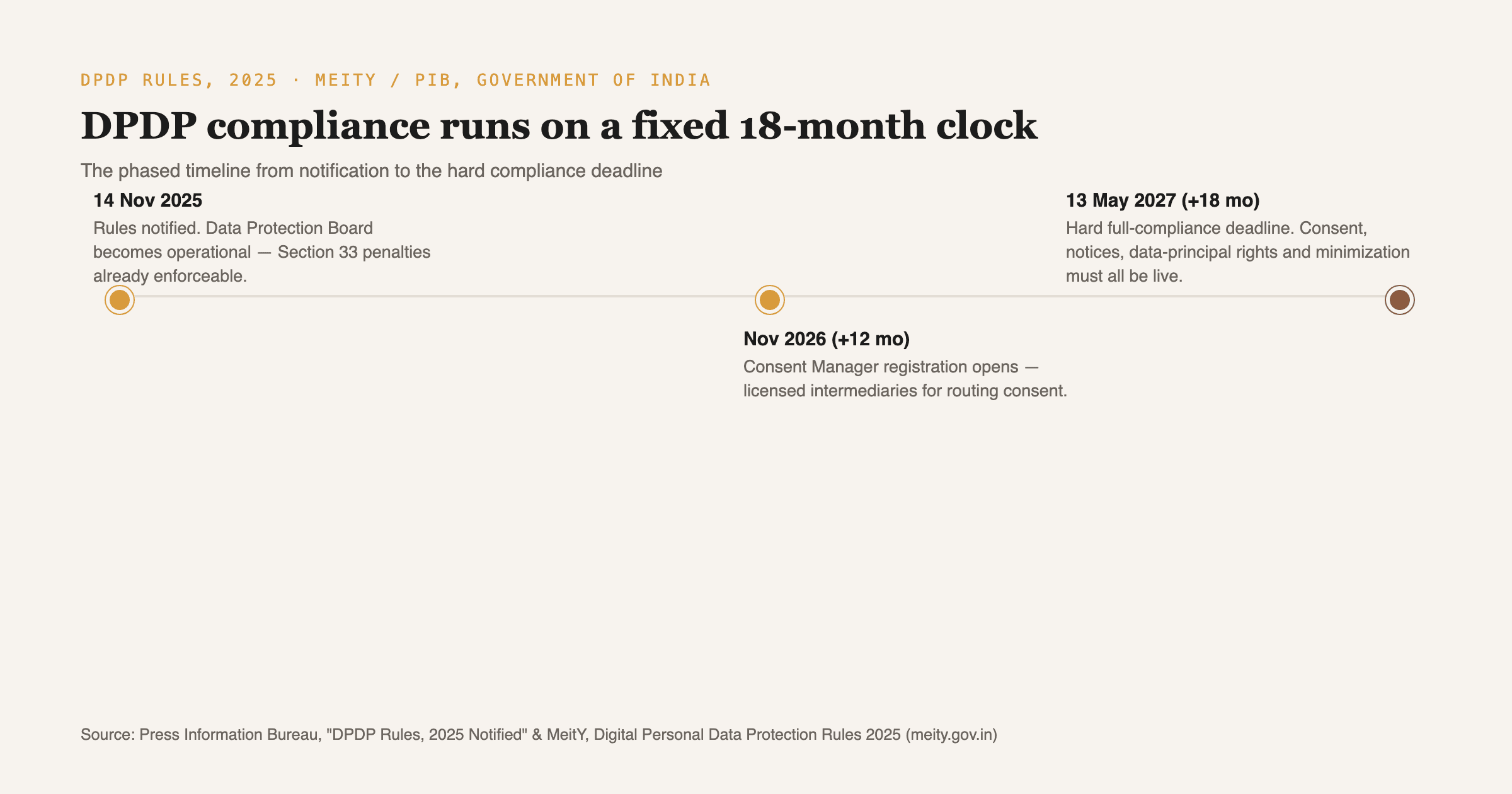
- 14 November 2025: DPDP Rules notified, the Data Protection Board becomes operational, and businesses can already be investigated for violations under Section 33.
- November 2026 (12 months in): Consent Manager registration opens, the licensed intermediaries through which businesses will need to route consent collection for many use cases.
- 13 May 2027 (18 months in): the hard full-compliance deadline. Consent capture, privacy notices, data principal rights handling and data minimization must all be operational, with no grace period expected once it passes.
Is your AI agent actually a 'data fiduciary' under DPDP?
| AI system | Touches personal data? | DPDP exposure |
|---|---|---|
| WhatsApp AI support agent | Yes — phone numbers, order history, conversation text | High: needs consent capture, purpose limitation, erasure support |
| CRM lead-scoring / enrichment agent | Yes — name, contact, behavioral data | High: same obligations, plus profiling adds scrutiny |
| Internal n8n automation (invoices, ops) | Depends — often internal business records only | Low, unless it pulls customer PII into third-party API calls |
| RAG chatbot over public marketing content | Usually no personal data in the knowledge base | Low for the knowledge base; high for the conversation logs it stores |
A rough triage, not legal advice — the actual classification depends on the specific data your system stores and processes.
What does DPDP actually require an AI agent to do differently?
Three requirements hit AI systems harder than traditional software, because agent architectures were built around ingesting and retaining as much data as possible, the opposite of what the law asks for.
- Purpose limitation: an agent grounded on customer data for support can't silently reuse that same data to train a marketing model or feed a different agent without fresh, specific consent, a real constraint on how shared vector stores and fine-tuning pipelines get built.
- Data principal rights, specifically erasure: a customer can request their data be deleted, and 'deleted' has to mean actually removed from the system a customer's conversation history was embedded into, not just a row deleted from a Postgres table while the same content still lives in a vector index.
- Breach notification: the Board must be notified within a fixed window of a breach, which means an AI agent's data flows, every API call, every place a customer's message gets logged or embedded, need to be mapped well enough to know what was actually exposed.
The technical gap most RAG and AI agent systems have today
Vector databases aren't built for row-level deletion the way SQL databases are. Once a customer's message is chunked, embedded and inserted into an index like Pinecone or pgvector, deleting it correctly means finding every chunk derived from that customer's data across every index it was inserted into, not just deleting a source document and assuming the embeddings disappear with it.
This is exactly the kind of traceability problem RAG pipelines built for regulated environments need to solve at the architecture stage: tagging every embedded chunk with a data-subject identifier at ingestion time, so an erasure request becomes a targeted query against that identifier instead of a manual audit of an entire vector index.
How AIBOOTSTRAPPER solved this for a client
ComplyNexus, the Hong Kong RegTech platform AIBOOTSTRAPPER built, runs on exactly this discipline: a RAG-powered compliance engine with full audit trails, mapping every ingested regulatory update back to a traceable source and control, the same architecture pattern that DPDP-grade erasure and breach-notification requirements demand of any AI system touching Indian personal data. It cut that client's regulatory change turnaround from three weeks to two hours, proof that building traceability in from day one is a speed advantage, not just a compliance cost.
How AIBOOTSTRAPPER helps
AIBOOTSTRAPPER's AI consultancy engagements now include a DPDP data-flow audit for any AI agent or automation that touches customer data, mapping what's stored, where, and whether it can actually be found and erased on request, before the May 2027 deadline turns that gap into a filed complaint.
If you're running a WhatsApp agent, CRM automation or RAG chatbot and aren't sure where your customer data actually lives, book a call and we'll map it before you have to explain it to the Data Protection Board.
Want this done for you?
Book a free strategy call and we'll show you how to build and market your business with AI.