A compliance officer at a mid-market fintech asks the internal policy assistant what the retention requirement is for EU customer KYC records, and gets back a clean, confident answer citing Article 30(1)(a). General counsel catches it in review before it goes to the auditor: the actual retention obligation sits in Article 32(1)(a), a different clause entirely, and the two articles read almost identically at the sentence level. The bot didn't hallucinate a fake regulation. It retrieved a real clause, from a real document, that just happened to be the wrong one, because nothing in its retrieval pipeline was built to tell 30 and 32 apart.
Why dense-vector-only search gets compliance documents wrong
Embedding models project text into a semantic space where meaning, not exact wording, determines closeness. That's exactly the wrong bias for a compliance document, where 'Article 30(1)(a)' and 'Article 32(1)(a)' are semantically near-identical strings sitting a few characters apart, describing entirely different legal obligations. A benchmark study on retrieval strategies for text-and-table documents found that classic BM25 keyword search actually outperforms dense embeddings on documents dense with identifiers, clause numbers, and exact terminology, precisely because dense retrieval smooths over the fine-grained tokens that carry all the meaning in a compliance corpus.
This isn't a model-quality problem you fix by upgrading to a better embedding model. It's a structural mismatch between what dense vectors are good at (topical, paraphrase-level similarity) and what compliance retrieval actually needs (exact clause and defined-term precision). The fix is architectural: stop asking one retrieval method to do a job it isn't built for.
What the benchmark data actually shows about hybrid retrieval
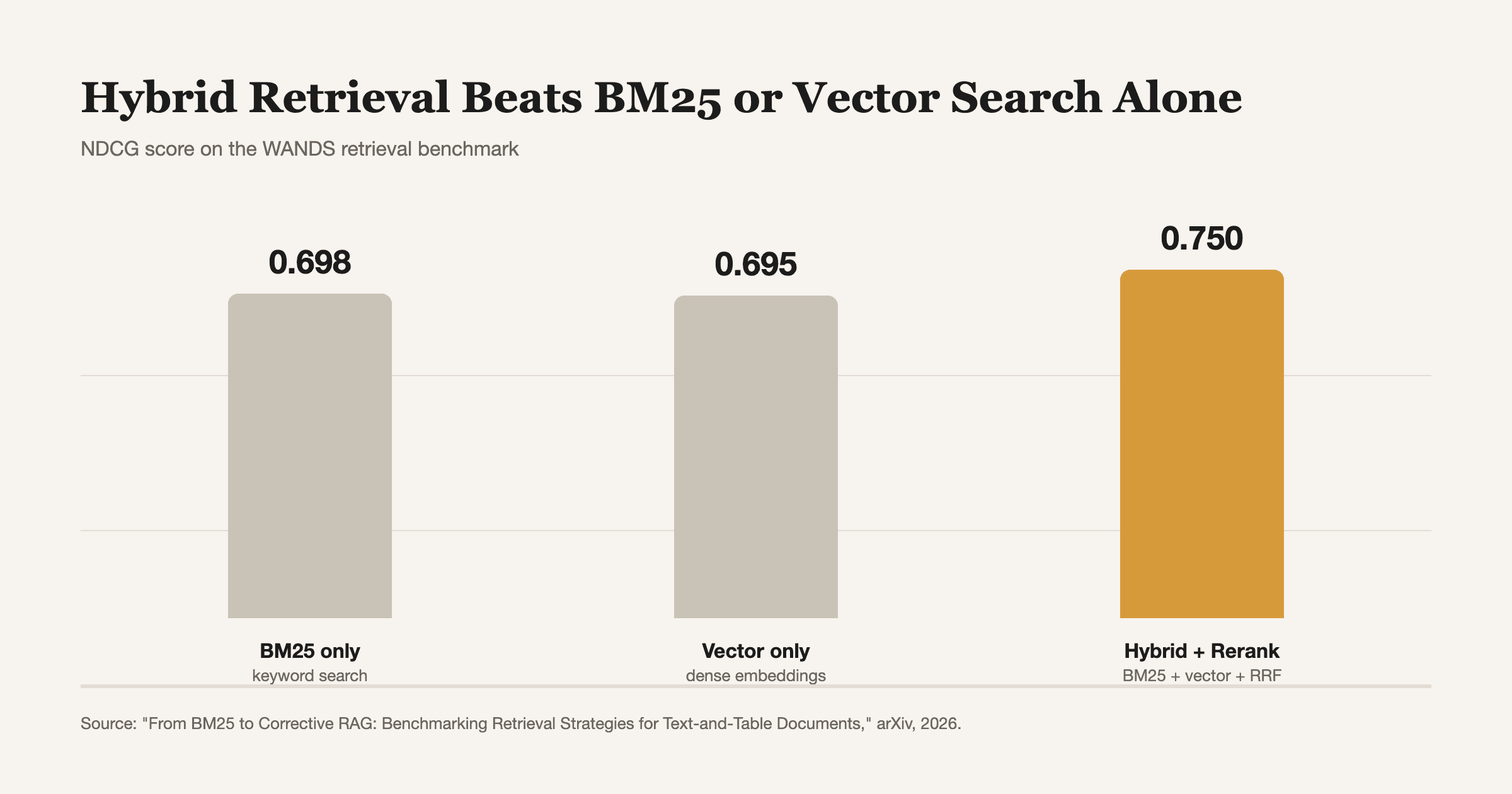
On the WANDS benchmark, a tuned hybrid retrieval setup reached 0.7497 NDCG, a real lift over BM25 alone (0.6983) and dense vector search alone (0.6953), which is the direct evidence that neither method wins on its own. On mixed text-and-table financial documents specifically, the same research found a two-stage pipeline, combining hybrid retrieval with a neural reranker, hit Recall@5 of 0.816 and MRR@3 of 0.605, beating every single-stage method by a wide margin.
The practical read: BM25 catches the exact clause numbers and defined terms dense search blurs together, dense embeddings catch the paraphrased questions a user actually types, and a reranker sitting after both re-scores the combined candidate list against the literal query before anything reaches the model. Skip any one of the three stages and you're back to the Article 30 vs. Article 32 problem.
The architecture: chunking, hybrid retrieval, reranking, and citations that trace back
- Chunk on clause boundaries, not fixed token counts. Splitting a clause mid-sentence to hit a token limit is how a retrieval system ends up handing the model half an obligation and none of its exception.
- Run BM25 and dense embedding search in parallel against the same chunked index, then merge the two ranked lists with Reciprocal Rank Fusion, which combines results by rank position rather than raw score, so you don't need the two systems' relevance scores to be on the same scale to merge them cleanly.
- Rerank the fused candidate set with a cross-encoder that scores each candidate directly against the literal query text, the step that actually resolves near-identical clause numbers by re-reading the full text side by side rather than trusting embedding proximity.
- Attach citation metadata to every retrieved chunk before it reaches the model: source document, exact clause, retrieval timestamp, and the user who asked, the same permission-and-provenance layer covered in our breakdown of permission-aware RAG for enterprise, so every answer traces back to a specific, auditable source instead of a paraphrase.
Why auditability has to be designed in, not bolted on afterward
A compliance answer that's correct but can't show its source is barely more useful to an auditor than one that's wrong, because the reviewer still has to manually verify it against the original document either way. The fix isn't a disclaimer at the bottom of the chat window, it's making the citation metadata a structural part of every retrieval call: which document, which exact clause, retrieved for which query, by which user, at what time.
That log is also what turns a compliance assistant from a convenience tool into something legal and audit teams will actually trust enough to rely on, since context engineering, not just prompting, determines whether a RAG system stays grounded in real sources instead of drifting toward plausible-sounding paraphrase.
How AIBOOTSTRAPPER solved this for ComplyNexus
A Hong Kong compliance team we worked with, ComplyNexus, was tracking changing regulations across multiple jurisdictions manually in spreadsheets, with constant risk of a missed obligation slipping through. We built a RAG-powered compliance engine that continuously monitors regulatory sources, interprets new rules with an LLM, maps them to the client's own control library, and surfaces gaps with full audit trails attached to every mapped clause.
The result was 92% less manual review time, regulatory change turnaround that dropped from three weeks to two hours, and 100% audit-ready traceability on every generated answer. If your compliance assistant is citing the wrong clause with total confidence, book a call and we'll walk through the retrieval architecture that fixes it, or see the full build in our case studies.
Want this done for you?
Book a free strategy call and we'll show you how to build and market your business with AI.