A Series A fintech founder in London spent eight months on backlinks the traditional way: guest posts, directory placements, a handful of DR-60 links from a PR agency billing by the placement. His nearest competitor, half his headcount and a fraction of his link count, kept showing up whenever a prospect asked ChatGPT or Perplexity to compare vendors in their category. Reading both companies' content side by side, his was better researched and better written. He wasn't losing on quality. He was losing on something his backlink report had never measured at all: whether the system generating that answer could tell, with confidence, who he actually was.
Why don't backlinks predict AI citations the way they used to predict Google rankings?
Classical search ranking leaned on link graphs: a page cited by many other pages was assumed to be more authoritative, the mechanism behind PageRank since 1998. Generative answer engines don't reason the same way, because they're not ranking ten blue links, they're deciding which specific facts and sources to pull into one synthesized answer, and that decision leans much harder on whether the system can confidently identify who or what is being discussed.
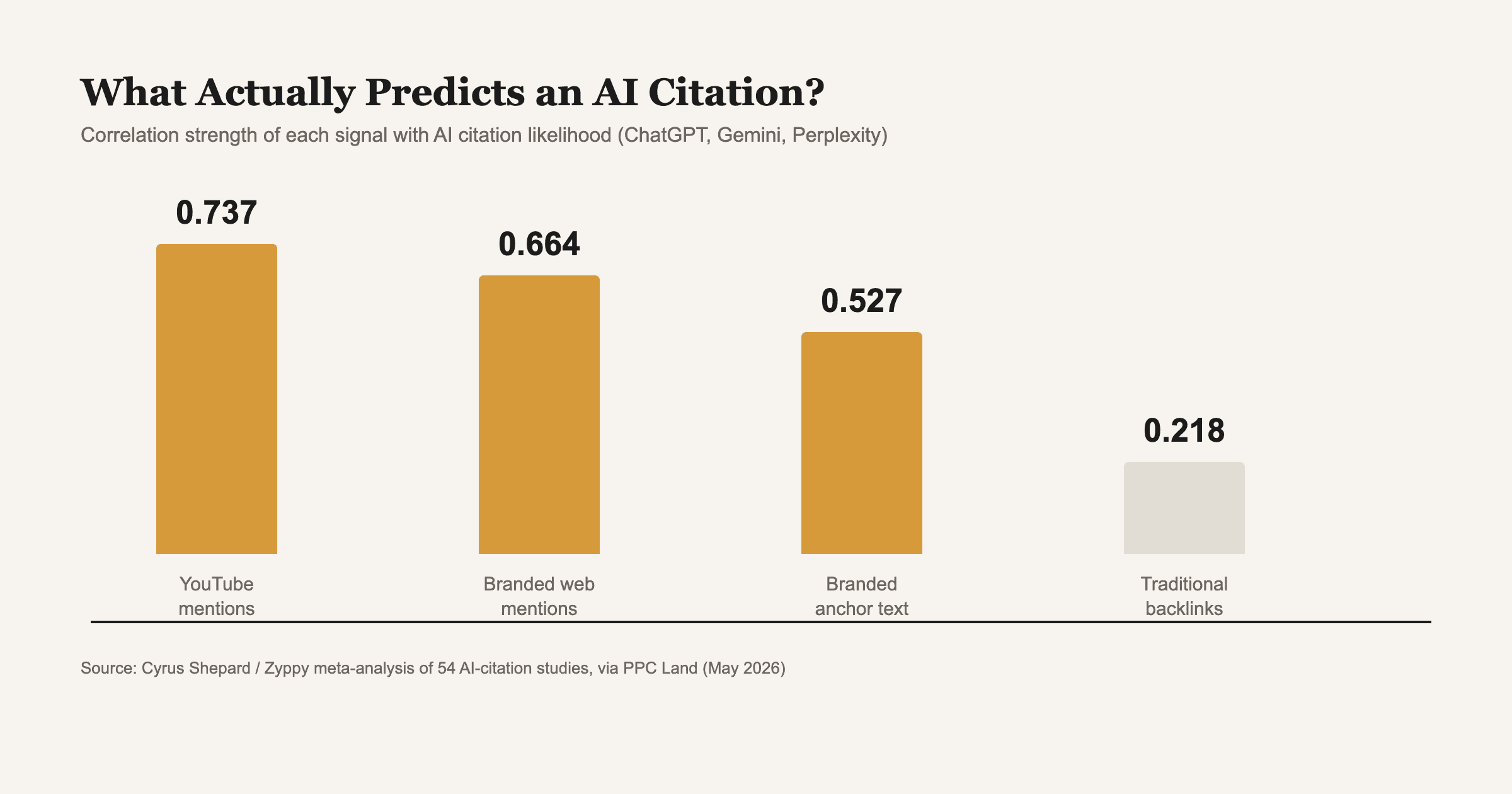
The most rigorous attempt to quantify that shift is a May 2026 meta-analysis by SEO researcher Cyrus Shepard, synthesizing 54 experiments, patents and case studies on what actually drives citations across ChatGPT, Gemini and Perplexity. The analysis found branded web mentions correlate at roughly 0.664 with AI citation likelihood, YouTube mentions at 0.737, and branded anchor text at 0.527, against just 0.218 for traditional backlinks, meaning brand-identity signals now outweigh link-building by 2-3x.
What is entity resolution, and why does it outperform link counting?
Entity resolution is the process an information system uses to decide that a mention in text, 'AIBOOTSTRAPPER', 'Aditya Jha's company', 'the AI agency in Indore', all refer to the same single, disambiguated real-world thing, and to link that thing to a canonical record it already has some confidence in. This is standard information-retrieval and NLP territory: named entity recognition finds the mention, entity linking maps it to a knowledge-base node (a Wikidata item, a Google Knowledge Graph ID), and disambiguation resolves collisions when multiple candidates share a name.
A link only says 'someone thought this page was worth pointing to.' It says nothing about whether the underlying subject is a stable, unambiguous entity the system can attach facts to with confidence. Organization and Person schema carrying a sameAs property is explicitly how Google resolves a page's publishing entity against Knowledge Graph records, and resolved entities receive materially higher trust in AI answer generation than pages whose subject the system can't pin down.
How do you actually build entity signals that a retrieval system can resolve?
- Publish Organization schema (Person schema, if the brand is genuinely founder-led) with a stable @id on your homepage or a single About page, not duplicated across every URL on the site.
- Populate sameAs with your verified LinkedIn company page, Crunchbase profile, X/Twitter, and Google Business Profile, in that order of practical leverage for a growing company.
- Get a Wikidata item created and verified, since Wikidata, not Wikipedia, is the actual structured node most entity-linking systems check against, and it doesn't require the notability bar a Wikipedia article does.
- Keep the entity's name, one-line description, and category worded identically across every one of those profiles; inconsistent naming across platforms is the single most common reason disambiguation fails for a small brand.
- Chase genuine brand mentions in press, podcasts, and industry roundups even when they don't include a link, since branded mentions now outweigh backlinks roughly 3-to-1 for AI citation likelihood.
How AIBOOTSTRAPPER helps
We build entity signals into every product site from day one rather than retrofitting them later. For Expensorr, an expense-management product we designed and built end to end, the GEO-optimized site, structured schema, and consistent entity information across every profile, was part of the initial build, not an add-on. It was ranking within weeks of launch, and the site was engineered discoverable by both search engines and AI assistants from the day it shipped.
If your content is strong but your brand still isn't showing up when a prospect asks ChatGPT or Perplexity to name vendors in your category, the gap is usually entity resolution, not content quality. Book a call or see how we scope GEO and AI marketing work.
Want this done for you?
Book a free strategy call and we'll show you how to build and market your business with AI.