A founder rewrites every page on their site: adds FAQ schema, restructures every heading, front-loads the answer in the first two sentences of every section, everything the last GEO checklist told them to do. Three months later they ask ChatGPT for the best option in their category and their own site never comes up, but a directory listing and a Reddit thread mentioning them do. The instinct is to assume the on-site work failed. It didn't, it was solving the smaller half of the problem.
Why does AI keep citing everyone except your own website?
Because most AI citations never trace back to a brand's own domain in the first place. A Muck Rack study cited by Backlinko's digital PR research found that 84% of AI citations come from earned media, third-party sources like editorial coverage, reviews and forums, not the brand's own pages.
On-site GEO work, schema, headings, answer-first structure, still matters, it's what makes a page citable at all once a model or a journalist lands on it. But treating it as the whole strategy means optimizing roughly the smaller slice of what actually gets pulled into an AI answer, not the majority of it.
What is actually getting cited instead of your homepage?
- Review platforms: building out a Trustpilot profile can lift a brand's AI citation rate from roughly 1% with no profile to over half once a profile exists, per Semrush's research on digital PR for AI visibility; G2 categories with 10% more reviews see about 2% more AI citations in the same research.
- Third-party roundups and comparison lists: in one analysis Semrush cites, ChatGPT cited a single accounting-software roundup site six times without citing the individual brands' own websites directly.
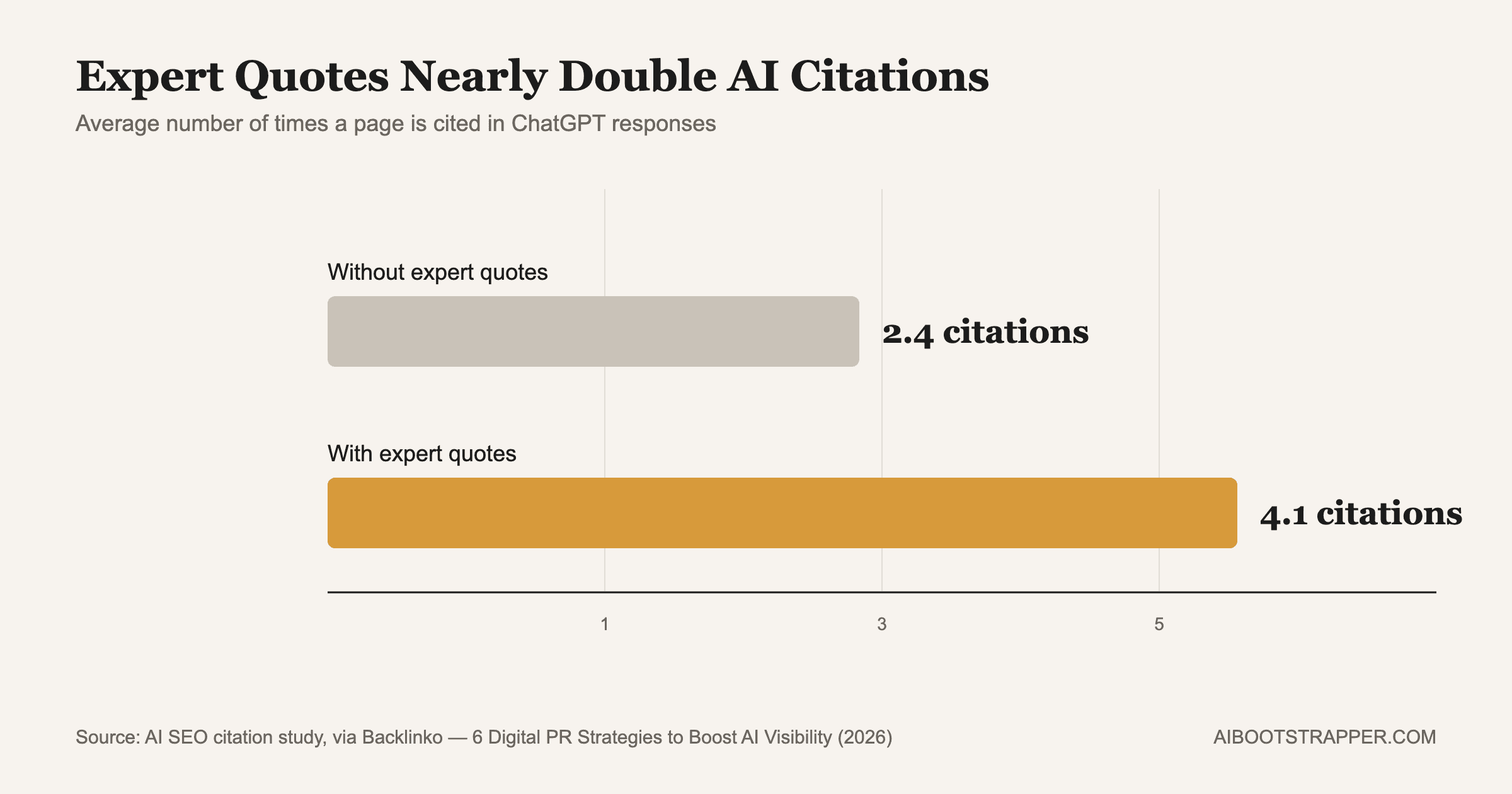
- Pages featuring expert quotes: pages containing expert commentary get roughly 4.1 citations in ChatGPT on average, compared with 2.4 for pages without them, per the AI SEO citation study referenced by Backlinko.
- LinkedIn posts and founder-led content: Backlinko's research found LinkedIn is the second-most-cited domain across ChatGPT, AI Mode and Perplexity, with most cited authors posting at least weekly.
Why expert quotes move the number this much
Retrieval systems behind AI answers favor passages that read as standalone, attributable claims, a quote with a named source attached is exactly that shape, which is why pages with expert commentary get cited nearly twice as often in the data above.
The digital PR tactics that actually move the citation number
| Tactic | What it does | Why it works for AI citation |
|---|---|---|
| Original research or data | Publish a proprietary stat other sites want to reference | Gives editors a concrete, self-contained number to cite, exactly the unit AI models tend to lift |
| Review platform presence | Claim and actively build out G2, Trustpilot or Capterra profiles | Review platforms are the kind of frequently-crawled, third-party source models default to over a marketing page |
| Expert quote placement | Get the founder quoted in trade or industry coverage | Attributed commentary reads as a citable claim, the same pattern that lifts on-site citation rates |
| Community presence | Answer real questions on Reddit, Quora or industry forums, non-promotionally | Forums are an increasingly weighted source, particularly for Perplexity |
Sources: Backlinko — 6 Digital PR Strategies to Boost AI Visibility; Semrush — Digital PR for AI Visibility.
So should you stop optimizing your own website?
No. On-site GEO is still the foundation, it's what turns a visit from a journalist, a directory crawler or an AI model into an actual citation once you've earned the mention. The two have to run together: schema and answer-first structure that make a page worth lifting, plus an off-site presence that gets the brand discovered and mentioned in the first place. A brand that only has one half is leaving most of the citation opportunity on the table, whichever half it is.
How AIBOOTSTRAPPER built the on-site half of this for PropLock
PropLock is AIBOOTSTRAPPER's proof of the on-site foundation this strategy depends on: an AI engine that auto-writes SEO and GEO optimized listings, paired with a GEO website engineered to rank for local intent, which reached 12,000 organic visitors a month within 90 days of launch. That's the on-site half already proven to work; the same schema and structure discipline is what makes a brand's pages worth citing once earned media and third-party mentions bring the visibility that a homepage alone can't generate.
How AIBOOTSTRAPPER helps
AIBOOTSTRAPPER's GEO optimized website work covers the on-site foundation, schema, structure, answer-first content, and we advise clients on the off-site presence (reviews, expert placements, community mentions) that the research above shows actually drives most AI citations.
If your site is technically GEO-ready but still isn't showing up in AI answers, book a call and we'll audit where the gap actually is.
Want this done for you?
Book a free strategy call and we'll show you how to build and market your business with AI.