A founder in Indore has forty blog drafts sitting unpublished, written with AI assistance to move faster, because a LinkedIn thread convinced them Google secretly detects and buries AI-written content. Six months of content calendar, stalled by a rumor. The actual answer sits in a very specific dataset: Ahrefs pulled a million pages from a hundred thousand real Google search results in June 2026 and measured, page by page, whether AI content share predicted anything about where a page ranked.
Does Google actually penalize content because it was written with AI?
No, not for that reason alone. Google's own guidance is explicit: Google Search's guidance about AI-generated content states its ranking systems reward original, high-quality content regardless of how it was produced, and that using automation, including AI, with the primary purpose of manipulating rankings is a violation of its spam policies, not the use of AI itself.
That distinction changes what you should actually optimize for. The rule isn't 'avoid AI,' it's 'avoid publishing content whose only purpose is to occupy more ranking real estate,' a distinction the industry blurred for two years before anyone ran the numbers at scale.
What did the largest 2026 study on this actually measure?
Ahrefs pulled roughly 1 million pages from the top 10 positions across 100,000 real Google SERPs in June 2026, ran AI-content detection on the ~100,000 pages with enough text to score reliably, then checked two things against AI content share: whether a page was indexed at all, and where it ranked.
The headline number is a correlation coefficient of 0.011 between AI content percentage and ranking position, statistically indistinguishable from no relationship. But the indexation data tells a sharper story, and it's the one that should actually change how you plan content.
So if AI content isn't penalized, why do some AI-heavy pages still underperform?
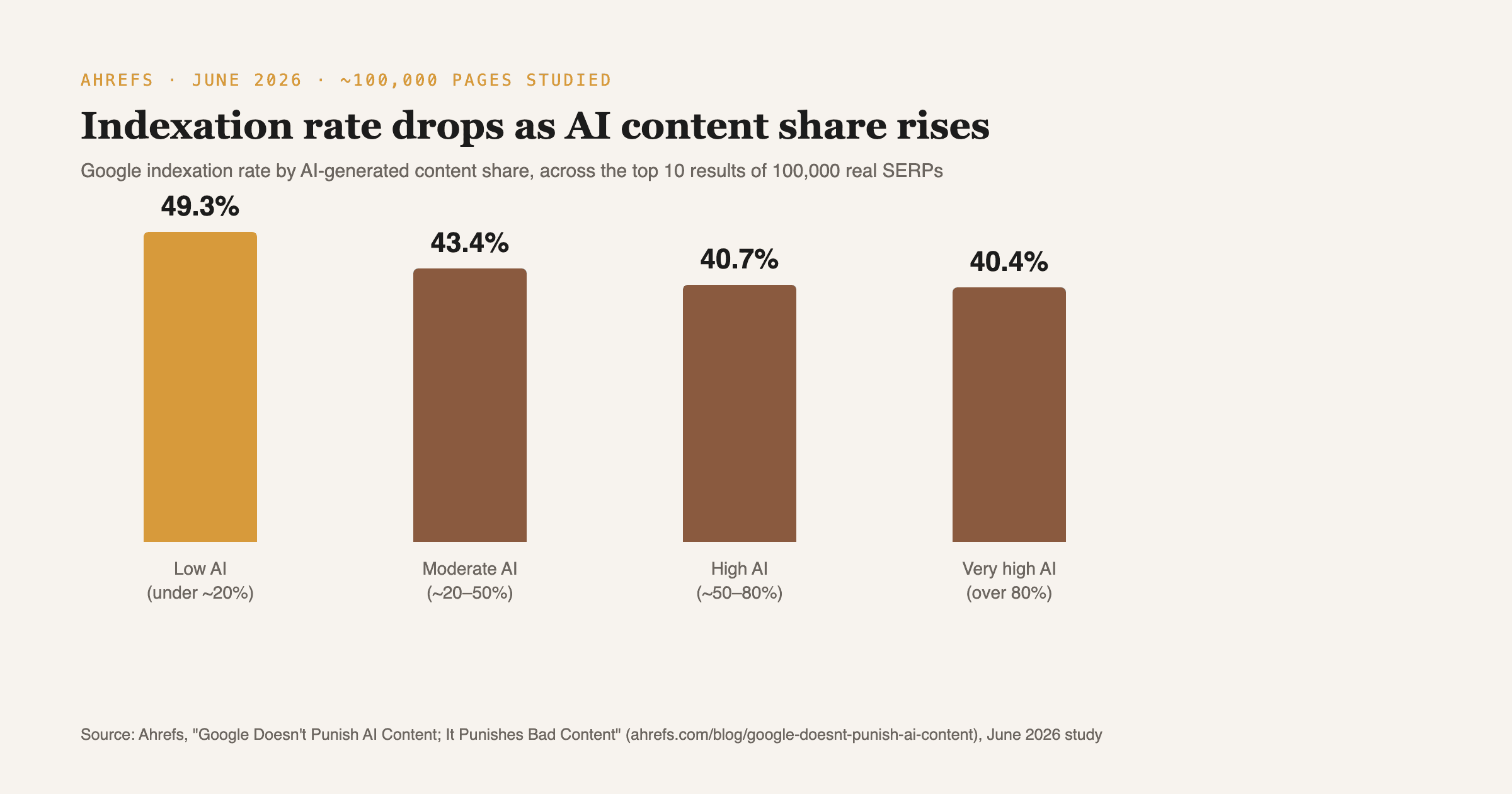
Indexation rate drops from 49.3% at low AI-content share to 40.4% at very high share, roughly a 9-point gap, and pages heavy in AI content received 2-3x fewer search impressions than low-AI pages that did get indexed. That's not a ranking penalty, it's a quality filter working as designed: content assembled with little editing, structure or original insight is thinner, and thin content has always indexed and performed worse, with or without AI in the byline.
Put differently: 54.7% of pages holding a top-3 position have under 20% AI content, and pages under 50% AI content account for 82.2% of all top-3 rankings. AI-assisted content dominates the top of Google. Fully AI-generated, unedited content is the minority that struggles, and it struggles for the same reason unedited human content always has.
| AI content share | Indexation rate | Search impressions vs low-AI pages |
|---|---|---|
| Low (under ~20%) | 49.3% | Baseline |
| Moderate (~20-50%) | 43.4% | Lower |
| High (~50-80%) | 40.7% | 2-3x lower |
| Very high (over 80%) | 40.4% | 2-3x lower |
Ahrefs, June 2026 study, ~100,000 pages scored for AI content share and cross-checked against Search Console impressions and indexation status.
What actually determines whether AI-assisted content ranks?
- Whether it answers the specific question a real searcher typed, not a generic version of the topic — see how this maps to intent-first structure in the GEO framework.
- Whether a person with real expertise edited, verified and added something the AI couldn't: a client number, a specific mechanism, a genuine opinion.
- Whether the page is the kind Google's scaled content abuse policy actually targets: many near-duplicate pages published at volume with no unique value between them, which is the behavior Google penalizes, not the tool used to draft the first version.
- Whether it's structured for citation, not just ranking, since AI answer engines like ChatGPT and Perplexity increasingly decide what to cite based on the same depth-and-specificity signals, a pattern covered in why some brands never get cited by ChatGPT or Perplexity.
The freshness angle nobody accounts for
There's a second, quieter risk with AI content that has nothing to do with detection: publishing fast means publishing more, and more pages need more maintenance to stay accurate as facts, pricing and product details change. A GEO strategy that pairs AI-assisted drafting with a real update cadence for staying cited by AI answer engines outperforms either pure-AI or pure-human content published once and left stale.
How AIBOOTSTRAPPER solved this for a client
PropLock, the UK real estate platform AIBOOTSTRAPPER built, hit 12,000 organic visitors a month within 90 days of launch on a content program that used AI to move fast but was structured, fact-checked and edited toward genuine buyer intent, not detection avoidance. The lesson generalizes: the 2026 data above shows AI-assisted content winning the top 3 positions at scale, which matches what actually drove PropLock's early organic traffic, structure and specificity, not the absence of AI in the workflow.
How AIBOOTSTRAPPER helps
AIBOOTSTRAPPER's GEO and AEO content process uses AI to move at the speed a real content calendar needs, while keeping the editing, fact-checking and structure discipline that the 2026 data shows is what separates a top-3 page from a page that never gets indexed.
If you've been sitting on drafts because of AI-penalty rumors, book a call and we'll show you what to fix first, most of the time it's specificity and structure, not the tool you used to write the first draft.
Want this done for you?
Book a free strategy call and we'll show you how to build and market your business with AI.