A founder checks Google Search Console and finds impressions holding steady, sometimes even climbing, while clicks quietly slide the other way. Nothing in the account looks broken. No manual penalty, no ranking drop. The traffic just isn't converting into visits the way it used to, and the reason isn't a Google update to a specific page, it's a structural shift in how Google itself answers a question before the user ever has to click anything.
How much has AI Overviews actually cut click-through rate?
Significantly, and the studies agree on direction even where the exact number varies. Ahrefs measured 58% lower click-through rate on the top-ranking page for keywords that trigger an AI Overview, compared to the same ranking position without one. Pew Research found an 8% click rate on searches with an AI Overview versus 15% without, roughly a 47% relative decline. Seer's tracked data shows an even steeper fall, from 1.76% to 0.61%, a 65% drop.
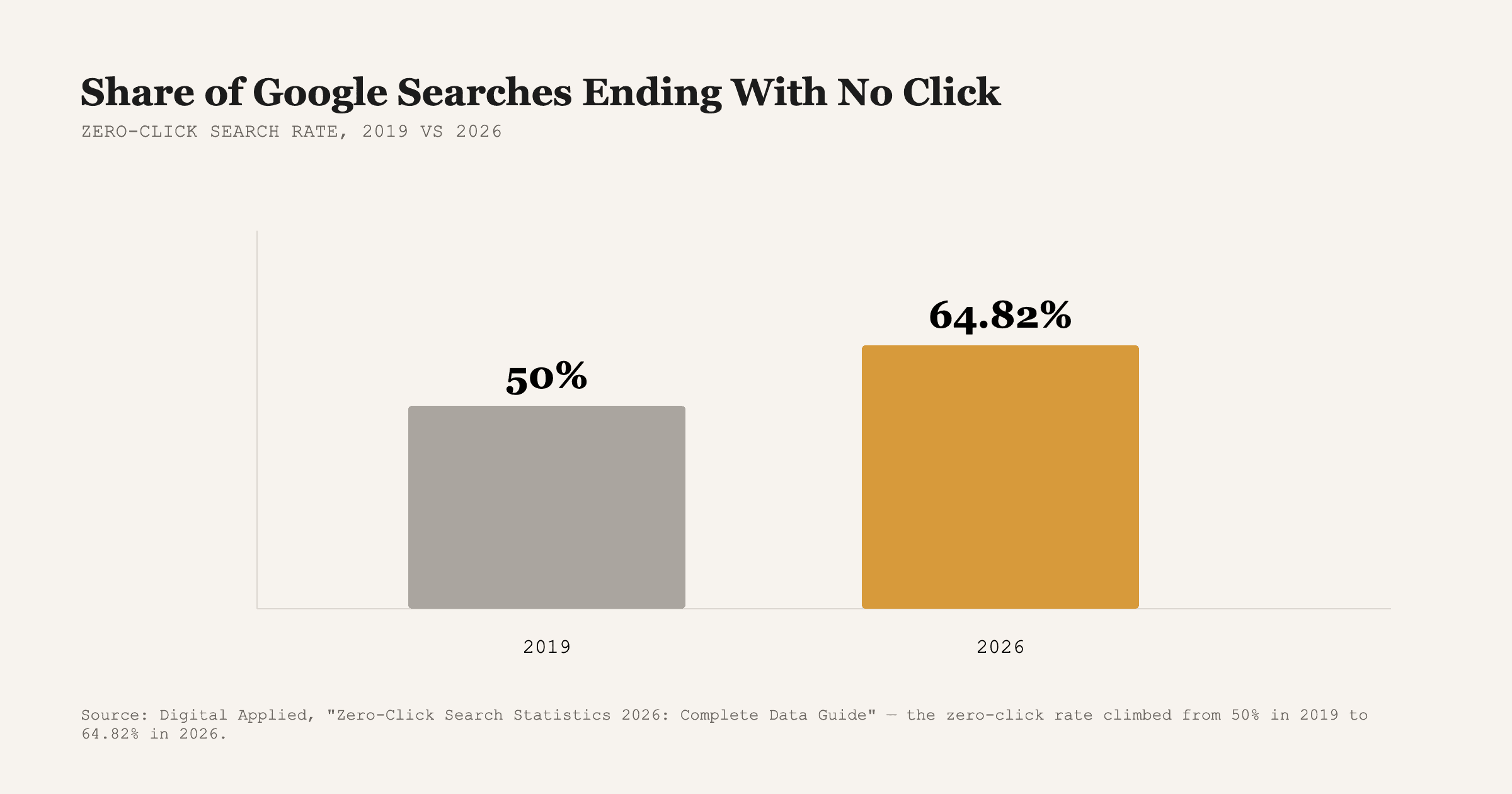
The zero-click rate, the share of all searches that end without any click to an external site, has climbed from 50% in 2019 to 64.82% in 2026. That is not a niche problem confined to a few informational keywords; it is now the majority behavior of search itself.
Why is this happening structurally, not just as a temporary Google experiment?
An AI Overview works by having a language model read the top-ranking pages for a query, synthesize an answer, and place it above every blue link, so the user's question is often already answered before they scroll to the first organic result. For factual, definitional and comparison queries, the kind that used to reliably send informational traffic to a business's blog, there is often no remaining reason to click through.
Google itself is not denying the shift, it is adjusting the interface around it. On May 6, 2026 the company announced updates to AI Overviews and AI Mode aimed at "better web discovery", including inline links, hover previews and community perspectives inside the AI answer itself, an acknowledgment that publishers need a path back to the site even as the answer moves into the AI layer.
If clicks are down, is this traffic actually worth chasing?
The traffic that does click through is disproportionately valuable. Ahrefs reports AI search visitors convert 23 times higher than regular search visitors, and Semrush data shows AI-driven traffic converting at roughly 4.4 times the rate of traditional organic traffic. The read is not that AI search traffic is worthless, it's that fewer people click, but the ones who do have already had their question partially answered and are further along in deciding to act.
That changes the optimization target. Instead of maximizing impressions for broad informational queries, the goal becomes earning the citation inside the AI answer itself (so your brand is the one named, even on the searches that never click), and building landing pages that convert fast for the smaller number of clicks that do come through, since answer engine optimization works differently from ranking for blue links.
What should you actually do about it?
- Structure content so an AI model can extract a direct, quotable answer in the first two sentences of each section, the same format AI Overviews pull from.
- Add structured data (schema) so entities, services and FAQs are unambiguous to both search crawlers and AI summarizers.
- Track whether your brand is being cited by name inside ChatGPT, Perplexity and AI Overviews, not just where you rank on the results page, since being cited is now the new version of ranking.
- Build high-intent, commercial pages (pricing, comparisons, case studies) that convert quickly, since these are the queries still generating real clicks even in an AI-first search world.
- Stop treating a small drop in click-through as a red flag on every keyword; check first whether an AI Overview now sits above that result, because the page may not be broken, the query itself may have changed.
How AIBOOTSTRAPPER helps
This is exactly the shift we built PropLock around. Rather than a traditional SEO site chasing blue-link rankings, we engineered a GEO-optimized platform, auto-written listings, structured data, and content built to be extracted and cited, and it generated 12,000 organic visitors a month within 90 days of launch, with 47% more qualified viewings, in a market where zero-click search is now the default.
If your impressions are steady but your clicks are sliding, the fix isn't more content, it's GEO structure built for an AI-first search result. Book a call and we'll show you where you're losing clicks and what to build instead.
Want this done for you?
Book a free strategy call and we'll show you how to build and market your business with AI.