A finance manager approves a $340 client-dinner receipt: correct restaurant name, correct tax math, a slightly worn photo of a printed slip. It's fabricated, generated by an AI image tool in under a minute, and it passed because it looked exactly like the thousands of real receipts that came before it. This isn't a hypothetical, it's the shape of expense fraud in 2026, and it broke the assumption every existing receipt-checking system was built on.
Why did fake receipts suddenly get so much harder to catch this year?
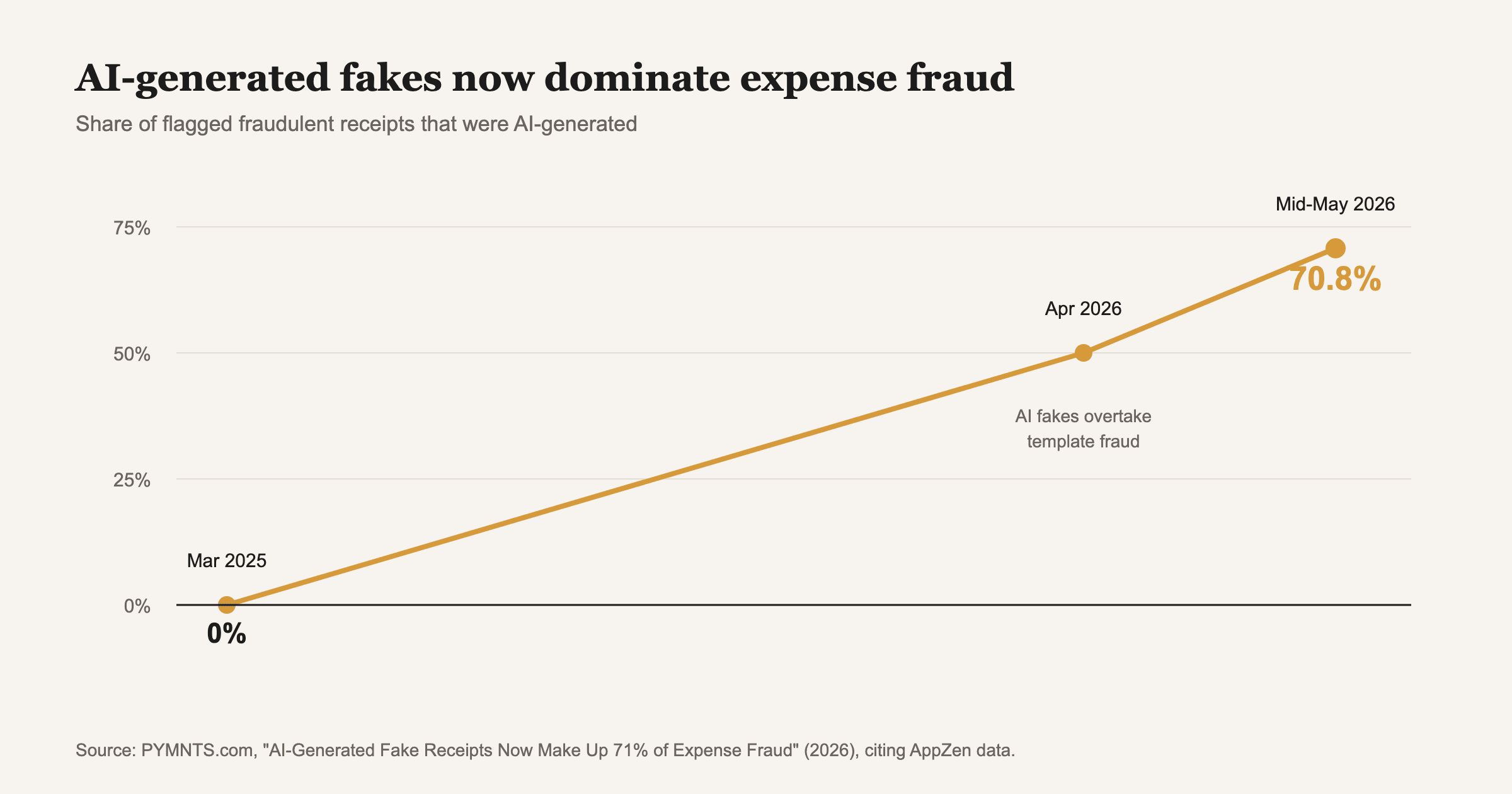
The numbers moved fast and in one direction. In March 2025, AI-generated fakes made up 0% of the fraudulent receipts finance teams flagged for review; by mid-May 2026, AI-generated fakes had overtaken template-based fakes and made up 70.8% of flagged fraud, based on 1,471 AI-generated fakes submitted by 745 employees across 174 companies, totaling $148,143 in claimed reimbursement.
The reason it happened this fast is structural, not just a matter of adoption. A template fraud (a real receipt edited in Photoshop) leaves a fixed, repeatable artifact, a mismatched font, a re-used background, a pattern a rules engine can be trained to flag. A generative fraud produces a brand-new image every single time, with statistically correct tax math, a plausible merchant name, and no repeated fingerprint across submissions, which is exactly the property that breaks pattern-matching and template-comparison as a detection strategy.
What does a detection pipeline actually need to look like end to end?
- Capture: the receipt image comes in through a mobile app, 79% of organizations using AI receipt scanning rely on a smartphone app as the primary capture method, rather than a scanned or emailed PDF.
- OCR extraction: pulls line items, totals, tax, merchant name, and date into structured fields. LLM-based OCR now runs 97-99% accuracy versus roughly 64% for traditional OCR, but extraction accuracy alone says nothing about whether the document itself is genuine.
- Semantic plausibility scoring: an LLM classification layer checks the extracted fields against known-good patterns, does this merchant exist, is this tax rate valid for this jurisdiction, is the itemization internally consistent, the layer that actually targets generative fraud rather than template fraud.
- Transaction-level matching: the receipt gets reconciled against the actual card-feed transaction, amount, merchant, timestamp, which catches a fabricated receipt for a real spend or a real receipt attached to a fabricated claim.
- Policy check and duplicate detection: the same expense doesn't get submitted twice, and the claim falls inside the category and spend limits the policy actually allows.
- Exception routing: anything that fails a check, or scores ambiguously, goes to a human reviewer with the specific flag attached, rather than either auto-approving or auto-rejecting a borderline case.
Why isn't better OCR the fix, and what is the LLM classification layer actually doing differently?
OCR answers 'what does this document say.' It has no opinion on whether the document should exist at all. A perfectly extracted, perfectly formatted fake receipt sails through an OCR-only pipeline every time, because OCR was never designed to judge authenticity, only to digitize text.
The classification layer is a different job: it's pattern-matching the receipt against the distribution of real receipts it's seen, structurally implausible tax math for the stated jurisdiction, a merchant name that doesn't resolve to a real business, metadata inconsistent with the claimed location or time. That's the same distinction between extraction and judgment that shows up in building a defensible RAG pipeline for compliance documents: retrieving the right text is necessary but not sufficient, the system also has to reason about whether what it retrieved is trustworthy.
What's the actual scale of the problem finance teams are underestimating?
Detection is only half the story, awareness is the other half. AI-generated fraud is landing on desks that don't know to look for it, which is exactly the exception-routing gap a fraud-detection architecture is built to close, the same resolve-or-escalate discipline covered in automating KYC onboarding for fintech: flag what the system can't confidently clear, rather than letting it pass by default.
The financial exposure compounds fast at scale. A single dataset of 745 employees across 174 companies produced $148,143 in fabricated claims in roughly a year, and that's before accounting for the fraud that never got flagged in the first place, which is the entire reason detection architecture matters more than policy memos reminding employees not to submit fake receipts.
How AIBOOTSTRAPPER solved this pattern for Expensorr
For Expensorr, a founder needed a focused expense management product built fast, with a data model that could scale as usage grew rather than one bolted together for a demo. We built the core expense-tracking logic, the underlying data model, and a GEO-optimized site engineered to be discoverable from day one, shipping from concept to production launch in five weeks and saving users more than 12 hours a month of manual expense tracking.
The same principle that makes a fraud-detection layer trustworthy, a data model architected from day one to show why an expense passed or failed a check, not just that it did, is exactly the foundation Expensorr's core logic was built on. If your expense pipeline still treats every submitted receipt as trusted by default, book a call or see the full build in our case studies.
Want this done for you?
Book a free strategy call and we'll show you how to build and market your business with AI.