A mid-market fintech's compliance team is drowning in a queue of new-account applications. Each one takes a reviewer 20 to 40 minutes: check that the passport photo isn't doctored, search a sanctions list by hand, estimate a risk score from a gut feel and a checklist, then decide whether to escalate. Roughly a quarter of applicants give up and abandon the process entirely before that review even finishes, a friction rate documented across the banking sector. By the time the reviewer approves the account, the customer who was excited to sign up three days ago has often opened one somewhere else instead.
What does 'five days to under a minute' actually mean, mechanically?
JPMorgan Chase is targeting production by April 2026 for an agentic KYC system that compresses a process previously taking up to five days down to under a minute. That isn't one faster model answering the same question quicker, it's parallelization: identity verification, sanctions screening, adverse media search, and beneficial ownership lookups running simultaneously instead of the sequential, one-at-a-time path a single human reviewer works through.
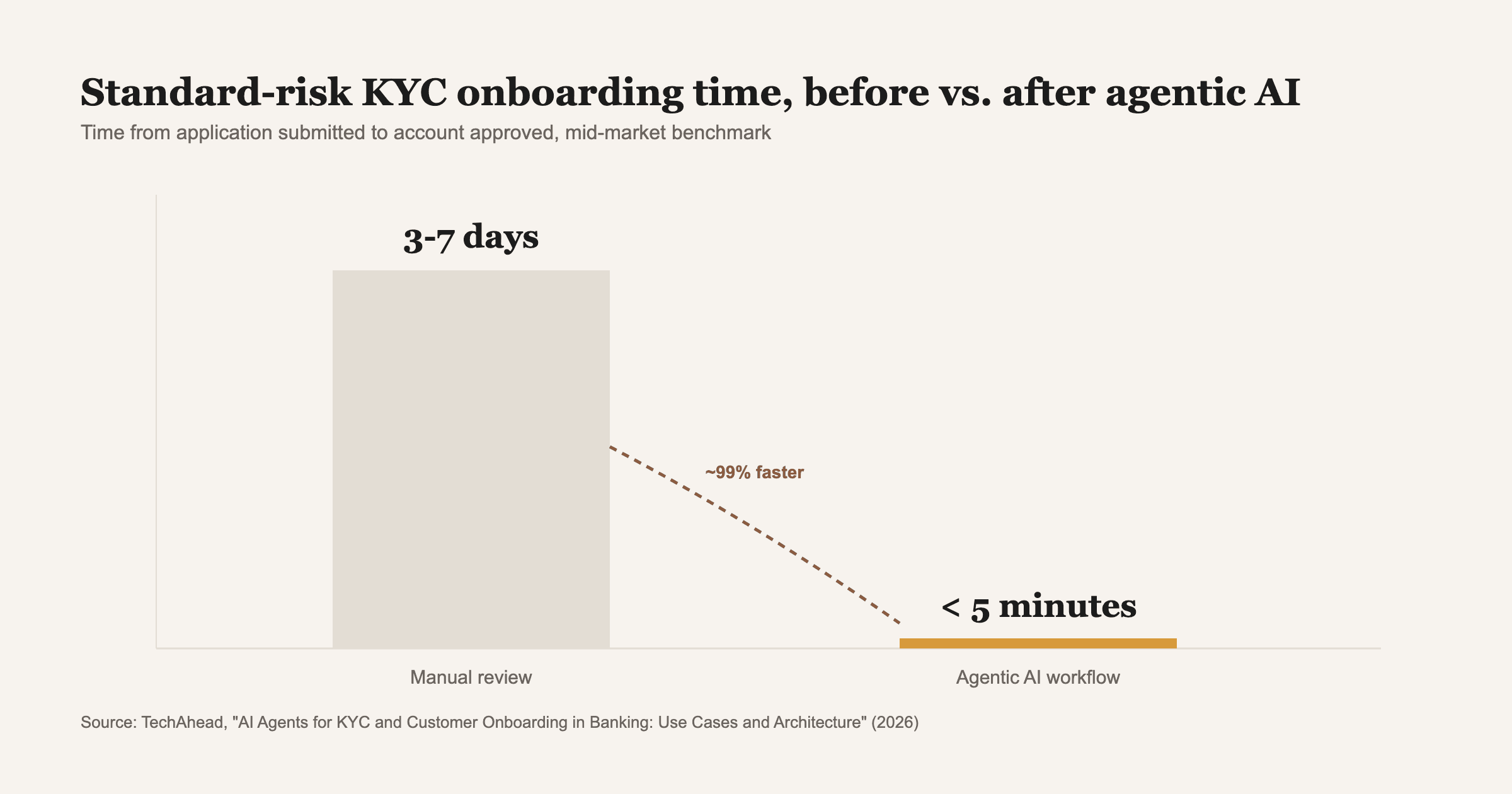
For most mid-market fintechs, the realistic benchmark isn't JPMorgan's sub-minute figure, that's the top end of a massive, custom engineering investment, it's standard-risk onboarding dropping from 3 to 7 days down to under 5 minutes, which is still roughly a 99% reduction in wall-clock time for the applicant.
What are the actual layers inside a KYC agent system, not just 'an AI checks your ID'?
A production KYC agent isn't a single model, it's five coordinated layers. A Document Verification Agent checks passport or ID authenticity and flags tampering. An Identity Cross-Referencing Agent runs sanctions-list and PEP screening in parallel rather than sequentially. A Risk Scoring Agent produces a real-time score with an auditable reasoning chain attached, not a bare number. An Exception Routing Agent escalates ambiguous cases to a human reviewer with a pre-assembled evidence file instead of a bare 'please review' ticket. An Orchestration Layer coordinates all four and maintains the regulatory audit trail across the whole run.
That routing layer is the same structural pattern we've covered for risk-tiered approval workflows generally: resolve what the system is confident about, escalate what it isn't, with the evidence attached either way.
Why does the 'auditable reasoning chain' matter more than the raw speed?
A regulator doesn't accept 'the model said so' as justification for a risk decision. A defensible risk score has to show which data points it weighted and which rule or precedent it matched, the same principle that makes a compliance drafting or retrieval system defensible rather than a black box nobody can explain in an audit.
There's a data-privacy layer underneath all of this too: identity documents are personal data, and processing them through an agent needs the same lawful-basis and audit-trail discipline regardless of jurisdiction, whether that's GDPR in the EU, UK data protection law, India's DPDP Act, or UAE PDPL. The architecture doesn't change by geography; only the specific compliance citations do.
What's the real cost case for this, beyond speed?
Manual KYC review runs $1,500 to $3,500 per customer, and large institutional banks spend up to $35 million annually just to onboard 10,000 new clients, with the financial sector's combined KYC and AML operations averaging $72.9 million a year. Parallelized, agent-coordinated workflows are reported cutting processing time by up to 90% and reducing screening false positives by up to 60%, which matters just as much as speed, since every false positive is a legitimate customer sent into an unnecessary manual review queue.
How AIBOOTSTRAPPER solved a version of this for AI Doctor
For AI Doctor, a Dubai-based digital health startup, patients waited hours for basic triage because doctor availability couldn't scale with demand. We built a clinically guarded AI assistant with a bilingual, Arabic-and-English handoff workflow that escalates uncertain cases to a human doctor with a complete, pre-filled summary, the exact same exception-routing pattern a KYC agent uses to hand an ambiguous application to a human reviewer with the evidence already assembled.
That build cut consultation prep time by 68% and gave the clinic 24/7 triage availability. Whether the domain is patient triage or account risk scoring, the exception-routing layer is what makes automation trustworthy enough for a doctor, or a regulator, to actually rely on it. If your onboarding funnel is losing customers to review friction, book a call or see the full build in our case studies.
Want this done for you?
Book a free strategy call and we'll show you how to build and market your business with AI.