A Melbourne operations manager signs off on an AI chatbot for customer FAQs in early 2025, checks the box marked 'we use AI now,' and moves on. Eighteen months later the chatbot still only answers the same handful of FAQs it launched with, nobody's touched the workflows around it, and when a board member asks what return the business is seeing from its AI investment, there isn't a clean answer. That business isn't unusual. It's the median case: Deloitte's own research found two-thirds of Australian SMBs are now using AI in some form, but only 5% have advanced past the basic stage to where the real financial return actually shows up.
How many Australian businesses are actually using AI in 2026, and what does it cost them not to progress?
The Australian Bureau of Statistics found 12% of employing businesses reported using AI in their workplace in 2024–25, up sharply from a much smaller base in 2021–22, with large businesses at 35% adoption and financial and insurance services growing 24 times over the same period, from 1% to 24%. Adoption is clearly accelerating. What's not accelerating at the same rate is depth: Deloitte Access Economics surveyed more than 1,000 Australian SMBs and found that while two-thirds are using AI, only 5% are fully enabled to realise its potential.
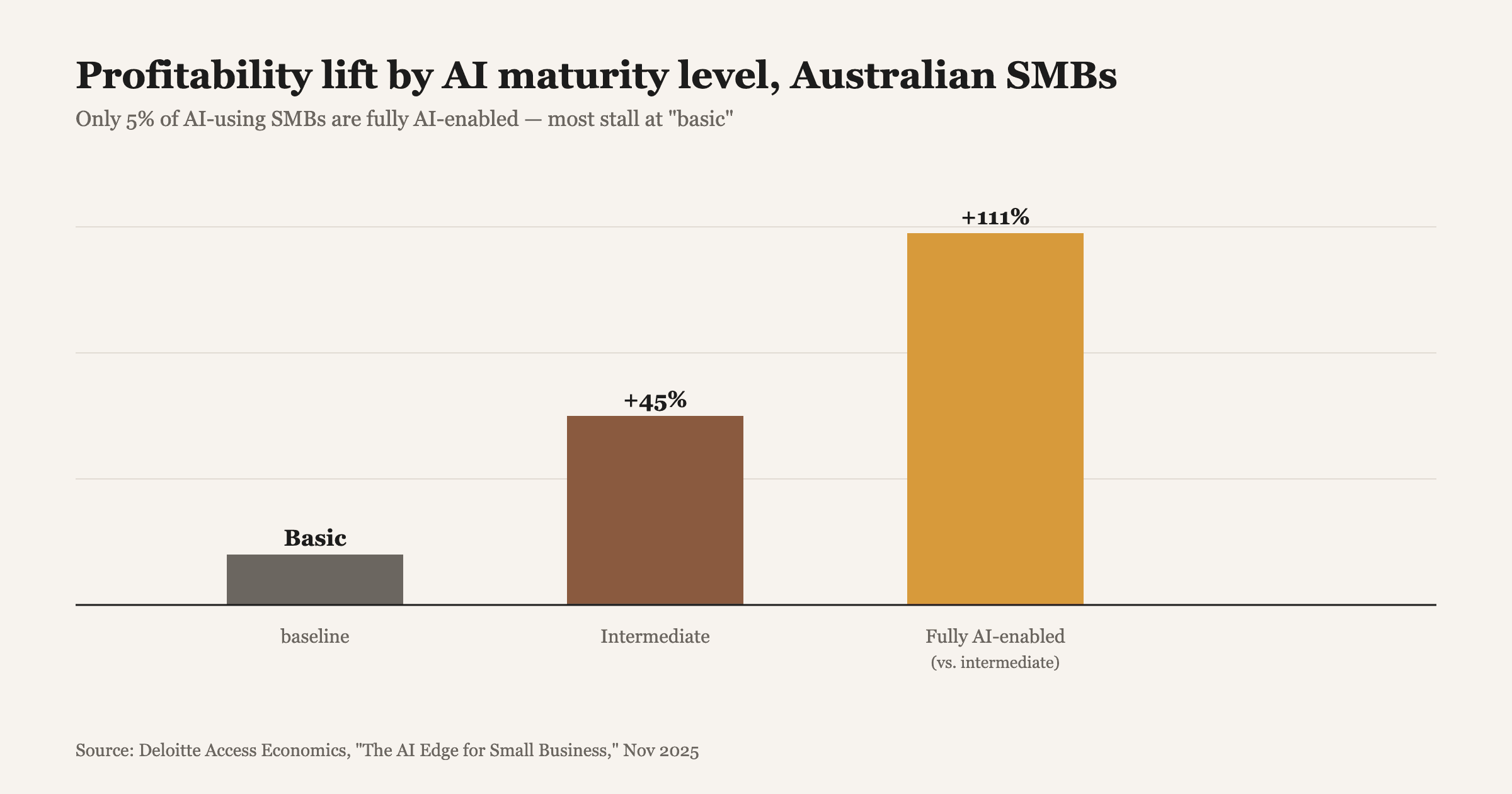
That 5% gap is the actual cost story, not the sticker price of a build. Deloitte's AI Maturity Index found businesses moving from basic to intermediate AI use saw a 45% increase in profitability, and moving from intermediate to fully AI-enabled saw a further 111% increase on top of that. Staying at 'basic' isn't a neutral, low-risk choice, it's the single most expensive place on the curve to sit, because it's where all of the setup cost has already been paid and almost none of the compounding return has started.
Where the profitability actually shows up as maturity increases
This is why scoping an AI automation project around 'launch one chatbot' rather than 'build a workflow that gets progressively more autonomous' leaves most of the value on the table. Deloitte estimates that if just one in ten SMBs currently sitting at basic or intermediate use advanced one level, it would add $44 billion to Australia's GDP annually, which is the economy-wide version of the same gap showing up inside a single business's P&L.
The practical read for a founder budgeting a build in 2026: price the roadmap past the first workflow, not just the first workflow. A single automation that never gets extended, monitored, or handed more of the process it touches is a business that's paid the setup cost and stopped one step before the return curve bends upward.
What actually changes the cost math for an Australian business in 2026
- A proposed federal measure would give a 50% tax deduction on eligible AI investment for businesses with turnover under A$50 million, part of an A$1 billion push Deloitte estimates could unlock roughly A$2 billion in additional SMB investment in the short term, a direct lever on the effective cost of a build, not just a demand-side nudge.
- The proof-of-concept-to-production cost gap still applies in Australia the same way it does everywhere else: a pilot proves the happy path, a production system has to survive malformed inputs, downstream API failures, and unattended operation, which is engineering work a demo never has to do, covered in more depth in our UK automation cost breakdown.
- Workforce readiness is a real, underpriced cost line: Deloitte found over half of SMB workforces have only basic or novice AI familiarity, and only 10% have advanced skills, so a build that ships without any handover training tends to stall at 'basic' regardless of how well it was engineered.
- Picking the highest-volume, most rule-clear workflow first compounds faster than picking the most impressive one; our ROI prioritization framework for a first AI automation project is the same discipline that separates the 5% who reach full enablement from the 95% who stall at basic.
How AIBOOTSTRAPPER solved this for AudioBolo
A founder came to us needing a working AI product shipped fast, without a large in-house engineering team and without compromising on production quality, the same resourcing constraint most Australian SMBs are working inside. We designed and built AudioBolo end to end, architecture, AI integration, frontend and backend, plus a GEO-optimized site engineered to be discoverable from day one, delivering a production launch in 6 weeks with average processing time cut from 3.2 seconds to 0.9 seconds and 99.5% uptime since launch.
That's the international-grade delivery model behind AIBOOTSTRAPPER's own positioning: production-quality AI builds priced on India-based economics, which is exactly the kind of leverage that lets a business skip the multi-year crawl from basic to fully enabled. If you're budgeting an AI automation build in Australia and want the roadmap priced past the first workflow, book a call or see the full build in our case studies.
Want this done for you?
Book a free strategy call and we'll show you how to build and market your business with AI.