A London operations director sends the same brief, an automation that routes and scores inbound leads into the CRM, to three agencies and asks for a quote. One comes back at £3,000. Another comes back at £15,000. The third comes back at £45,000 and a six-week timeline. All three read the same one-paragraph brief. None of them is lying, and none of them is padding the number to see what sticks. They're quoting three different architectures that all happen to satisfy the same one-sentence description, and the brief never specified which one it meant.
Why do two 'AI automation' quotes for the same problem differ by 10x?
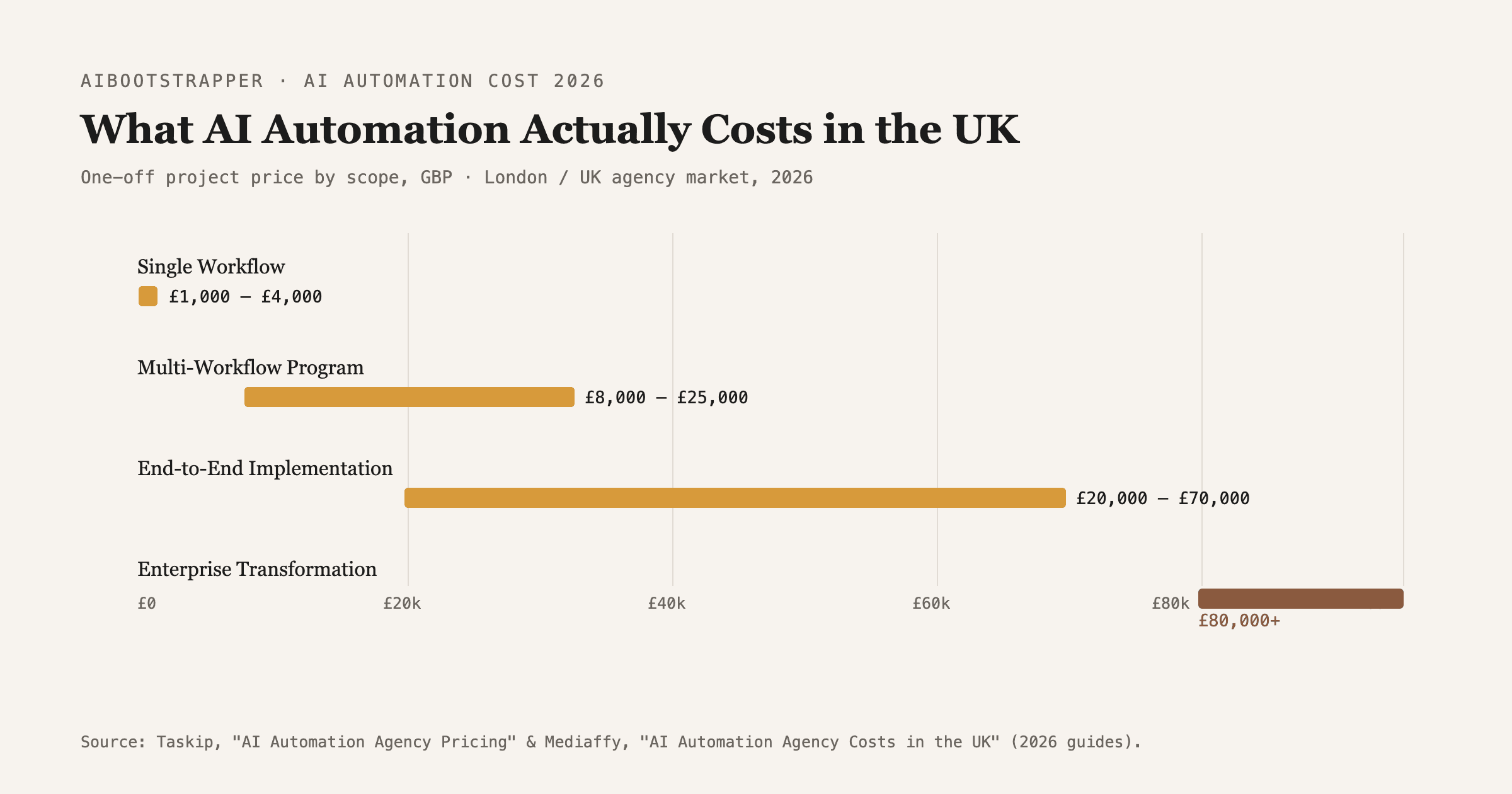
Because "automate lead routing" describes an outcome, not an architecture, and the UK market has settled into distinct pricing tiers for genuinely different builds hiding under that same outcome. A focused single-workflow engagement, one trigger, one CRM integration, a scoring rule, typically lands between £1,000 and £4,000. A multi-workflow program spanning three to five connected processes runs £8,000 to £25,000. A full end-to-end implementation, discovery through a 90-day operate phase, lands between £20,000 and £70,000, and an enterprise transformation with a dedicated automation team for six months or more starts at £80,000+.
The £3,000 quote and the £45,000 quote can both be honest answers to "automate lead routing" if one agency scoped a single webhook-to-CRM workflow and the other scoped a multi-system program with approval branching, deduplication logic and a monitoring dashboard. The number isn't the tell; the architecture behind it is.
What actually drives the cost at the architecture level, not the sales page?
Three engineering variables move the price far more than the tool being used. The first is integration count: every third-party system a workflow touches adds authentication handling (OAuth token refresh, credential rotation), rate-limit backoff logic, and idempotency, making sure a retried execution doesn't double-email a lead or double-write a CRM record, plus schema mapping between two systems that model the same data differently. A workflow touching two systems is a different engineering problem than one touching six, even if both get called "an automation."
The second is state management. A single trigger-to-action workflow, a webhook fires, one API call runs, done, executes synchronously and cheaply. A multi-step, stateful workflow that waits on a human approval, branches, then waits again for a webhook callback hours later needs persistent execution state and concurrent worker handling to avoid one long-running execution blocking every other job in the queue, the exact scaling problem that pushes a team toward queue-mode workers once volume grows. The third is error handling and observability: dead-letter queues for failed runs, alerting on silent failures, and audit logging are invisible in a demo and expensive in engineering time, but skipping them is exactly how a workflow fails at 2 a.m. with no record of what changed, and any competent quote at the higher end of these tiers is pricing that work in, even if the sales page never mentions it.
What does ongoing support cost after the workflow ships?
Most UK automation agencies price a build and a monitoring retainer as two separate line items, and skipping the second one is a common way a cheap quote stays cheap. Monthly retainers for ongoing automation management in the London market typically run £500 to £2,500, scaled to how often workflows change and how much monitoring responsibility the agency carries versus the client's own team.
A one-off build with no retainer is fine for a stable, low-change workflow. It's the wrong choice for anything touching a system that changes often, a CRM field gets renamed, an API version deprecates, because nobody is watching for the silent break until a lead stops routing and someone notices three weeks later.
How do you avoid overpaying for scope you don't actually need?
Scope to the bottleneck, not to the ambition. The same discipline that applies to AI automation ROI generally applies here: a narrow automation targeting a real, high-volume bottleneck pays back fast at the low end of these tiers, while a broad "automate everything" program with no single expensive problem driving it routinely lands in the £70k+ range without a correspondingly larger return, because the value gets spread thin across many small changes instead of concentrated on one costly one.
Geography changes the number more than most buyers expect, too. The same class of build that runs £8,000 to £25,000 in the London market prices meaningfully lower out of an India-based team without cutting engineering quality, since the cost difference is delivery overhead, office and account-management layers, not the underlying architecture. That's worth pricing out explicitly before defaulting to the nearest local agency for a multi-workflow program.
How AIBOOTSTRAPPER helps
We built Leon & Vera, the AI marketing and booking agents running for local service studios across Europe, as two tightly scoped agents rather than one sprawling platform: Leon produces weekly ad creative, Vera handles 24/7 enquiry response and booking, and the owner controls ad spend from as little as €10 a day with zero manual posting or production required. That's the same principle that keeps a UK automation quote in the £8k–£25k tier instead of drifting into six figures, scope the architecture to the actual bottleneck, price the integrations honestly, and build the monitoring in rather than bolting it on later.
If you've got two wildly different quotes for what sounds like the same automation and can't tell which architecture you're actually buying, talk to us about scoping it properly, or see how we approach these builds at our AI automation services.
Want this done for you?
Book a free strategy call and we'll show you how to build and market your business with AI.