A founder in Indore ranks #1 on Google for the exact phrase describing what they sell. They check it every week, proud of the position. Then a friend asks ChatGPT the same question, phrased a little more naturally, 'who's the best option for this in Indore', and a competitor two spots below them on Google gets named and linked, while their own site doesn't appear at all. Nothing about their SEO is broken. The problem is that ChatGPT search isn't reading Google's index, it's reading Bing's, and a site can rank perfectly on Google while being functionally invisible to Bing, which makes it invisible to ChatGPT no matter how good the content is.
Why does ChatGPT cite Bing results instead of Google's?
OpenAI built ChatGPT's live search on top of Microsoft's search infrastructure. Microsoft and OpenAI made Bing the default search backend for ChatGPT official at Microsoft Build 2023, and that dependency hasn't changed since, it's the same underlying index Copilot draws from too. Practically, this means Google Search Console rankings tell you nothing about whether ChatGPT can find your page. The two indexes are built by different crawlers, Googlebot versus Bingbot, updated on different schedules, and weighted by different signals. A page can sit in Google's index for years and never once be crawled by Bingbot if nothing has ever pointed Bing toward it.
This is the single most common reason a well-ranked local business turns up invisible in AI answers: not weak content, not poor SEO, but a search engine dependency most teams have never checked because they've spent a decade optimizing for the other one.
How do I check if Bing has actually indexed my site?
Search `site:yourdomain.com` directly in Bing, not Google, and count the results. Zero or near-zero results means Bing hasn't discovered or trusts the site at all, and no amount of Google ranking fixes that. The reliable way to check and fix it is Bing Webmaster Tools, Microsoft's own console: verify the domain, submit an XML sitemap, and check the Index Explorer report, which shows exactly which URLs Bing has crawled versus which it knows about but hasn't indexed.
A domain that's brand new to Bing, or one that migrated URLs, changed platforms, or simply never submitted a sitemap, can sit unindexed indefinitely. Bing doesn't discover pages by accident the way Google sometimes does through backlinks alone, it needs to be told directly.
What is IndexNow, and why does it matter more for AI search than for traditional SEO?
IndexNow is a free, open protocol, co-created and run by Microsoft, that lets a site push a direct 'this URL changed' ping to Bing the moment content is published or updated, instead of waiting for Bingbot's own recrawl schedule. For traditional SEO this shaved days off discovery time. For AI search it matters more, because a live citation engine like ChatGPT search is only as current as the index behind it, a page that updates and never pings IndexNow can sit stale in Bing's index for weeks, showing outdated information, or nothing, in an AI answer even after the live page has already been fixed.
Implementation is a handful of steps: generate an API key, host a verification key file at the domain root, and send a request with the URL list to the IndexNow endpoint whenever a page publishes or changes. Most CMS platforms, including a small API route in Next.js, can automate this ping on every deploy rather than relying on someone to remember.
Does content quality still matter once Bing has actually indexed the page?
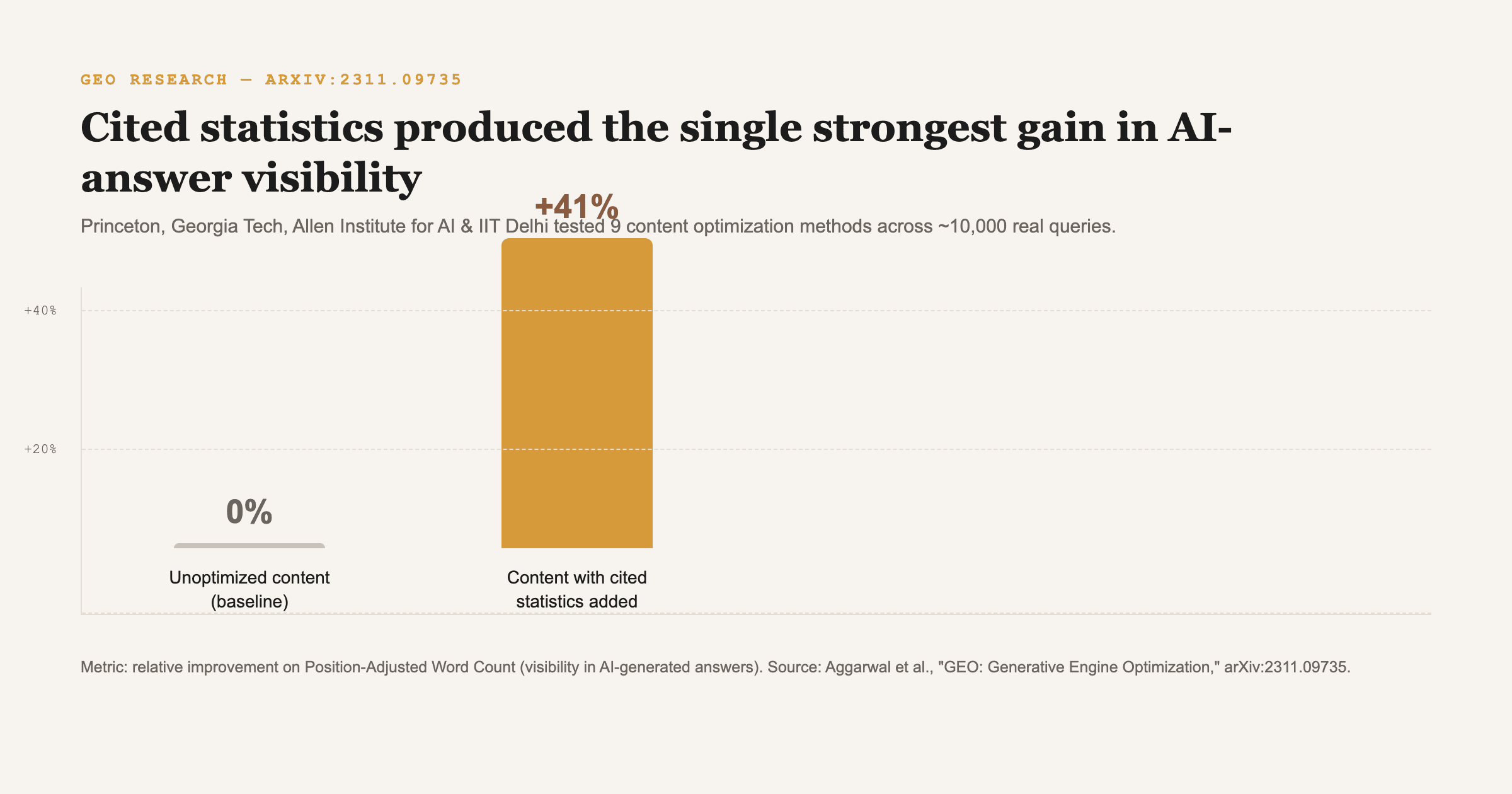
Yes, indexation earns a page a place in consideration, it doesn't win the citation on its own. A controlled study from Princeton, Georgia Tech, the Allen Institute for AI and IIT Delhi, published as the GEO: Generative Engine Optimization paper, tested nine content optimization strategies across roughly 10,000 real queries. Adding cited statistics to a page produced the single strongest gain, a 41% relative improvement on their visibility metric versus unoptimized content, with the top three methods, statistics, citations and quotations, clustering around a 30 to 40% improvement.
The mechanism lines up with how these systems actually retrieve answers: an LLM composing a cited response is pattern-matching for passages that look extractable and verifiable, specific numbers, named sources, direct quotes, not just topically relevant paragraphs. A page that's indexed but written in vague marketing language loses to a competitor's indexed page with three cited statistics in its first two paragraphs, consistently.
How AIBOOTSTRAPPER solved this for PropLock
When AIBOOTSTRAPPER built PropLock, a UK real estate platform, from the ground up, the site was engineered from day one to be discoverable by both traditional search and AI answer engines: proper indexation signals, structured listing data, and content written to actually answer the questions buyers were asking, not just rank on keyword density. The result was 12,000 organic visitors a month within 90 days of launch and 47% more qualified viewings, growth that came from being findable everywhere buyers were actually searching, not only on Google.
That's the same principle behind fixing a site that's invisible to AI search: indexation and content structure aren't a one-time SEO checklist item, they're infrastructure a GEO-first build gets right from the start instead of retrofitting later.
How AIBOOTSTRAPPER helps
AIBOOTSTRAPPER's GEO and AEO team audits exactly this gap for clients: whether Bing has actually indexed and trusts a domain, whether IndexNow is wired into the publishing workflow, and whether existing content has the citable, statistic-backed structure that AI answer engines actually pull from, before touching a single word of new copy.
If your site ranks well on Google but you've never checked whether ChatGPT, Copilot or Perplexity can actually find and cite it, book a call and we'll run the Bing index check live.
Want this done for you?
Book a free strategy call and we'll show you how to build and market your business with AI.