A founder sits down to approve an AI automation budget and asks the only question that actually matters: will this pay for itself, and how fast. It is a fair question, and one most vendors answer with vague confidence instead of numbers. This is a benchmarked answer, using 2026 industry data on realistic ROI ranges and payback periods, plus what AIBOOTSTRAPPER's own client builds actually returned, so you can hold any automation proposal, including ours, to a real standard before signing off on it.
What ROI should you realistically expect from AI automation?
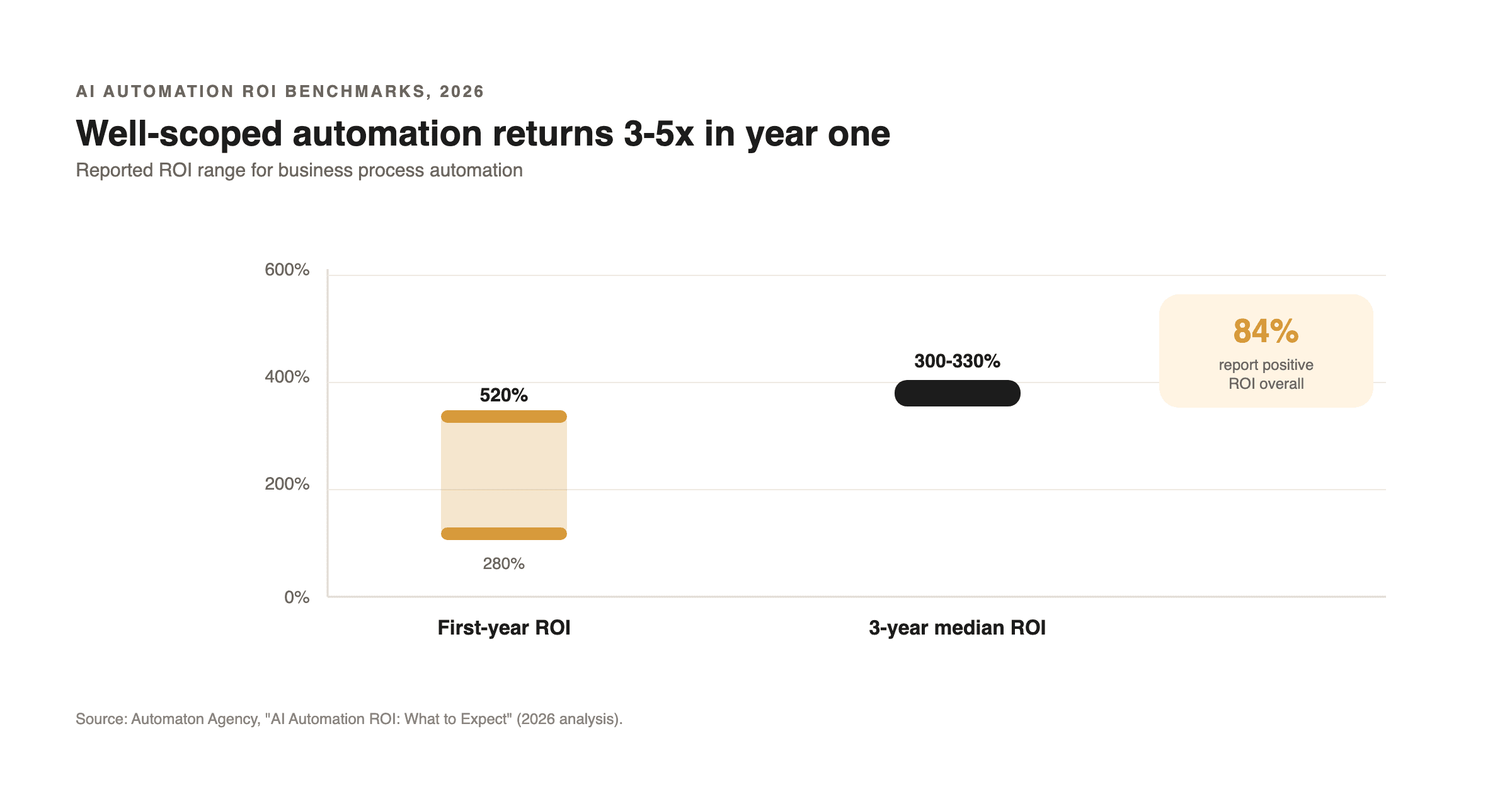
For well-scoped automation, expect somewhere in the range of a 280% to 520% first-year return, and a median 300% to 330% return over three years, according to Automaton Agency's 2026 analysis of AI automation ROI, which also found 84% of companies reporting a positive ROI on AI investments overall. That is a wide range on purpose, the return depends entirely on whether the automation targets a real, high-volume bottleneck or a low-frequency task that was never expensive to begin with.
The number that matters more than the multiple is the bottleneck it is attached to. A 300% ROI on automating a task that took 20 minutes a week is still a small number in absolute terms; a 150% ROI on a task consuming 15 hours a week is a much bigger deal in practice. Scope the automation to the bottleneck first, and let the ROI multiple follow.
How fast does AI automation actually pay for itself?
For focused automation, businesses saving 15+ hours a week typically see a positive return within 30 to 60 days, per the same 2026 ROI analysis. A single well-built n8n workflow (a lead follow-up sequence, an invoice-processing flow) is usually a weekend-scale implementation with low tool costs, which is why the payback window is measured in weeks, not quarters.
This is also why scoping matters more than the sophistication of the tooling: a narrow, correctly targeted automation pays back inside two months, while an ambitious, broad 'automate everything' rollout with no clear bottleneck in mind routinely takes far longer to show a return, because the value is spread thin across many small, low-impact changes instead of concentrated on one expensive problem.
What does AI automation actually cost, and what's a reasonable budget?
Digital Applied's 2026 small business AI adoption research puts typical AI tool spend for small businesses at around $50 to $2,500 a month depending on scope and complexity, with average spend near $120 a month generating roughly $4,100 a month in measured benefit, a return of about 34 to 1 on the tool cost alone, before counting the time saved on the human side.
That figure is for tooling cost specifically, not implementation. A single custom workflow (like the invoice-processing pipeline or lead follow-up automation covered elsewhere on this blog) is typically a fixed-scope build, while an ongoing AI consultancy engagement is priced against the size of the roadmap, not a flat monthly number, which is why the right first step is usually a scoped audit, not a blanket subscription.
Which processes actually show the highest ROI?
- Email and lead follow-up, since delayed response is one of the most direct, measurable causes of lost pipeline.
- Lead qualification and routing, because it removes a manual triage step that otherwise sits between a form fill and a sales conversation.
- Appointment booking and scheduling, a high-frequency, low-judgment task that is straightforward to automate end to end.
- Invoice and expense processing, where the cost per manual transaction is well documented and automation directly replaces typing, not judgment.
- Customer support triage, where a first-response layer can resolve or correctly route the majority of incoming volume without a human touching it first.
- These five consistently appear among the highest-ROI automation categories for small and mid-size businesses in 2026 industry benchmarking, precisely because each one is high-frequency, low-ambiguity, and currently done by a person typing or clicking rather than deciding.
How AIBOOTSTRAPPER's own builds measure up: AudioBolo and Expensorr
Numbers are easy to cite from a report, harder to point to in a shipped product. AudioBolo, an AI-powered audio platform AIBOOTSTRAPPER designed and built end to end, went from concept to a production launch in 6 weeks, cut average audio processing time from 3.2 seconds to 0.9 seconds, and has held 99.5% uptime since launch, a payback timeline that lands squarely inside the 30-to-60-day range the industry data above describes, once you count the weeks to build against the weeks to first users.
Expensorr, an AI-powered expense management product AIBOOTSTRAPPER also built end to end, shipped in 5 weeks and now saves each user more than 12 hours a month in manual expense tracking, which is the same 'high-frequency, low-judgment task' pattern the ROI benchmarks above identify as the highest-return category to automate first. Full numbers for both are on the case studies page.
How AIBOOTSTRAPPER helps
The honest answer to 'what ROI will I get' is always 'it depends on what you automate first', which is exactly why AIBOOTSTRAPPER's AI consultancy process starts with a scoped audit of your actual bottlenecks and their real time cost, ranked by expected return, before recommending a single workflow.
If you want that audit instead of a generic proposal, book a call and we will map your highest-ROI automation opportunity first, the same way it was scoped for AudioBolo and Expensorr before either was built.
Want this done for you?
Book a free strategy call and we'll show you how to build and market your business with AI.