A health-tech team in Sydney ships a patient-facing assistant. Security review asks for prompt-injection protection, clinical review asks for harmful-content screening, and legal asks for PII checks on outputs. The engineers do the obvious thing: run every message through a large safety model before the LLM, and every answer through it again afterwards. Each check is individually reasonable. Together they push the assistant's response time past the point where users notice, and the product team starts quietly asking which guardrails they can turn off. That's the wrong trade. The problem isn't that guardrails are slow, it's that they've been wired as a serial chain of equally expensive checks instead of a cascade.
Where do guardrails sit in an LLM request, and why do they add latency?
Every guardrail that must finish before the user sees something adds its full runtime to the critical path. Input guardrails sit before generation, so they delay time to first token. Output guardrails sit between generation and the user, so they delay the moment a response is released. Both stack on top of the model latency we unpacked in why your AI agent feels slow.
NVIDIA's NeMo Guardrails makes the full surface explicit with five rail types: input rails, retrieval rails over fetched context, dialog rails over conversation flow, execution rails around tool calls, and output rails on the final response. Naively, each is another blocking call. Architecturally, they don't have to be.
Why does one big safety model on every request fail?
Because you're paying heavyweight latency to catch problems that a much cheaper check could have caught or ruled out. An LLM-based hazard classifier like Meta's Llama Guard 3 is an 8-billion-parameter model that generates a safe/unsafe verdict across 14 MLCommons hazard categories. It's accurate, scoring 0.939 F1 on Meta's English benchmark with a 4.0% false-positive rate versus GPT-4's 0.805 F1 and 15.2% false-positive rate as a moderator, but it's a generative LLM call, with the cost profile of one.
Running it on every message treats "what's your refund policy?" with the same scrutiny as an obvious jailbreak attempt. The overwhelming majority of real traffic is benign, so most of that compute is spent confirming what a cheaper layer could have established.
How does a guardrail cascade work?
Order checks from cheapest to most expensive and let each layer either decide or escalate. A production cascade usually has three tiers:
- **Tier 0: deterministic checks (sub-millisecond).** Regex for secrets and card numbers, blocklists, input length limits, and JSON schema validation on structured outputs. These catch the literal, mechanical failures for effectively zero latency cost.
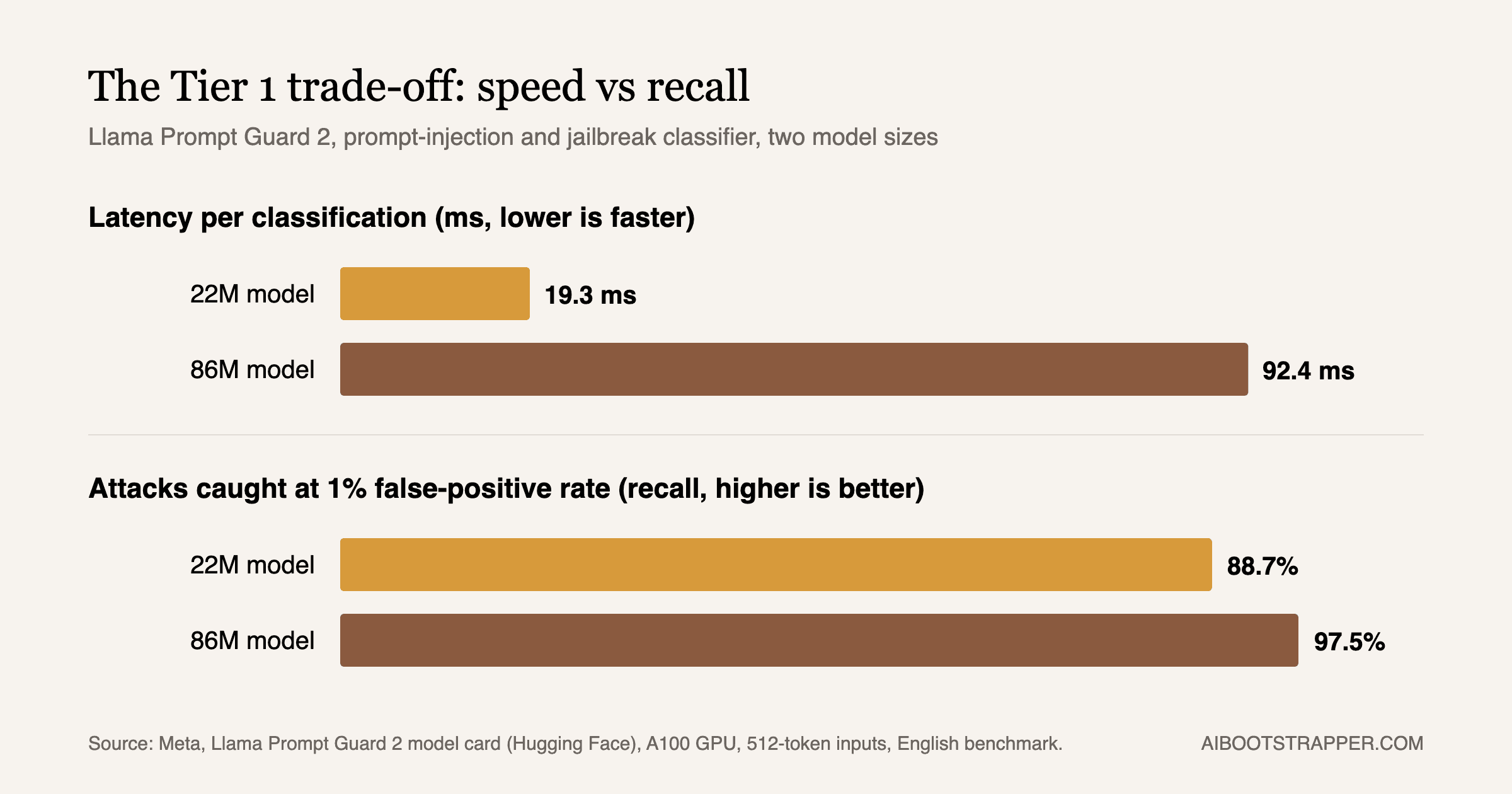
- **Tier 1: small specialized classifiers (tens of milliseconds).** A purpose-built encoder model scores one narrow risk. Llama Prompt Guard 2 is the canonical example: a prompt-injection and jailbreak classifier with a 512-token window, available in a 22M-parameter version (19.3 ms per classification on an A100) and an 86M version (92.4 ms).
- **Tier 2: the heavyweight judge (only when escalated).** Llama Guard 3 or an equivalent LLM-based policy classifier runs only on traffic that Tier 1 flags as uncertain, on high-risk routes (medical, financial, tool calls that move money), or on a random sample for monitoring.
Which small classifier should sit in Tier 1?
It's a recall-versus-latency choice, and Meta's own numbers make the trade-off concrete. On Meta's English benchmark, the 86M Prompt Guard 2 catches 97.5% of attacks at a 1% false-positive rate; the 22M version catches 88.7%, but runs roughly 4.8x faster. The 86M model is multilingual across eight languages including Hindi, and for either size, inputs longer than 512 tokens are split into segments and scanned in parallel.
Our default: the 22M model as the always-on gate for chat traffic where latency is visible, the 86M model on content that will be fed into tool-using agents, and on retrieved documents, where injection is the attack path we described in prompt injection and AI agent security. Retrieved content isn't latency-sensitive in the same way, because it can be scanned at ingestion time instead of query time.
How do you hide guardrail latency instead of removing it?
Run checks concurrently with generation and cancel on failure. The OpenAI Agents SDK does this by default: input guardrails run concurrently with the agent, and if one trips, the runner raises a tripwire exception and halts execution. You can switch a guardrail to blocking mode, which completes before the agent starts and avoids spending tokens on a request that fails.
- **Parallel for read-only, low-risk turns.** The guardrail and the LLM start together; on a tripwire the stream is cancelled before release. Benign requests, the large majority of real traffic, pay close to zero added latency.
- **Blocking for anything with side effects.** If the next step is a tool call that sends an email, updates a record or moves money, the check must finish first. Execution rails belong here.
- **Streaming output checks in windows.** Instead of waiting for the full answer, evaluate output in chunks (for example per sentence) and withhold only the chunk being checked, so the user sees text flowing while the output rail runs slightly behind it.
- **Cache verdicts.** Identical system-prompt-plus-input pairs, common in FAQ-style traffic, can reuse a prior guardrail verdict for a short TTL.
How do you know the cascade is actually safe?
Measure each tier's escalation rate and miss rate on a labeled set, not just its average latency. Log every Tier 1 score, sample escalated and non-escalated traffic for human review, and track how often Tier 2 overturns Tier 1. If the heavyweight judge is disagreeing with the cheap gate often, your threshold is wrong; if it almost never runs, confirm that's because traffic is benign and not because the gate is too permissive.
Guardrails don't replace grounding. A response can pass every safety classifier and still be confidently wrong, which is the separate problem covered in why AI agents hallucinate.
How AIBOOTSTRAPPER helps
We've built guardrails into a product where both safety and responsiveness were non-negotiable. For VitalPulse in Dubai (see case studies), we engineered a remote patient monitoring platform with a clinically guarded AI assistant that triages symptoms in Arabic and English with safety guardrails, then hands off to human doctors with a pre-filled summary, delivering 24/7 triage and 68% faster consultation prep.
If your AI product's safety layer is turning into a latency problem, or your security review is blocking launch, we design the guardrail cascade with the product rather than bolting it on afterwards. See our AI product development services or book a call.
Want this done for you?
Book a free strategy call and we'll show you how to build and market your business with AI.