
A customer asks a newly deployed support agent whether a jacket can be returned after 45 days. The agent, wired up to the company's help center and order system, replies with total confidence: yes, returns are accepted within 60 days, no questions asked. There is one problem, the company's real policy is 30 days, and no document anywhere says 60. The agent did not lie on purpose and it was not fed bad data either, it generated the single most statistically plausible-sounding number for a returns policy, because nothing in its pipeline forced it to check before it spoke. That gap between sounding right and being right is what hallucination actually is, and understanding why it happens mechanically is the only way to close it.
What is actually happening when an AI agent hallucinates?
A large language model does not carry a database of facts it checks before answering, it predicts the next most probable token given everything it has seen so far, an AI hallucination is fundamentally an output that deviates from real-life facts because the model is pattern-matching, not fact-checking. Ask it a returns-policy question with no real policy document in its context, and it will still produce a fluent, confident answer, because fluency was never the thing the model was trained to avoid getting wrong.
This is why hallucination gets worse, not better, as you hand an agent more autonomy. A single-turn chatbot with a wrong fact is embarrassing. A multi-step AI agent that hallucinates a policy, an order status or an approval and then acts on it, sending an email, issuing a refund, updating a record, turns a wrong guess into a real operational mistake.
Why grounding alone does not fully solve it
Grounding means anchoring the model's answer in real, retrieved data instead of its trained-in guesses, and it is the single biggest lever for cutting hallucination, but grounding is necessary, nowhere near sufficient, to prevent hallucinations on its own, because a basic retrieval step still has no way to judge whether the document it fetched is actually the right one, or whether two retrieved sources quietly contradict each other.
That gap is exactly why grounded answers still go wrong in practice: naive retrieval fetches the closest-sounding paragraph by keyword or embedding similarity, not the objectively correct one, and hands it to the model with no verification layer in between, a failure mode covered in more depth in why RAG chatbots give wrong answers.
The guardrail stack that actually keeps an agent honest
- Retrieval with a citation contract: the agent must answer only from retrieved context and cite the source, so it cannot quietly fall back on trained-in guesses when the real document is missing.
- Confidence-based escalation: when retrieval returns weak or conflicting matches, the agent should say so and hand off, instead of smoothing the gap over with a fluent-sounding guess.
- Human-in-the-loop checkpoints on real-world actions: anything with consequences, a refund, an email, an approval, should pass a review gate before it executes, not just before the response is shown to someone.
- Continuous evaluation, not a launch-day check: agentic RAG systems add fact-checking validation and referenced summarization so responses carry inline citations an operator can independently verify, rather than trusting a single test pass to catch drift months later.
Why most companies stall before production
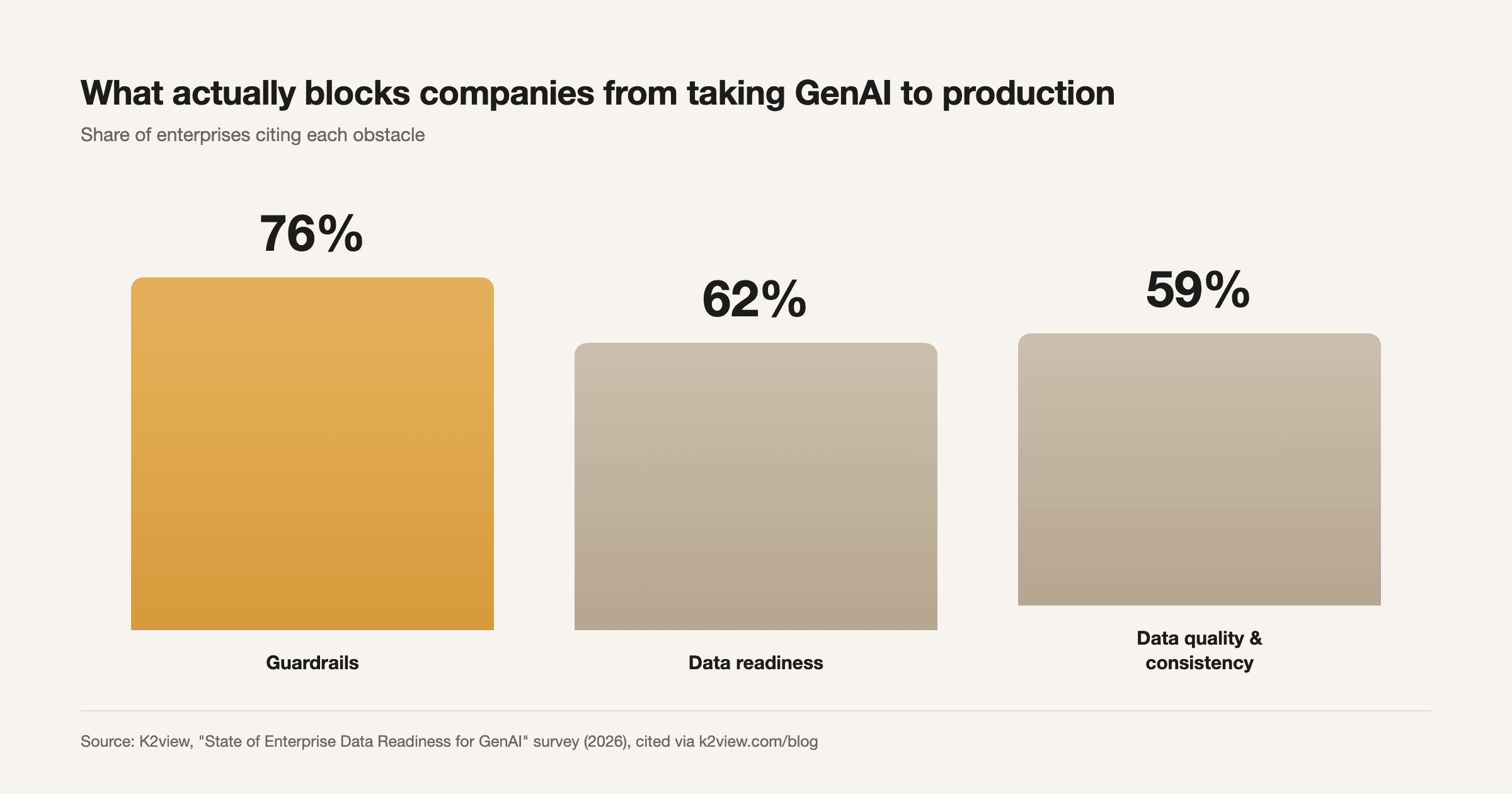
In K2view's State of Enterprise Data Readiness for GenAI survey, guardrails were the single most cited obstacle to moving generative AI into production, ahead of both data readiness and data quality and consistency, with 76% of respondents naming guardrails as a barrier, versus 62% for data readiness and 59% for data quality and consistency.
That tracks with what we see day to day: teams get a demo working fast, then stall for months trying to make it trustworthy enough to actually ship, because the guardrail work, not the model, is the harder engineering problem.
How AIBOOTSTRAPPER solved this for a client
Our ComplySpark case study is this exact problem in a legal setting, where a wrong answer is not just embarrassing, it is a compliance liability. The client's legal team was losing days per document drafting and updating policies and SOPs by hand, with inconsistent language creeping in across the organization.
We built a document copilot grounded entirely in the client's own policy library, with human-in-the-loop review baked into every draft instead of letting the model publish unchecked. The result was 10x faster document drafting, a single source of truth, and zero off-policy language slip-ups, proof that grounding plus a review gate, not raw model quality, is what makes an AI system trustworthy enough to run a real business process.
How AIBOOTSTRAPPER helps
Every AI agent we build starts with an AI readiness pass that scopes exactly what the agent is grounded in, what it is allowed to do unattended, and where a human needs to stay in the loop, before a single line of the agent's logic gets written.
If you have an AI agent that is technically working but nobody fully trusts yet, book a call and we will audit the grounding and guardrail gaps before they turn into a customer-facing mistake.
Want this done for you?
Book a free strategy call and we'll show you how to build and market your business with AI.