A founder running one product out of Indore signs a first UK client, then a Dubai one, and builds a single '/uk' folder and a single '/uae' folder to hold country-specific pricing and compliance language, reasonable instinct, wrong execution. Six months later, Google is serving UAE visitors the UK page in AI Overviews, ChatGPT quotes the wrong currency when a Hong Kong prospect asks about pricing, and the founder can't figure out why the site that ranks fine for 'AI automation agency' in India is invisible for the exact same phrase searched from Dubai. The page exists. The tag telling search engines and AI crawlers which page belongs to which market does not.
What hreflang actually does, and what it doesn't
Hreflang is an HTML attribute (or an XML sitemap entry) that tells crawlers which version of a page to serve based on a visitor's language and region, `en-ae` for English speakers in the UAE, `en-gb` for the UK, `en-hk` for Hong Kong, so a search engine doesn't have to guess which of your near-duplicate country pages is the right one for a given searcher. Without it, Google explicitly states in its own documentation that it will use its own signals, including a browser's location and language settings, to decide which page to show, and those guesses are frequently wrong when the pages are similar enough to be genuinely ambiguous.
What hreflang does not do is influence which page gets retrieved and cited by an AI assistant in the first place. Search Engine Land's 2026 international SEO analysis makes the distinction explicitly: hreflang can influence which URL is served to a human clicking a search result, but it cannot influence which URL an AI system retrieves for synthesis when it's building an answer, that retrieval step runs on content relevance and structure, not the hreflang tag. You need both: hreflang for the serving decision, and genuinely differentiated per-country content for the retrieval decision.
The hreflang setup, step by step
- Decide your country/language structure first: subdirectories (`/uae`, `/uk`, `/hk`) are the simplest to manage and keep all domain authority in one place, which is usually the right call for a growing service business rather than splitting into separate country domains.
- Add reciprocal hreflang tags to every page in the cluster: each country page must list itself and every other country/language variant, including a self-referencing tag, a one-directional link (UK page points to UAE, but UAE page doesn't point back) is one of the most common ways this breaks silently.
- Include an `x-default` tag pointing to a fallback page for visitors who don't match any of your defined regions, without it, unmatched traffic gets an inconsistent, unpredictable experience.
- Implement via HTML `<link>` tags in the page head for smaller sites, or an XML sitemap for larger ones, both are valid per Google's documentation, but pick one method per page, mixing both for the same URL is a common source of conflicting signals.
- Validate with Google Search Console's International Targeting report and a dedicated hreflang checker after every deploy, hreflang errors are invisible in a normal browser session since the page still loads fine, they only show up in crawler-facing tools.
The errors that quietly break it
| Error | What it looks like | Why it breaks |
|---|---|---|
| Missing return tags | UK page links to UAE page, UAE page doesn't link back | Search engines require reciprocal confirmation; a one-way link is treated as invalid and ignored |
| Wrong language/region code | Using `en-uae` instead of the correct `en-ae` | Codes must follow ISO 639-1 (language) + ISO 3166-1 Alpha 2 (region); malformed codes are silently dropped |
| No self-referencing tag | UK page's hreflang list doesn't include itself | Google's spec requires every page to reference itself in its own hreflang set |
| Conflicting canonical + hreflang | Canonical tag points to a different country page than hreflang declares | Canonical signals override hreflang when they conflict, collapsing your country pages into one |
| Near-duplicate, not differentiated, content | UK and UAE pages are the same copy with the country name swapped | Passes hreflang validation but fails the AI retrieval step, thin differentiation reads as duplicate content |
Common hreflang implementation errors that pass a casual review but break international visibility.
Why AI assistants need more than a correct tag
This is the part most international SEO guides stop short of. Search Engine Land's analysis draws a clean line: the dividing factor in 2026 international visibility is between true market-scoped content and translated replicas, country pages that reflect real market differences, pricing in local currency, region-specific compliance language, market-specific case studies and examples, actually get retrieved and cited by AI systems, while pages that are identical copy with the country name swapped get treated as low-value duplicates regardless of a technically perfect hreflang setup.
Practically, that means your `/uae` page shouldn't just translate your `/uk` page, it should answer what a Dubai-based founder is actually asking, price in AED, reference UAE-specific regulatory or market context where relevant, and cite locally relevant proof. This mirrors the same discipline behind GEO for a single market: AI engines reward content written to be genuinely useful to the specific reader asking, not content engineered to rank.
What this looks like when it works
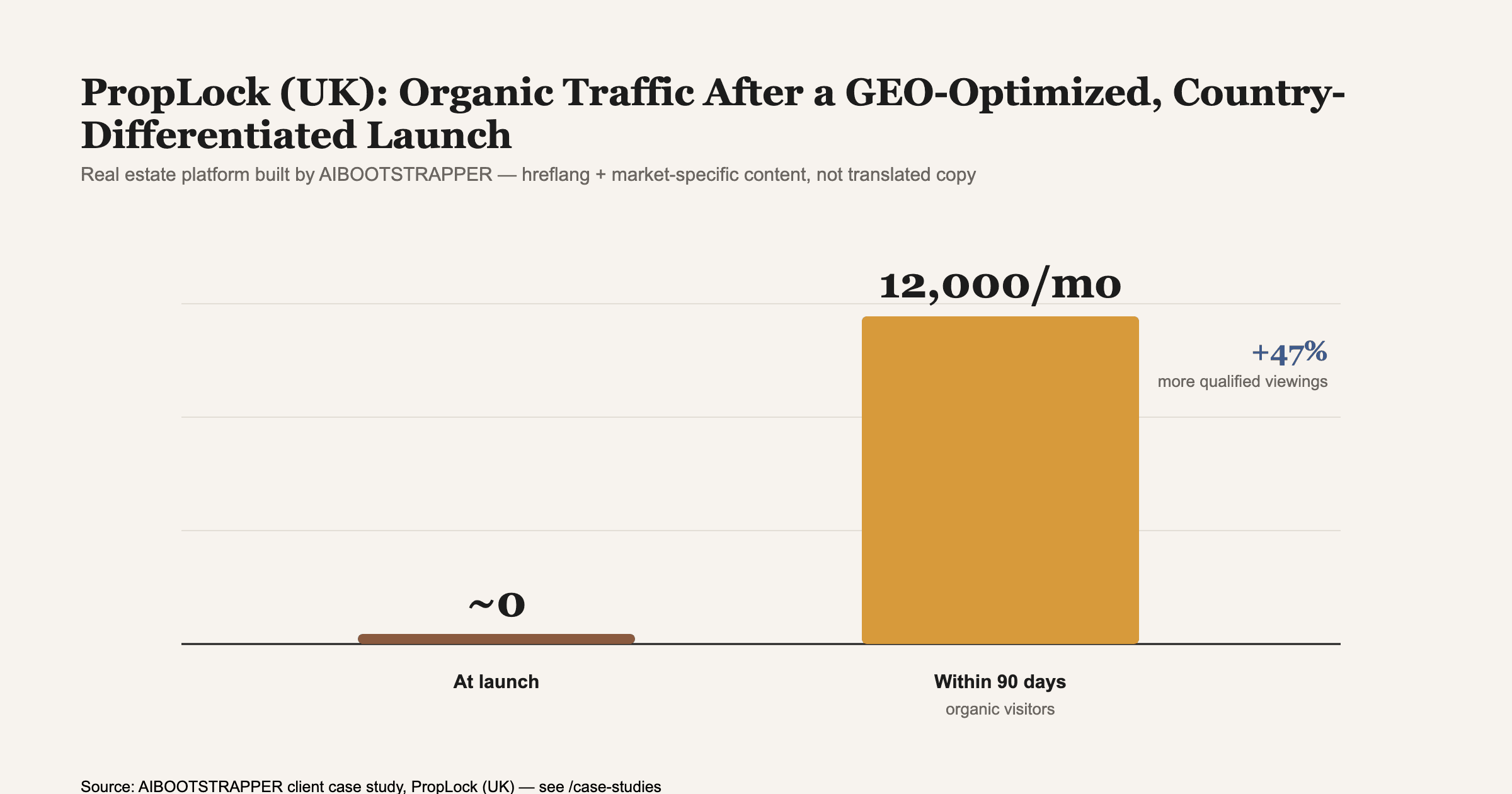
This isn't a hypothetical payoff. When AIBOOTSTRAPPER built PropLock, a UK-based real estate platform, we paired the GEO-optimized site architecture with genuinely local content, listings, pricing and buyer intent language scoped to the UK property market rather than generic real-estate copy, and the site reached 12,000 organic visitors a month within 90 days of launch, alongside a 47% increase in qualified viewings. That result depends on both halves of the equation: the technical signal (correct hreflang, clean canonical structure) and content an AI system, and a human reader, actually recognizes as market-specific.
How AIBOOTSTRAPPER helps
AIBOOTSTRAPPER builds GEO optimized websites for founders serving multiple countries at once, correct hreflang and canonical structure from the first line of code, plus the market-differentiated content strategy that actually earns AI citations in each region, not translated copy with the country swapped. If your site ranks in India but goes quiet the moment a prospect searches from Dubai, London or Hong Kong, that's usually a fixable structural gap, not a content problem you have to solve by writing more.
Book a call and we'll audit your current hreflang setup and per-country content against what AI assistants and Google are actually seeing in each market.
Want this done for you?
Book a free strategy call and we'll show you how to build and market your business with AI.