A founder wires an AI SDR tool straight to their primary company domain, uploads a scraped list of 2,000 contacts, and sets it loose sending 400 personalized emails a day starting Monday morning. By Wednesday, replies have gone quiet, and by Friday even the company's regular customer emails are landing in spam. Nothing about the AI's writing was the problem, the domain never had a chance, because deliverability isn't decided by how good the copy is, it's decided by a set of authentication checks and a trust score that took days to destroy and will take weeks to rebuild.
Why do AI-sent cold emails get flagged more often than human-written ones?
It's rarely that a spam filter detects 'AI-generated text' as a category, it's that AI SDR tools make it trivially easy to send at a volume and speed that breaks the trust signals mailbox providers actually check. A human SDR sending 40 emails a day from an established inbox looks like normal business correspondence; an AI agent capable of writing and sending 400 personalized emails in an hour, from a domain with no sending history, looks exactly like the pattern spam filters are built to catch, regardless of how well-written each individual message is.
Instantly.ai's 2026 cold email benchmark analysis found AI-generated emails carry a meaningfully higher spam-flag rate than human-written ones, not because the writing quality is lower, but because the volume, consistency, and sending patterns an AI SDR enables are exactly what reputation scoring is designed to catch when a domain hasn't earned trust first.
What do SPF, DKIM and DMARC actually check, mechanically?
SPF (Sender Policy Framework) is a DNS TXT record published on your domain that lists exactly which mail servers and IP addresses are authorized to send email on your behalf. When a receiving server gets a message, it checks the sending IP against that published list, if your AI SDR platform's sending servers aren't on it, the message fails SPF, a straightforward allow-list check.
DKIM (DomainKeys Identified Mail) attaches a cryptographic signature to each outgoing message's headers, generated with a private key your sending platform holds. The receiving server looks up the matching public key in your domain's DNS and verifies the signature, confirming the message genuinely came from an authorized sender and wasn't altered in transit. DMARC (Domain-based Message Authentication, Reporting and Conformance) sits on top of both: it's a policy record that tells receiving servers what to do when a message fails SPF or DKIM alignment, reject it, quarantine it, or let it through, and it generates aggregate reports so a domain owner can see who's sending mail as their domain and whether it's passing.
None of these three checks say anything about whether your email content is good. They only establish that the message is authentically from you. A domain with perfect SPF, DKIM and DMARC alignment can still land in spam, because authentication is necessary but not sufficient, the reputation layer decides the rest.
How does a mailbox provider actually decide inbox versus spam once authentication passes?
Past the authentication checks, inbox placement comes down to a dynamic sender-reputation score built from real recipient behavior: complaint rate, bounce rate, and engagement quality. Google's official bulk sender guidelines set a hard enforcement ceiling of 0.3% spam complaints, above that, Gmail requires seven consecutive days back under the threshold before mitigation support returns, and Google explicitly recommends staying under 0.08% for a real safety buffer. Bounce rate matters just as much: sending to a stale or scraped list drives hard bounces up immediately, and that's one of the fastest ways a brand-new domain burns its reputation before it's built any.
Engagement quality is the harder signal to game: how many recipients open the message, how many reply, and how long a message sits read versus getting deleted unopened. A domain sending to a cold, unqualified list at AI-SDR volume generates weak engagement and a rising complaint rate simultaneously, which is precisely the combination that tanks reputation fastest.
What does an AI SDR pipeline actually need architecturally to stay out of spam?
- A dedicated sending subdomain, separate from your primary company domain, so a reputation hit from cold outreach never touches the domain your invoices, support replies and customer emails depend on.
- SPF, DKIM and DMARC configured and aligned before the first send, not after volume ramps up, since a domain with no authentication history is treated with maximum suspicion by every major mailbox provider.
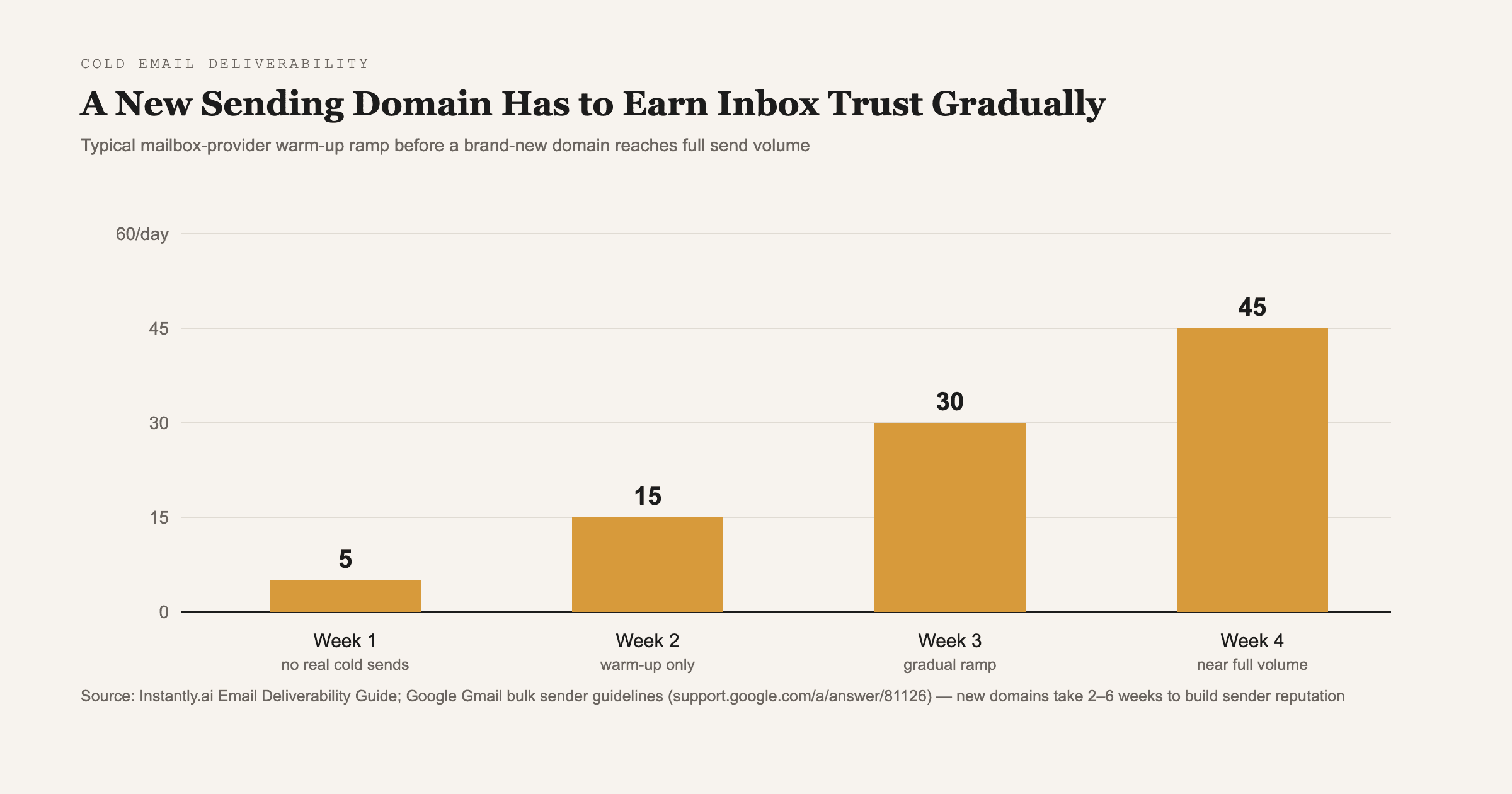
- A staged warm-up schedule, typically a low daily volume in week one building gradually toward full send volume by week four, so the domain accumulates a positive sending history before it's asked to carry real outbound load.
- Bounce-rate and reply-rate monitoring wired directly into the automation workflow, an n8n pipeline can watch for a rising bounce or complaint signal and automatically throttle volume before reputation damage compounds, the same error-handling discipline covered in our guide to n8n workflow reliability.
- Real personalization depth, not templated mail-merge with a first-name token swapped in, since low reply rates and quick deletes are themselves a negative engagement signal that compounds the deliverability problem.
How AIBOOTSTRAPPER helps
AIBOOTSTRAPPER doesn't have a published case study specifically on cold-email SDR deliverability, we're honest that this is a distinct, narrow technical problem from the lead-scoring and follow-up automation work documented in our case studies. What we do bring is the same n8n and AI-agent build discipline behind that automation work: reliable workflows, real error handling, and pipelines built to survive contact with production, covered in more depth in our guide to automating lead follow-up with n8n and GPT-4.
If you're evaluating an AI SDR tool and want the sending infrastructure built correctly the first time instead of burning a domain's reputation in week one, book a call and we'll walk through the setup.
Want this done for you?
Book a free strategy call and we'll show you how to build and market your business with AI.