
A founder generates 50 AI ad variants in an afternoon, thirty scripts and twenty hooks recombined across a handful of avatars, and launches all fifty at once on a modest daily budget. Two weeks later, the ad account has fifty rows of data and not one of them has enough conversions to mean anything. More creative felt like more information, but it actually diluted the one thing that makes a test usable: enough traffic landing on each individual variant to tell a real winner from noise.
AI didn't fix the testing problem, it just made the volume problem worse
Generating ad variants used to be the bottleneck, a shoot, an edit, a script rewrite for each concept. AI removed that cost almost entirely, which is a genuine advantage, but it changes nothing about the statistics underneath a test. A test's reliability depends on how many people saw and converted on each individual variant, not on how many variants exist in the account.
Multivariate testing math makes this explicit: a test with twelve combinations, say two headlines by three images by two calls to action, needs roughly twelve times the sample size of a single A/B test to reach equivalent statistical power in each cell, per Optimizely's explanation of multivariate testing. Fifty AI-generated variants on the same daily budget that used to fund three manual ones isn't fifty times more information, it's the same budget split fifty ways thinner.
What 'statistical significance' actually means for an ad test
Statistical significance means the result is attributable to a real difference between variants, not random noise, in practice, that if you reran the same test again, you'd see a similar outcome most of the time rather than a different winner by chance. It is not a feature of how the ad looks or how confident the performance graph seems on day two.
Reaching it reliably requires a real floor of conversions per variant, not just impressions or clicks. Teams that stop a test the moment one variant looks ahead, often at a few dozen conversions, are usually reading noise, not a signal, especially once the number of simultaneous variants climbs into double digits.
Why AI creative testing still wins, when the math is done right
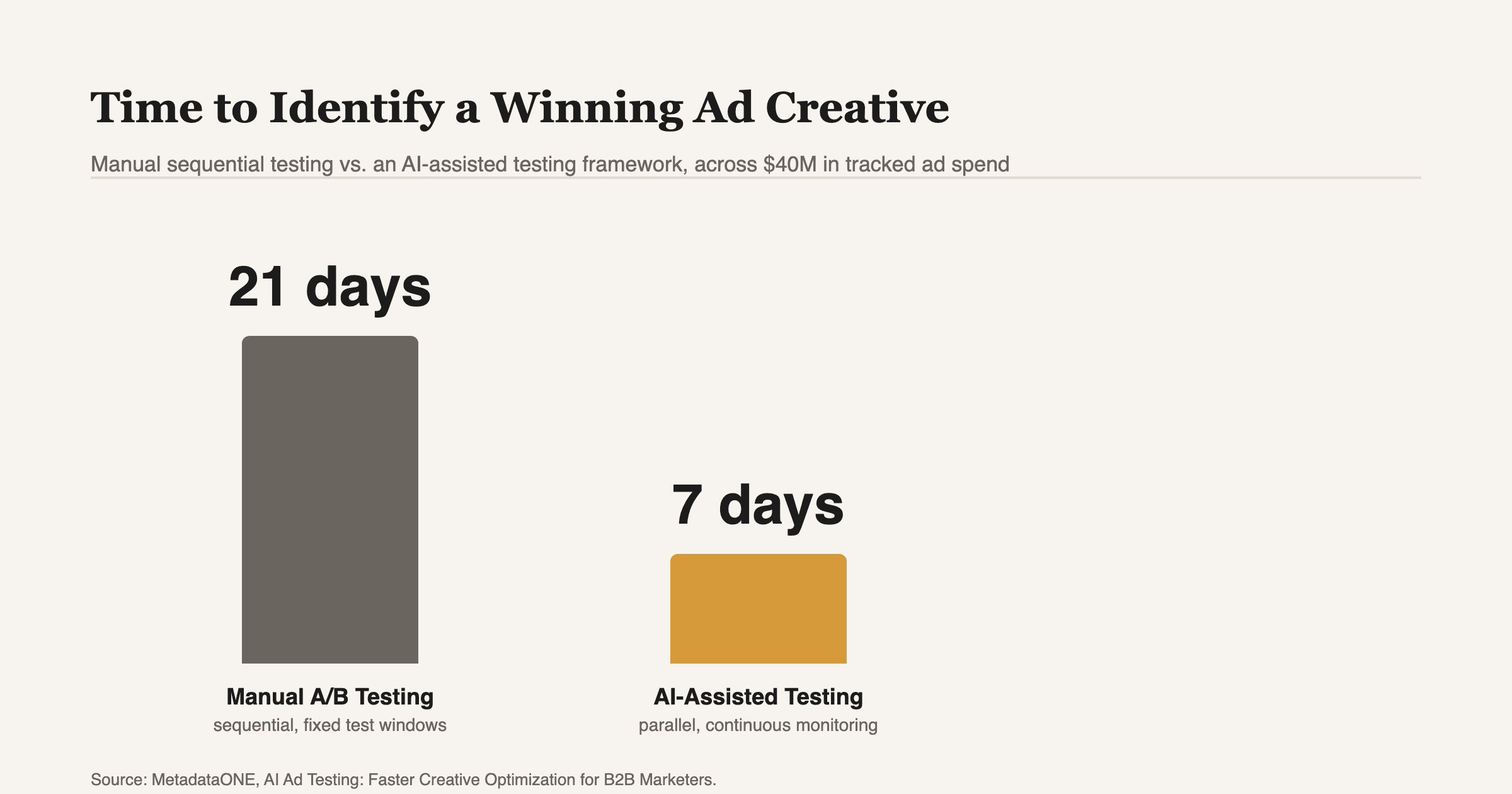
The advantage of AI in creative testing isn't the variant count, it's continuous monitoring across variants running in parallel instead of sequential fixed-length tests waiting for a calendar date. After implementing an AI-driven testing framework, one analysis of $40M in tracked ad spend found time-to-winner dropped from 21 days to 7, while accuracy in identifying the actual winning creative improved by 73%, according to MetadataONE's breakdown of AI ad testing. The gain comes from cutting dead variants early and concentrating spend, and therefore sample size, on the ones still worth testing, not from testing more things at once with the same fixed budget.
The workflow that actually works: generate wide, test narrow
- Use AI to generate a wide concept pool, 20 to 50 hooks, scripts or angles, cheaply and without production cost, that's genuinely where AI changes the economics.
- Launch a structured elimination funnel rather than all variants live simultaneously, a handful of genuinely different concepts first, not fifty near-duplicates competing for the same thin budget.
- Fund each surviving concept to a real conversion floor before judging it, and cut a variant only once it has had a fair chance to reach that floor, not the moment it looks behind on day one.
- Reallocate budget from losers to survivors continuously. This is the same logic Meta's own Advantage+ automation runs on at platform scale, a system Meta reported had reached a $75 billion annualized revenue run rate in its Q2 2026 earnings call, according to Investing.com's transcript of Meta's Q2 2026 earnings call, applied at the account level with a fraction of that budget.
How AIBOOTSTRAPPER helps
AIBOOTSTRAPPER's AI UGC and AI avatar production team generates the wide concept pool AI makes possible, and our performance marketing team runs it through a structured testing funnel instead of fifty variants competing for the same thin budget, so creative volume turns into a real answer instead of fifty inconclusive rows in an ads dashboard.
If your last AI-generated ad batch produced a lot of variants and no clear winner, book a call and we'll look at your actual test structure before recommending more creative.
Want this done for you?
Book a free strategy call and we'll show you how to build and market your business with AI.