A DTC founder generates a batch of AI UGC ads, the avatar looks convincing, the lighting is clean, the product shots are sharp, and the campaign still returns half the click-through rate of the influencer-shot version it replaced. The founder's first instinct is to blame the face, maybe the avatar isn't realistic enough, maybe people can tell. Nine times out of ten that's the wrong diagnosis: the avatar rendering has gotten good enough that viewers rarely consciously clock it as AI in the first three seconds, the ad is losing them, and by then the technology was never the bottleneck.
The real failure point: it reads like an ad, not a person
The most common reason an AI UGC ad underperforms has nothing to do with rendering quality: the script sounds like marketing copy instead of a person describing an actual experience. Real user-generated content converts because it sounds conversational and unscripted even when it's planned, filler words, casual phrasing, the specific way someone actually talks to a friend about something they bought, and when an AI UGC script skips straight to benefit statements and polished claims, it breaks the exact illusion the format depends on regardless of how photorealistic the avatar is.
This creates what's often called the credibility gap: viewers aren't necessarily reacting to 'this looks like AI', they're reacting to 'this sounds like an ad', and the two get conflated because AI UGC is disproportionately used for over-produced, benefit-stacked scripts that a real customer would never actually say out loud.
The 3-second problem: most of an ad's value is already decided
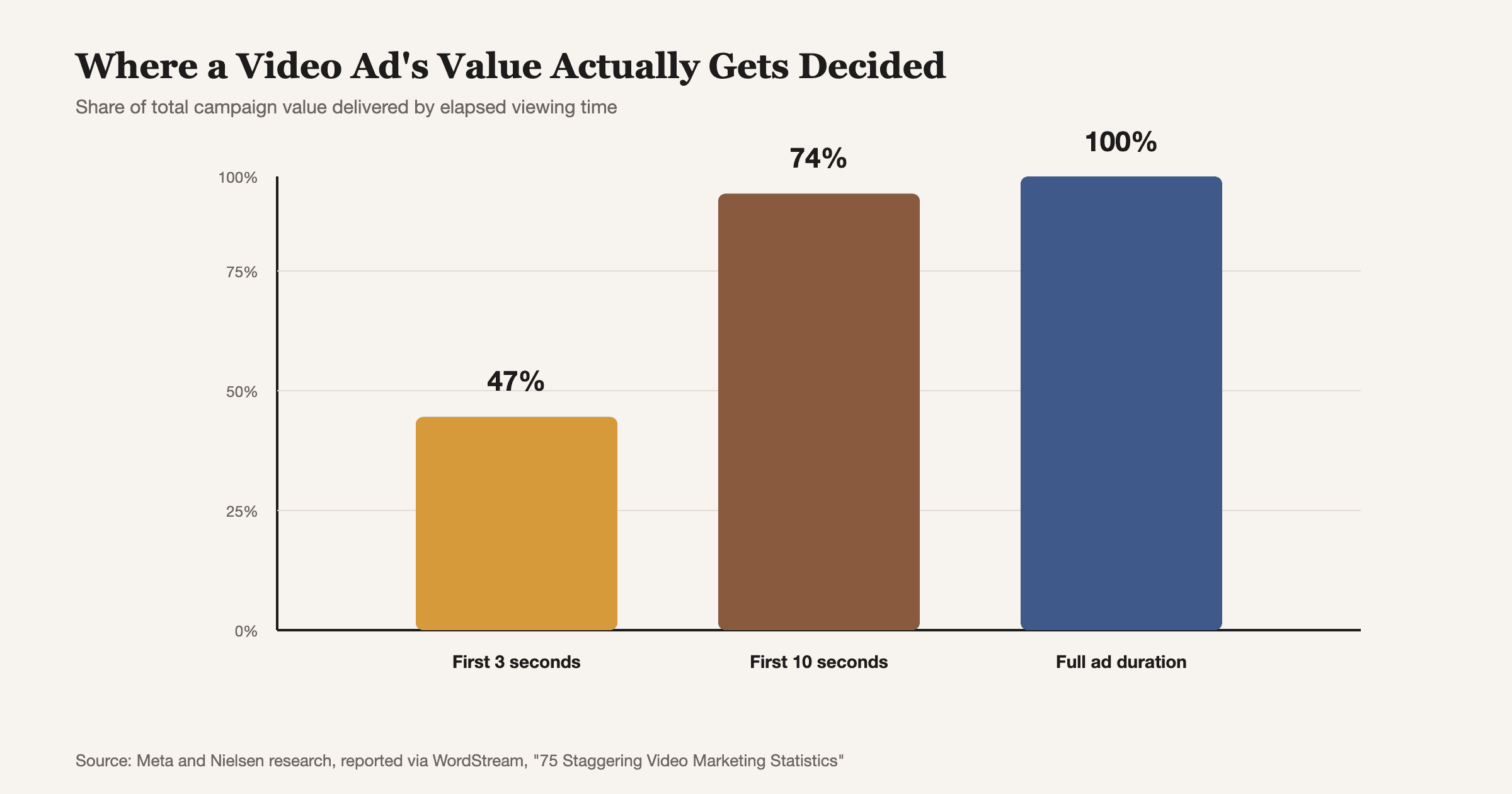
Before the script or the offer matters at all, the ad has to survive its opening. A landmark Meta and Nielsen study, reported via WordStream, found that 47% of a video ad's total campaign value is delivered within the first three seconds, and 74% within the first ten, which means an AI UGC ad that opens with a slow product reveal or a generic greeting has already lost most of its available value before the actual pitch begins.
Hook rate, the share of viewers who watch past the first three seconds, is the metric that exposes this directly. Industry benchmarking on Meta places a solid hook rate around 20-25%, with strong performers reaching 30% or higher, and Reels/Stories-specific placements often needing 58-68% to be considered genuinely strong, and Meta's algorithmic delivery rewards content that holds attention early with more distribution, so a weak hook doesn't just lose viewers, it actively throttles reach.
The diagnostic checklist: script, hook, then avatar
- Open with a pattern interrupt, not a greeting: a specific claim, a question, or a mid-sentence start that assumes the viewer is already listening, the first frame has roughly three seconds to earn the next ten.
- Read the script out loud before generating: if it sounds like copy when spoken, it will sound like copy from the avatar too, the model only performs the words it's given, it can't fix an unnatural script.
- Keep the imperfection: filler words, a slight tangent, a specific and slightly odd detail (not 'saved me time', but 'saved me the twenty minutes I used to lose every Monday'), specificity reads as lived experience, generic benefit language reads as marketing.
- Only after script and hook are fixed, audit the avatar itself for the actual technical tells, unnatural blinking, lip-sync drift, static eye contact, covered in our breakdown of why AI avatar videos look fake and how to fix it, since fixing rendering on top of a weak script won't move conversion.
- Treat it as a testing pipeline, not a one-off asset: the advantage of AI UGC is generating and testing many hook variants fast, brands winning with the format in 2026 run it as a repeatable, data-driven process rather than shipping one polished version and hoping.
What the numbers look like when the hook is fixed
The practical read of the Meta/Nielsen data is that hook quality isn't a minor optimization lever, it's most of the game: with 47% of value locked in by second three, an AI UGC ad's opening line and first visual do more to determine campaign performance than the offer, the CTA, or the avatar's realism combined. That's also why AI UGC video's actual conversion data against real creator content shows the format performing closer to real UGC when the script discipline is there, and noticeably worse when it isn't, the technology was never the ceiling.
How AIBOOTSTRAPPER helps
One AIBOOTSTRAPPER client put it plainly: "the AI avatar alone saved me ten shoot days a month, same face, same voice, ten times the content, and the ads actually convert" (Sara Khan, DTC Brand Owner, Dubai), and the difference between that outcome and an underperforming batch is almost entirely script and hook discipline applied before a single frame gets generated. AIBOOTSTRAPPER's AI UGC and AI avatar production team writes scripts the way a real customer would actually talk, tests hooks in batches, and only then builds the final render, so the avatar's realism is working with the script instead of trying to save a weak one.
If your AI UGC ads are underperforming and you've been troubleshooting the wrong layer, book a call and we'll audit your last batch of scripts and hooks against what's actually converting for AIBOOTSTRAPPER's own performance marketing clients.
Want this done for you?
Book a free strategy call and we'll show you how to build and market your business with AI.