A CTO signs off on an AI agent pilot that handles customer-service escalations: $8,000 a month in model API calls, clean demo, everyone's happy. Six months later, the same agent is live for real volume and the bill is $38,000 a month, the model didn't get more expensive per token, in fact the opposite happened, and nobody on the team can point to the one thing that changed. This isn't a billing mistake. It's the predictable result of scoping a production system using a pilot's cost structure, and Gartner's own data says pilots run at roughly 15 to 25% of what the real, supported production bill ends up being, which means the other 75 to 85% was never in the spreadsheet to begin with.
Why does a working pilot's budget have almost nothing to do with the production bill?
Because a demo only has to work once, on inputs someone already knows will work, and production has to work every time, on inputs nobody picked. A pilot answering twenty hand-picked support tickets correctly represents, mechanically, maybe ten percent of what shipping the same agent safely actually requires, and it's the ten percent that happens to look like the whole job from the outside.
Everything that makes an agent safe to leave running unattended, evals, guardrails, observability, cost controls, security review, and an owner who answers when it breaks at 2am, is invisible in a demo and non-negotiable the moment real customers touch it. None of that infrastructure shows up in a pilot's bill because a pilot, by design, doesn't need it yet.
Where does the actual token burn come from once an agent goes live?
From the mechanics of being an agent, not a chatbot. A single chatbot call takes one prompt and returns one response, so the token cost is roughly fixed per interaction. An agent plans a task, calls a tool, reads the result back into its own context, decides whether to call another tool, and repeats that loop, sometimes five or ten times, before it produces the answer a human sees, and every one of those intermediate steps re-sends the growing context back through the model.
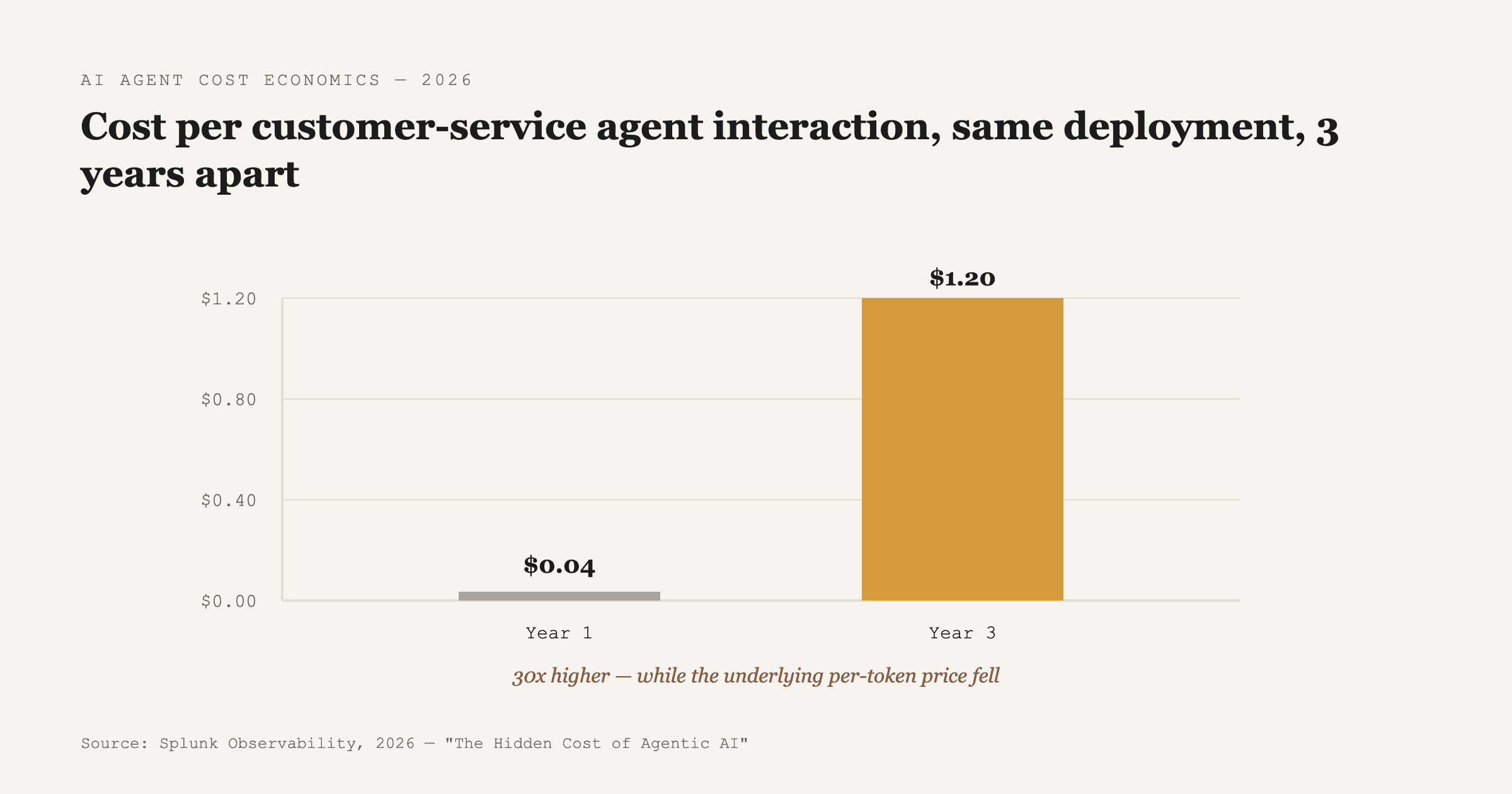
That structural difference is why agents burn 5 to 30 times more tokens per task than a single chatbot call does, and it compounds in ways a pilot never surfaces: one documented customer-service deployment saw its cost per interaction climb from $0.04 to $1.20 over three years, a 30x increase, while the underlying per-token price was falling the entire time, because the agent kept doing more tool calls, more retries and more reasoning steps per task as real-world edge cases piled up.
What specifically makes up the 75-85% nobody puts in the pilot's budget?
- Observability and tracing infrastructure, logging every tool call and intermediate reasoning step, not just the final answer, because you cannot control a cost or a failure you cannot see, the same tracing discipline covered in how to evaluate an AI agent before it ships.
- Guardrails that reject an unsafe or malformed action before it executes, instead of after a customer or a finance system has already been affected by it.
- Security review on every tool the agent can call, since a tool with write access is a new attack surface the pilot's read-only demo never exposed.
- Retry and idempotency handling at real traffic volume, where the same compounding-probability problem that breaks automation workflows without proper retry logic also quietly multiplies token spend every time a step fails and reruns.
- An on-call owner with an actual budget line, because the exceptions an agent surfaces in production need a named human to resolve them, not a Slack channel nobody checks, which is the same ownership gap behind why 88% of enterprise agent pilots never reach production at all.
How do you actually scope a pilot so the production number doesn't blindside anyone?
Price the pilot's token cost using its worst realistic path, not its best one. Run the eval set with retries, malformed tool arguments and multi-step failures included, because that is the traffic pattern production will actually see, not the clean one the demo was built to show.
Then budget observability, guardrails and security review as line items from day one, not as a phase-two add-on once the pilot 'proves itself.' A system built with tracing and cost controls baked in from the first commit doesn't need a separate, expensive retrofit six months later, it just needs to scale what already exists.
How AIBOOTSTRAPPER helps
This is the exact discipline behind ComplyNexus, the AI-powered compliance platform we built that continuously monitors regulatory sources and maps new rules to a client's control library. We didn't bolt on logging after the fact, every regulatory interpretation the system makes was built to be traceable and audit-ready from the first version, which is why the client's compliance team got 100% audit-ready traceability and cut regulatory change turnaround from three weeks to two hours without a painful, expensive retrofit once the system went from pilot to real daily use.
If you're scoping an AI agent pilot right now, book a call before you lock the budget, not after production traffic shows you the real number, or see our AI consultancy and automation services for how we price observability and guardrails into the build from day one.
Want this done for you?
Book a free strategy call and we'll show you how to build and market your business with AI.