Six weeks after a company-wide AI workshop, the L&D lead checks tool usage logs and finds exactly what she was afraid of: a spike the week of training, then a steady decline back to almost nothing by week four. The feedback scores were excellent, 4.6 out of 5, people said they 'finally got it'. But almost nobody is actually using AI in their daily work. The training didn't fail to teach anything, it failed to survive contact with people's actual workflow, and that gap between a good session and a changed habit is where most corporate AI training money quietly disappears.
The gap isn't knowledge, it's workflow integration
A workshop can successfully teach someone how a tool works and still fail to change what they do on Monday morning, because the two are different problems: understanding a capability versus rebuilding a habit around it. As Go1's 2026 guide to AI training for employees puts it plainly, 'completing a course doesn't automatically translate to confident, daily AI use', the confidence and the daily habit have to be built separately, and most one-off training programs only address the first.
This is why attendance and satisfaction scores are such poor predictors of adoption. A session can be genuinely well delivered, well received, and still leave every attendee without a concrete task where they're expected to use the tool tomorrow, which means the default behavior, doing it the old way, simply reasserts itself once the novelty wears off.
Enterprise AI adoption is accelerating faster than usage habits are
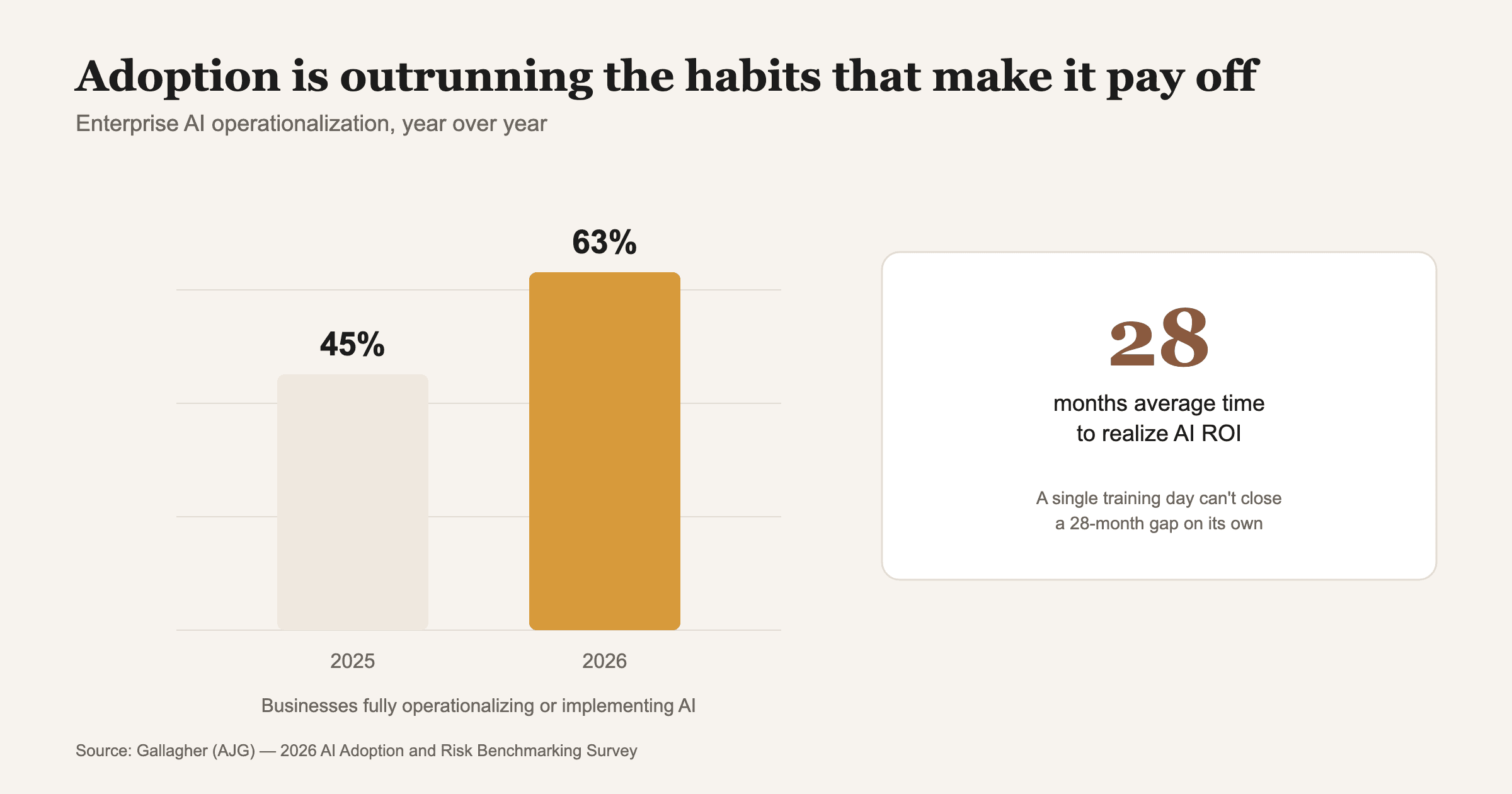
The scale of the gap shows up clearly at the market level. Gallagher's 2026 AI Adoption and Risk Benchmarking survey of more than 1,200 global businesses found that 63% have fully operationalized or implemented AI within parts of their business, up sharply from 45% in 2025. Yet organizations actively measuring ROI on that investment estimate it will take an average of 28 months for the value to outweigh the upfront cost.
Read together, those two numbers describe exactly the problem a single training session can't solve on its own: companies are rolling out AI access faster than they're building the habits and workflow changes that make it actually pay off, and a 28-month realistic ROI horizon means the first few months of low, patchy usage are the norm, not a sign that training failed, unless nothing is done to close the gap deliberately.
What actually closes the gap between the workshop and the workflow
- Anchor training to named, real tasks, not tool features: teach the AI on the actual report, email, or ticket type someone handles every week, not a generic demo prompt, so there's a specific habit to repeat immediately after the session.
- Assign a task-level owner in every team who is expected to use the tool that week and report back, since diffuse organization-wide encouragement almost never survives the first busy week without a named person accountable for it.
- Build a 30-day follow-up checkpoint into the program, not just the training day, to catch the usage drop-off while it's still reversible, rather than discovering it in a usage report three months later.
- Separate leadership alignment from hands-on team training: a leadership session should set the ROI and prioritization narrative, while team sessions need to be role-specific and mapped to real workflows, conflating the two produces a session too abstract for either audience.
- Track usage persistence, not attendance, as the real success metric: whether the tool is still open in week eight is the number that predicts ROI, covered in more depth in how to measure the ROI of corporate AI training.
Adoption pace: what the market data shows
The takeaway isn't that training doesn't work, it's that a single session is being asked to do a job that actually requires a sustained program: workflow-specific practice, named accountability, and a follow-up checkpoint, the same structure covered in AIBOOTSTRAPPER's guide to corporate AI training workshops.
How AIBOOTSTRAPPER helps
AIBOOTSTRAPPER's corporate programs are built around this exact gap: the Company Wide Masterclass uses a custom curriculum per department mapped to real workflows and hands-on practice on people's actual tasks, rather than one generic session for the whole org, and the AI Leadership Alignment track is kept separate so leadership gets the ROI and prioritization conversation it actually needs. Across 25+ corporate programs and 5,000+ professionals trained, the sessions consistently score 4.8 out of 5, but the design goal has always been the habit that survives week four, not just the score on day one.
If your last AI training produced a great feedback form and not much usage, that's a workflow-integration problem, not a content problem, and it's fixable. Book a call to scope a program built around your team's actual tasks.
Want this done for you?
Book a free strategy call and we'll show you how to build and market your business with AI.