A DTC skincare founder was proud of a video: an AI avatar walking through the product's ingredient list, polished, on-brand, 2.1 million views on Instagram in three weeks. When she asked ChatGPT to recommend a vitamin C serum for sensitive skin, her brand never came up. A competitor's video did, a clunky, single-take clip filmed on a phone with 4,000 views. The difference wasn't production value. It was that one video had a transcript an AI system could actually read, and the other, technically, didn't.
Why doesn't view count help a video get cited by AI search engines?
Views, likes and subscriber counts measure human engagement with a video as a video. AI answer engines don't watch a video the way a viewer does when deciding whether to cite it; at the scale they operate, they work primarily off the text layer a video exposes, its transcript, captions, title, and description, not frame-by-frame visual analysis of a 4,000-view clip versus a 2-million-view one.
A 2026 study by AI-visibility tracker Otterly, analyzing over 100 million AI citation instances across six major search engines, found that views, likes and subscriber count have near-zero correlation with whether a video actually gets cited, while YouTube overtook Reddit as the most-cited social platform across Google AI Overviews, ChatGPT and Perplexity, on the strength of its transcript layer, not its engagement metrics.
What does an AI search engine actually "read" when it cites a video?
It reads the caption-derived transcript, chunked into passages the same way a RAG pipeline chunks a PDF or a web page, essentially treating each timestamped segment as its own retrievable unit of text, the same chunking mechanics that determine retrieval accuracy in any RAG system. A video with no captions, or with captions so broken they can't be segmented into coherent passages, is functionally invisible to that process regardless of how good the footage looks.
That's why Otterly's data shows 78% of timestamped videos get cited multiple times, typically across two to five different chapters: each chapter is a distinct citable chunk. A 500-view video with a clean transcript and clear topic segmentation genuinely outperforms a 5-million-view video with garbled auto-captions and no chapter structure, because the AI system is retrieving text passages, not counting views.
How accurate are auto-generated captions, really?
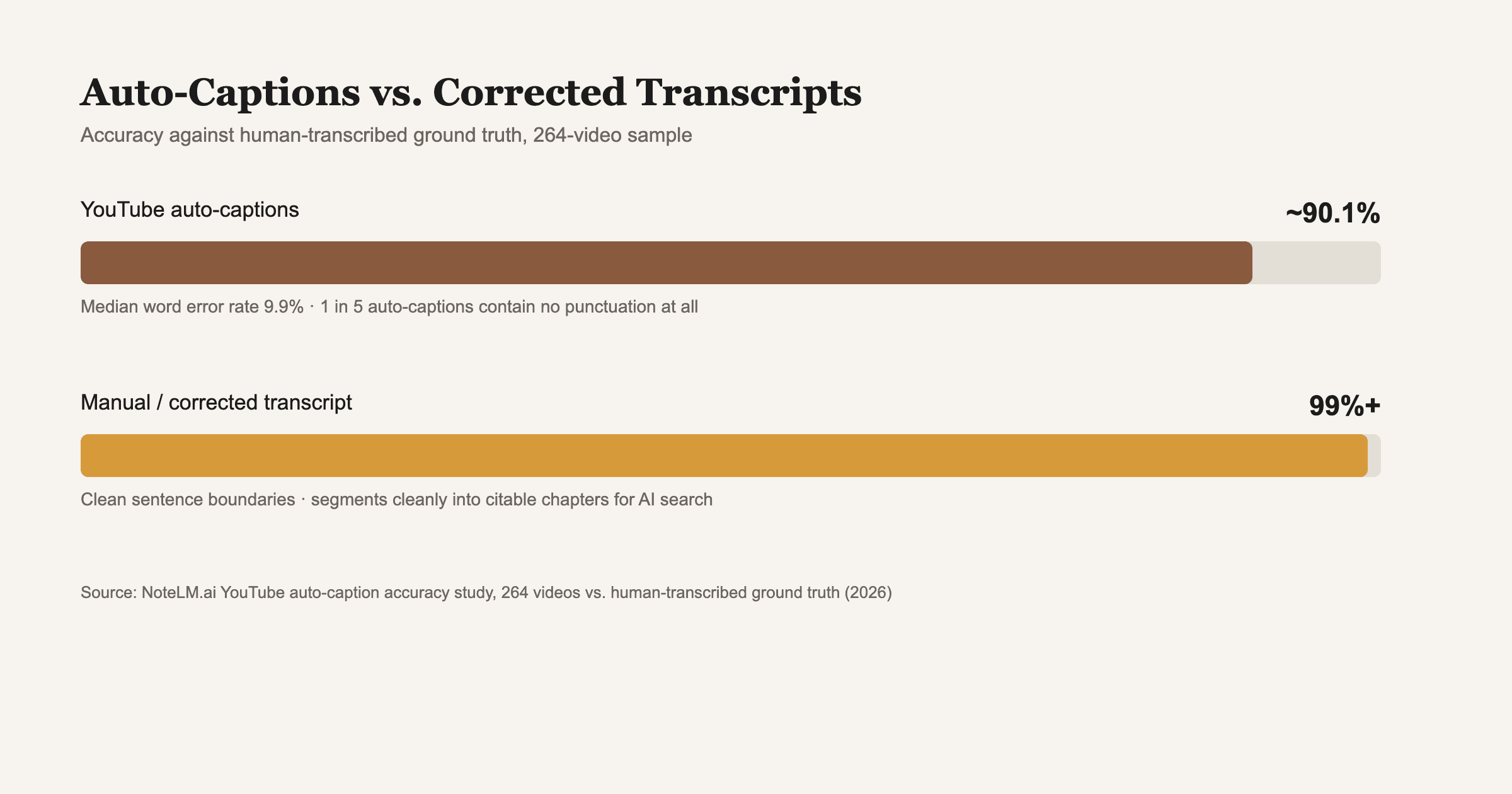
Not accurate enough to rely on by default. A YouTube auto-caption accuracy study measuring 264 videos against 997,401 words of human-transcribed ground truth found a median word error rate of 9.9%, and that 20% of auto-captions contain not a single period, which means one in five auto-captioned videos produces a wall of run-on text with no sentence boundaries at all.
That matters structurally, not just cosmetically: a chunking system that splits text on sentence boundaries can't cleanly segment a transcript that has none, so the whole video collapses into one oversized, low-precision chunk instead of several citable ones. Manually corrected or creator-uploaded transcripts, by contrast, routinely reach 99%+ accuracy, which is the difference between a video an AI system can cite five separate ways and one it can barely parse at all.
How do you actually structure a video so it gets cited?
- Upload a corrected or creator-made transcript rather than shipping raw auto-captions, since a 9.9% median word error rate and missing punctuation actively breaks how these systems chunk your content.
- Add explicit chapter markers around distinct topics or questions the video answers, since chapter-segmented, timestamped videos get cited across multiple chunks instead of once, if at all.
- Write specific, descriptive alt text and file names for any accompanying thumbnails or product images, the same 'specific beats generic' rule that makes a transcript citable applies to image metadata.
- Add VideoObject structured data with the transcript field populated where your CMS supports it, so the text layer is machine-readable in more than one place, not just inside the platform's own caption system.
How AIBOOTSTRAPPER helps
AI avatar and UGC video production is part of our AI marketing work, and the caption discipline above isn't an afterthought in that process: every video we produce ships with a corrected transcript and real chapter structure, not a raw auto-caption pass, because a video an AI system can't parse is a video that isn't actually doing discovery work for the brand, regardless of how many views the platform algorithm hands it. If you're producing AI avatar or UGC content and it isn't showing up when prospects ask an AI assistant for a recommendation, book a call and we'll audit the transcript layer, not just the creative.
Want this done for you?
Book a free strategy call and we'll show you how to build and market your business with AI.