A CMO at a SaaS company in Austin signs off on a GEO retainer. Week one deliverable: an llms.txt file, pitched as the fastest way to get ChatGPT and Perplexity to cite the brand. It ships in an afternoon. Six weeks later nothing has moved, and the CMO asks the fair question: did anything ever read it? Ahrefs checked 137,210 domains' server logs for May 2026 and found that 97% of llms.txt files received zero requests. SE Ranking's separate analysis of roughly 300,000 domains found no measurable link between having the file and being cited. The file is not harmful, but it is not the lever it was sold as.
What is llms.txt, and what was it supposed to do?
llms.txt is a plain markdown file at your domain root that lists your most important pages with short descriptions, meant as a curated reading list for language models. The pitch was that a model could skip navigation, ads and JavaScript and read one clean index of your best content. We covered the format in our llms.txt and structured data setup guide, and it is still a reasonable file to have. The question this post answers is narrower: does it change who cites you?
One thing to settle first. llms.txt is not a permission system. Access control is still robots.txt, where GPTBot, OAI-SearchBot and ClaudeBot each need their own decision. llms.txt cannot allow or block anything.
Does anyone actually request llms.txt files?
Almost nobody does, and the ones that do are mostly not the engines you care about. In the Ahrefs dataset, 28% of domains published a file (an upper bound, since Ahrefs customers skew technical), 97% of those files got zero requests in May, and 96% of the requests that did arrive came from bots rather than people.
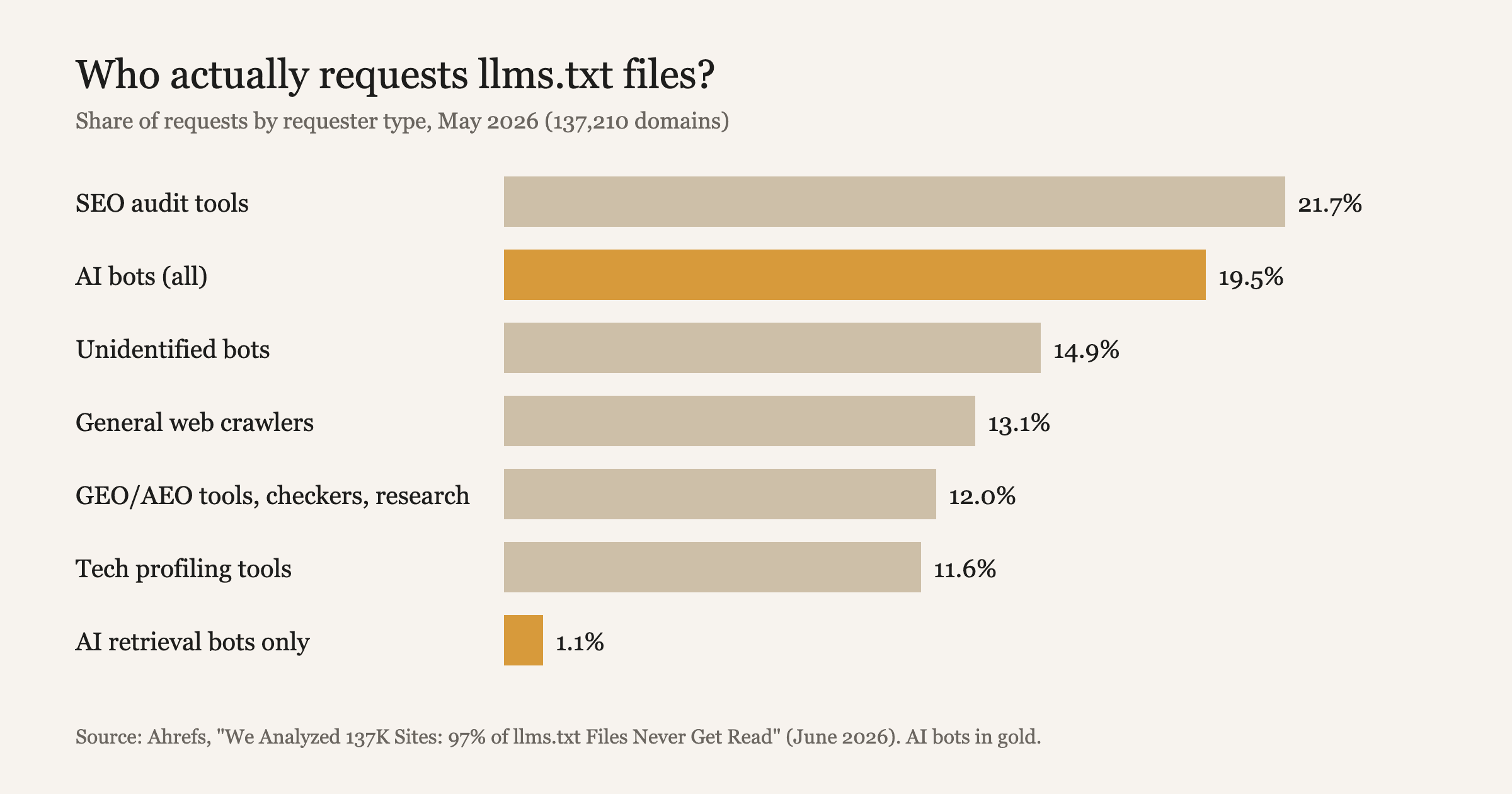
The breakdown of who fetched it is the useful part. SEO audit tools made up 21.7% of requests, AI bots combined 19.5%, unidentified bots 14.9%, general web crawlers 13.1% and tech profiling tools 11.6%. Inside the AI slice, agents were 10.5%, training crawlers 5.3%, assistants 2.5% and retrieval bots just 1.1%. Retrieval bots are the ones that fetch pages to answer a live question, so they are the ones that decide whether you get cited in the moment. They barely touch the file.
Does having llms.txt correlate with more AI citations?
No. SE Ranking measured how often roughly 300,000 domains were cited across major LLM answers, then tested llms.txt as a feature using correlation tests and an XGBoost model. Adoption was 10.13%, and removing the llms.txt feature actually improved the model's accuracy. In plain terms, the file added noise, not signal. SE Ranking's own conclusion was hedged to "at least not yet", which is fair.
Be precise about what this proves. Correlation studies on citations are blunt: sites that publish llms.txt may differ from those that do not in ways the model cannot see. But combined with the Ahrefs log data, there is no mechanism and no correlation. Neither Google nor OpenAI documents llms.txt as a ranking or citation input, and Google's own AI features guidance for site owners points to ordinary crawlability and helpful content.
Is it worth shipping anyway?
- **Cost is low, so ship it if you must, but do not report it as a win.** An afternoon of work is fine. Presenting it to a board as your GEO strategy is not.
- **Check your own logs first.** Ahrefs' advice is to see whether anything fetches yours before investing further. Filter access logs for the path and group by user agent.
- **Treat it like code.** Ahrefs recommends reviewing the file as you would any content an agent will ingest, because text an agent reads can carry prompt-injection risk. Keep it to plain descriptions of pages you control.
- **Never let it replace robots.txt or real page quality.** Agents that do read it still have to fetch the pages it points to.
What should you do instead if you want citations?
Spend the effort where retrieval systems demonstrably look. First, make pages extractable: answer the question in the first two sentences, use question-style headings, add comparison tables, and mark up entities with JSON-LD that matches the visible page. Second, get the robots.txt decisions per bot right, so retrieval crawlers can reach the pages you want quoted. Third, build the external trust signals engines weight: third-party reviews, listicle and comparison inclusion, and real mentions on forums buyers read. Fourth, measure it: sample your target prompts repeatedly, since citations vary run to run, instead of trusting a single check.
None of this is as quick as uploading a text file, which is exactly why the text file got oversold. A tidy index of your best pages is housekeeping. Authority and extractability are the work.
How AIBOOTSTRAPPER helps
We did not have a client case study that fits this topic, so we will not invent one. What we can say is how we approach it: we audit server logs and citation samples before recommending any GEO tactic, rank fixes by evidence, and build the extractable page structure, schema and entity work that retrieval systems actually use. That is the same approach behind this site's own blog program.
If an agency has sold you llms.txt as a headline deliverable, book a call and we will review what you have against your logs. See our marketing services for how we run GEO audits.
Want this done for you?
Book a free strategy call and we'll show you how to build and market your business with AI.