A founder types their own brand name into ChatGPT to see how the launch is landing, and a competitor gets cited instead, word for word, on a question their own page answers better. They check Google: their site ranks third for the exact same query. Nothing about the page changed between the two searches. What changed is which engine was asked, because ChatGPT, Perplexity and Google's AI Overviews are not three windows onto the same index, they are three separate retrieval systems with different blind spots, and most GEO advice ignores that entirely.
Why does the same question get answered with different sources on different AI engines?
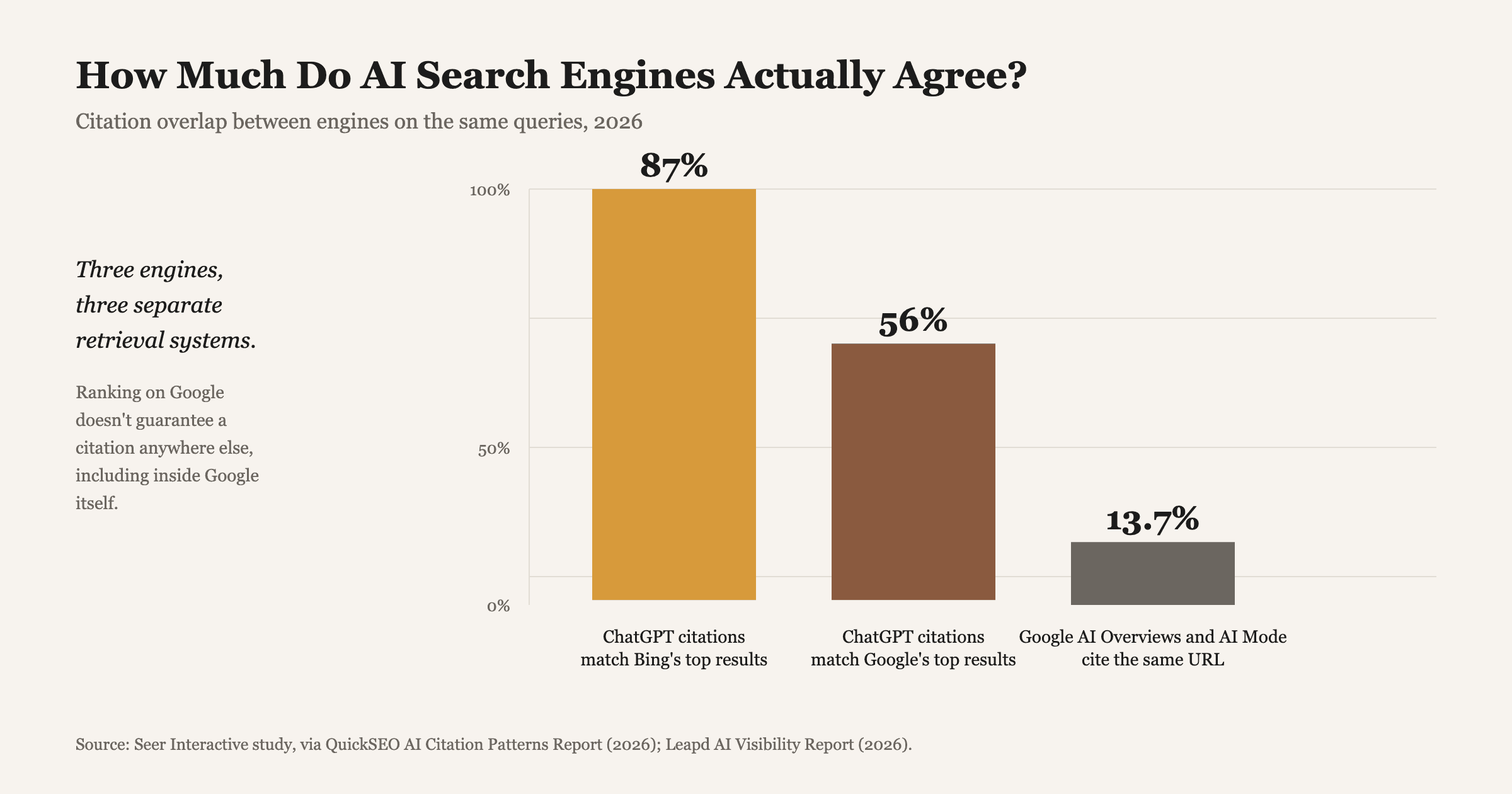
Each engine runs its own retrieval pipeline end to end, not a shared citation database. ChatGPT's search feature depends heavily on Bing's index through its own crawler, OAI-SearchBot, rather than building an independent index from scratch. A controlled study by Seer Interactive, reported by QuickSEO's 2026 AI citation patterns analysis, found that 87% of ChatGPT search citations match Bing's top results, while only 56% match Google's, an 11-point swing that only makes sense once you know which backend engine is actually doing the retrieval.
That single fact reframes most GEO advice: optimizing purely for Google Search Console rankings leaves a real gap if the underlying page has never been checked against Bing's own index, since a page ChatGPT can't find in Bing is a page ChatGPT can't cite, regardless of where it sits in Google.
What structural blind spot erases a site from ChatGPT search entirely?
OpenAI's crawlers, including OAI-SearchBot, don't execute JavaScript, so anything rendered purely client-side is invisible to them. A page that depends on a browser running React to paint its actual content, rather than serving that content in the initial HTML response, effectively doesn't exist for ChatGPT's crawler no matter how well it's written or how well it ranks on Google, whose own Googlebot does render JavaScript.
This is a different failure mode from the one covered in our GPTBot vs OAI-SearchBot guide, which is about accidentally blocking the right bot in robots.txt. This is about the bot being allowed in but unable to read the page at all. The fix is the same discipline good SEO already requires: server-side rendering or static generation for any page you actually want cited, verified by checking what the page's initial HTML response contains with JavaScript disabled, not just what a browser shows you.
Why does Perplexity cite different, often newer, sources than ChatGPT or Google?
Perplexity runs a live web search on every single query rather than leaning on a cached index the way ChatGPT and Google Search partly do, which makes it the most retrieval-driven and recency-weighted of the major engines. Leapd's 2026 AI visibility research found Perplexity cites content published within the last 30 days at an 82% rate, and that a visible year signal, like '2026' appearing in a title or heading, lifts citation rates by roughly 30%.
That has a direct, testable implication: a page with no visible date, or a stale-looking '2023' still sitting in an H1, is quietly disqualifying itself from Perplexity's freshness weighting even if the content underneath was updated last week. Dating your content visibly, not just in a hidden metadata field, is not cosmetic here, it is a ranking signal specific to this one engine.
Why do Google's own AI Overviews and AI Mode cite different sources from each other?
Even inside a single company, Google's AI Overviews and its more conversational AI Mode cite the same URL for the same query only 13.7% of the time, according to Leapd's 2026 data, despite frequently reaching similar conclusions. AI Overviews leans more heavily on the existing classic index and structured data already attached to a page, while AI Mode does more active query fan-out, breaking one question into several sub-queries and retrieving separately for each.
The practical takeaway is that 'ranking well in Google AI Overviews' and 'getting cited in AI Mode' are two different optimization targets sitting inside the same product, not one achievement that automatically covers the other.
So what should you actually check, engine by engine?
- Audit rendering: confirm your highest-value pages return real content in the raw HTML response, not just after JavaScript executes, since OAI-SearchBot can't run scripts.
- Check Bing separately: set up Bing Webmaster Tools alongside Google Search Console, since ChatGPT's citation behavior tracks Bing's index far more closely than Google's.
- Add visible year signals: date time-sensitive content in the actual heading or intro text, not only in a byline, to capture Perplexity's recency weighting.
- Keep structured data current: schema markup still matters most for Google's AI Overviews specifically, more than for Perplexity's live retrieval.
- Stop treating 'GEO' as one target: a page can win one engine's citation and lose another's for structurally different reasons, so track citation rates per engine, not as one combined number.
How AIBOOTSTRAPPER solved this for a client
When we built PropLock, a UK proptech firm relying on manual listings and slow, gut-feel lead handling, the brief wasn't just a website, it was a GEO-optimized site engineered to be found across search and AI answer engines from day one, alongside an AI matching engine and on-chain ownership verification. The site pulled 12,000 organic visitors a month within 90 days and drove 47% more qualified viewings, results that depend on exactly the kind of engine-by-engine technical hygiene covered above, not a single 'SEO score' that happens to look good in one tool.
If your site ranks well on Google but you can't tell whether ChatGPT, Perplexity or Google's own AI Mode actually cite you, that's a diagnosable, fixable gap, not bad luck. Book a call or see the full build in our case studies.
Want this done for you?
Book a free strategy call and we'll show you how to build and market your business with AI.