A founder in Indore finally nails a UGC ad that converts, in Hindi and English, and then hits the wall every business selling internationally hits: the same ad needs to run in Dubai in Arabic, in London in a different register of English, and in Hong Kong for a Cantonese-speaking audience. The traditional answer is a full reshoot per market, new actors, new studio time, weeks of turnaround, which is exactly why most founders just don't localize at all and leave conversion on the table in every market outside their home language. AI dubbing changes the actual economics of that decision, and it's worth understanding the real mechanism before trusting it with a campaign.
How AI dubbing actually works: it's not just a voiceover swap
Traditional dubbing replaces the audio track and leaves the video untouched, which is why dubbed content always looks slightly off, the mouth is still forming the original language's shapes while a different language plays. AI-driven 'vubbing' (visual dubbing) goes further: it modifies the video itself to match the new audio, using models that reconstruct the lower part of the face frame by frame so the mouth shapes match the new language's sounds.
The key mechanical insight, covered in more depth in our breakdown of why AI avatars look fake, is that lip-sync models map phonemes to visemes, the mouth shape a given speech sound produces, not words to mouth movements. Because visemes are tied to phonetic structure rather than specific vocabulary, the same underlying technique works language-agnostically: an 'oh' sound produces roughly the same mouth shape whether it's in English, Arabic or Cantonese, which is what makes cross-language visual resync possible at all.
The pipeline end to end
- Speaker separation and transcription: the original audio is isolated from background music and transcribed, preserving who said what and exactly when.
- Translation with tone and timing preserved: a literal translation is not enough, since a phrase that takes four words in English might take nine in Arabic, so the translation pass has to fit the new script into the same speech duration as the original.
- Voice-cloned synthesis in the target language: the original speaker's voice, tone and emotional delivery are preserved in the new language using voice cloning, so the ad still sounds like your founder or your creator, just speaking Arabic or Cantonese.
- Visual lip resync (vubbing): the lower face is regenerated frame by frame to match the new audio's phoneme timing, closing the gap between what the mouth is doing and what the audience is hearing.
- QA pass on phoneme-to-viseme accuracy: ElevenLabs' dubbing documentation notes their pipeline handles overlapping dialogue, background music and ambient noise as part of a single automated pass, with a configurable voice-cloning strength setting to control how closely the new-language voice matches the original speaker's identity.
What this actually costs vs a traditional reshoot
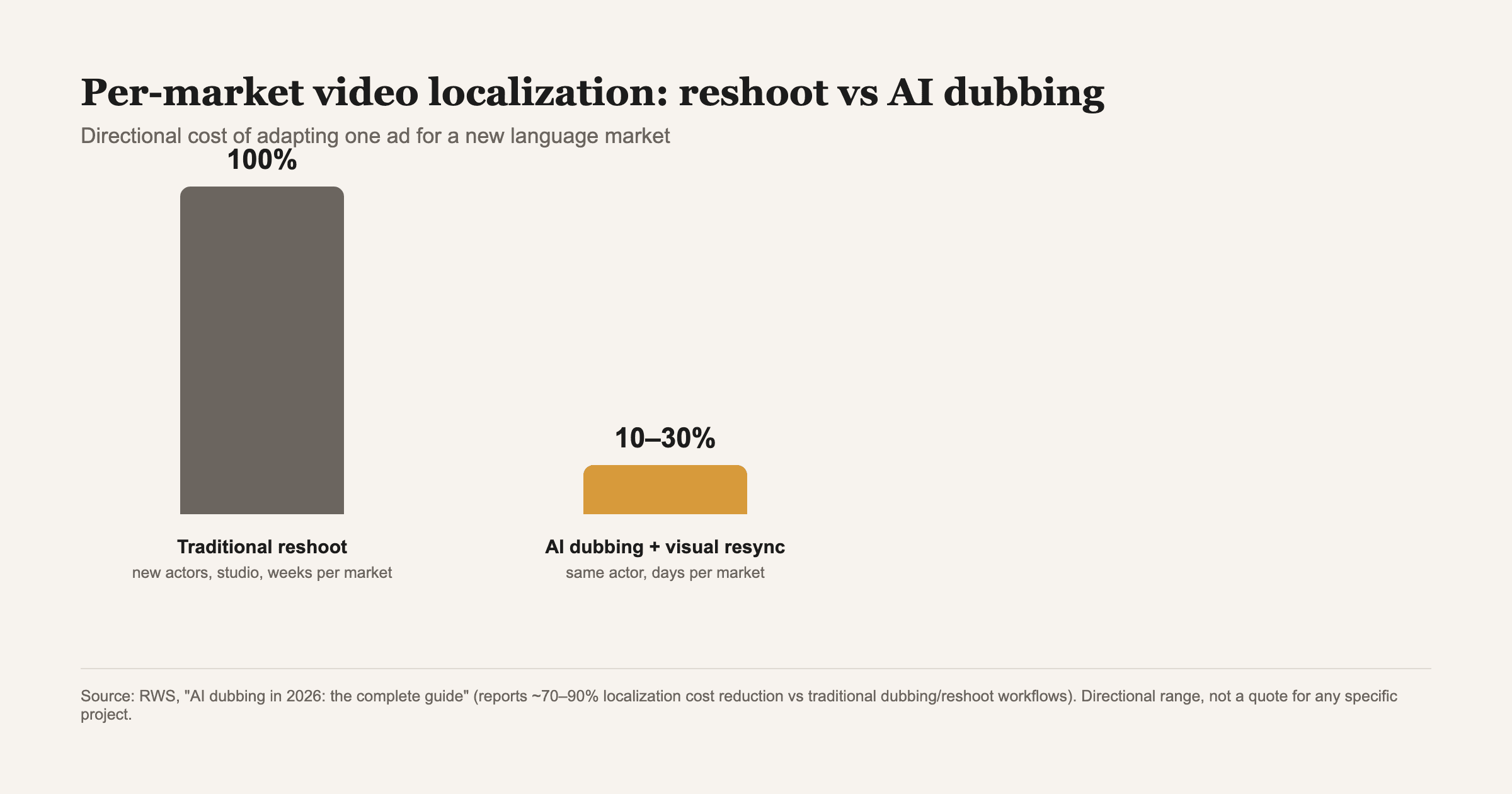
A traditional per-market reshoot means new actors or voiceover talent, studio time, and a production timeline measured in weeks, repeated separately for every language you want to enter. RWS's 2026 guide to AI dubbing reports AI dubbing workflows cutting localization costs by roughly 70-90% against that baseline while compressing turnaround from weeks to days, since the same source performance is reused across every language rather than re-shot.
The category is scaling accordingly: the AI dubbing tools market grew from roughly $1.15 billion in 2025 to $1.35 billion in 2026, which tracks with how many international-facing brands have quietly moved multilingual ad production from 'occasional project' to 'default workflow.'
Where it still breaks
- Literal translation without localization: a script translated word-for-word often loses the idiom, humor or urgency that made the original convert, so the translation pass needs a human or AI localization step, not just machine translation.
- Side angles and occluded mouths: visual resync works best on clear, front-facing shots of the mouth; heavy angles, hands near the face, or fast cuts reduce how convincing the resync looks.
- Flat source performance stays flat: if the original delivery was monotone, the same emotional flatness carries into every dubbed language, since voice cloning preserves the performance you gave it, not a better one.
- Disclosure requirements: platforms increasingly require flagging AI-generated or AI-modified ad content, so a dubbed and resynced ad running on Meta needs the same disclosure discipline as any AI avatar ad.
How AIBOOTSTRAPPER helps
AIBOOTSTRAPPER already ships production audio AI end-to-end, AudioBolo, an AI-powered audio platform we built from architecture through launch in six weeks, is proof of the audio-pipeline engineering this work actually requires. That same voice-cloning and audio-production discipline is what a proper multilingual dubbing pass needs, not a generic translate-and-swap job.
For founders selling across India, the UAE, the UK, Hong Kong and Canada, AIBOOTSTRAPPER's AI marketing production team builds the AI avatars, voice clones and localized ad variants so one great creative becomes a campaign in every market you actually sell into. Book a call to see what that looks like for your current ad set.
Want this done for you?
Book a free strategy call and we'll show you how to build and market your business with AI.