An L&D lead at a mid-sized company gets a vendor quote to update sixty compliance training videos after a policy change: eleven weeks, a full reshoot with the original presenter (who has since left the company), and just over $180,000. The actual content change is a handful of updated slides and one new procedure. The video crew, the studio day, the editing pass, all of it is being paid for again to fix what is, in substance, a text edit. That gap between the size of the change and the size of the bill is exactly what AI avatar production was built to close, and the economics behind it are less about AI being trendy and more about where the cost was actually hiding in traditional video production all along.
Where the cost actually comes from in traditional training video production
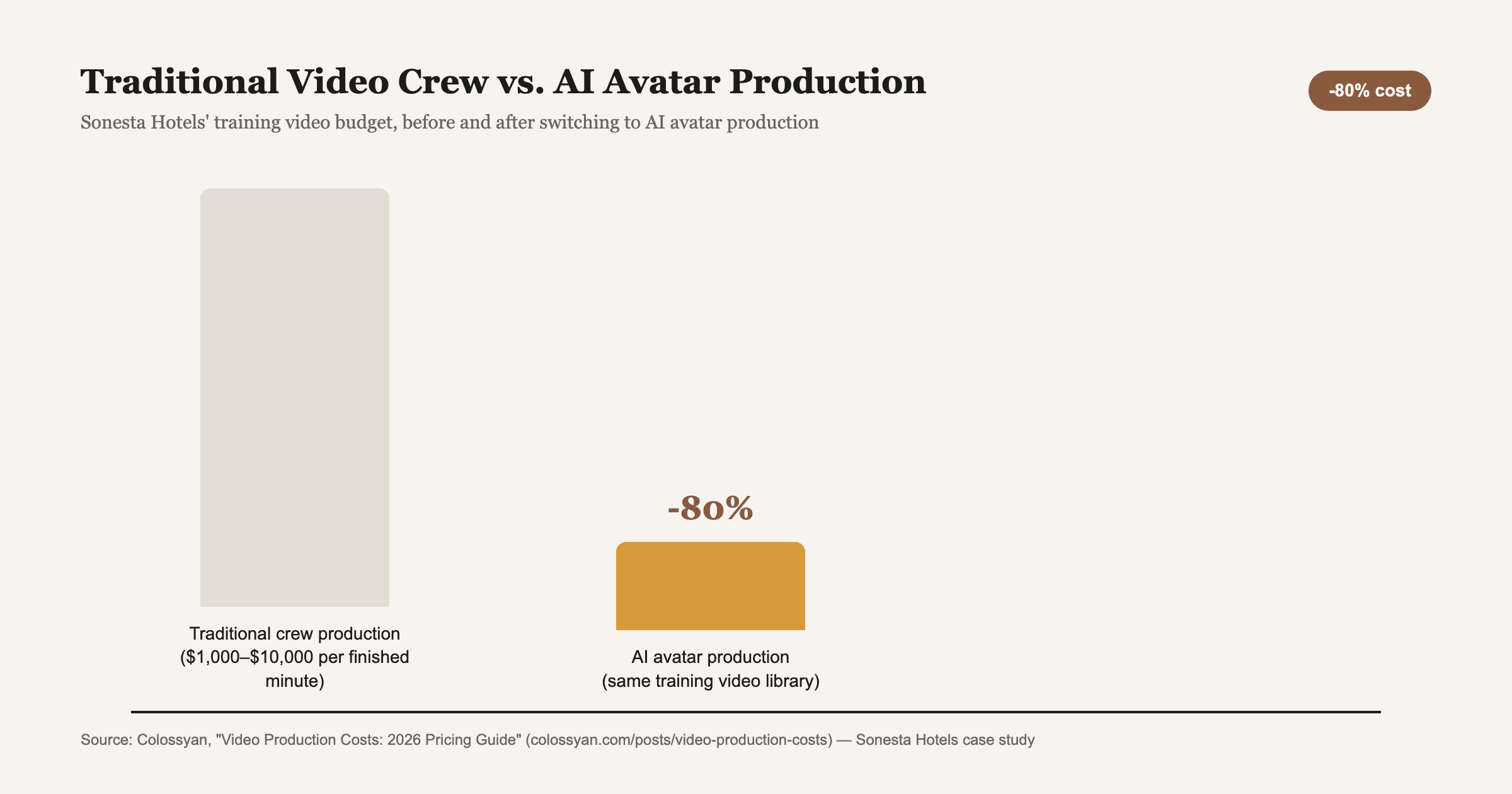
Traditional professional video production runs $1,000 to $10,000 per finished minute depending on crew size, format and post-production complexity, according to Colossyan's 2026 video production cost guide, which draws on agency survey data. For a training library, that cost isn't dominated by the shoot day itself, it's the presenter's time, a studio booking, a multi-person crew, and an edit pass, all of which get paid for again in full the moment a single slide needs updating, because none of those costs scale down for a small change.
A two-to-three minute corporate training video typically lands between $2,000 and $30,000 total under this model. Multiply that across a sixty-video library, and the real cost isn't producing the content once, it's the fact that every future update reopens the entire production process from scratch.
What actually changes with AI avatar production
AI avatar platforms replace the studio-and-crew cost structure with a subscription and a text-editing workflow: a presenter's likeness and voice are recorded once, and every subsequent video is generated from a script rather than reshot on camera. Colossyan's pricing data shows enterprise AI avatar plans running $8,000 to $30,000 a year, a fixed cost that covers effectively unlimited video generation rather than a per-project fee, which is the structural reason updates stop being expensive: editing a script and regenerating a clip takes minutes in the platform editor, not a new studio booking.
The reported result across the industry: 70-90% cost reduction for training and enablement content compared to traditional production, according to the same Colossyan analysis. One concrete case backs the range up directly, hospitality group Sonesta reported an 80% cost reduction after moving its training video production from traditional crews to AI avatars.
The real before-and-after
The Sonesta figure is useful precisely because it isn't a vendor's best-case marketing number, it's a single company's actual reported outcome switching its real training video pipeline, which lines up with the broader 70-90% range Colossyan's cost guide documents across the category rather than sitting as an outlier above it.
Where a video crew still genuinely wins
- A hero brand video meant to carry emotional weight or a founder's specific on-camera presence, an AI avatar is a production tool, not a replacement for a face and voice that is itself the message.
- A one-time video with no realistic update cycle, where the subscription cost of an AI avatar platform doesn't get amortized across enough future edits to beat a single traditional shoot.
- Content requiring complex live-action footage, real locations, real product demos filmed by hand, that an avatar reading a script can't substitute for.
- For everything else, recurring compliance training, onboarding modules, process walkthroughs, product feature explainers that change every quarter, the economics point the other way: it's exactly the content type that gets reshot most often, which is where a subscription with near-zero marginal cost per update compounds fastest.
How AIBOOTSTRAPPER helps
One AIBOOTSTRAPPER client described it plainly: "the AI avatar alone saved me ten shoot days a month, same face, same voice, ten times the content, and the ads actually convert" (Sara Khan, DTC Brand Owner, Dubai). The same underlying production discipline, one recording session becoming a reusable avatar and voice clone that generates new content on demand, applies directly to a training video library that needs updating every quarter instead of reshot from zero.
AIBOOTSTRAPPER's AI avatar and voice cloning production team builds a founder or presenter's avatar once and turns future training updates into a script edit instead of a studio booking. If your last training video refresh cost more than the actual content change justified, book a call and we'll scope what an avatar-based production pipeline would save on your specific library.
Want this done for you?
Book a free strategy call and we'll show you how to build and market your business with AI.