A founder ships an MVP AI feature that costs a few cents per conversation in testing, greenlights production, and watches the first full month's API bill land at ten times the forecast finance signed off on. Nothing about the model changed. What changed is that the feature moved from a single-query chatbot pattern into a multi-step agent, and nobody remodeled what that step change actually does to token consumption before it hit production traffic.
Why does an agentic workflow cost so much more than the chatbot it started as?
A single-query chatbot makes one LLM call per user turn: prompt in, answer out. An agent doesn't. Every step in a 'think, act, observe' loop, deciding what to do, calling a tool, reading the result, deciding the next step, is its own LLM call, and a workflow with four or five tool calls is doing four or five round trips of prompt-plus-context, not one.
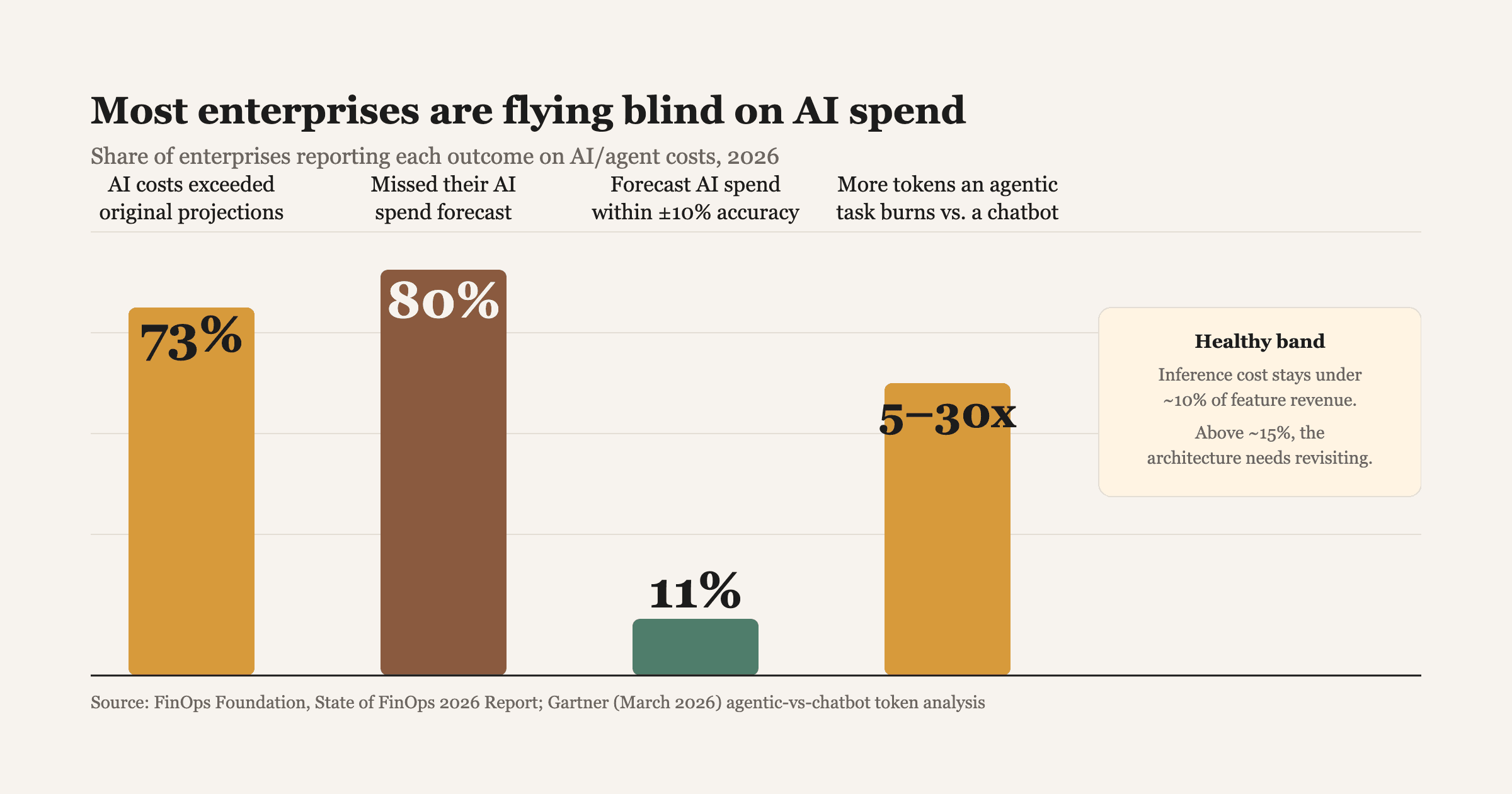
Reasoning models compound this further: they generate hidden reasoning tokens the user never sees but the API bills for, and Gartner's March 2026 analysis found agentic AI workflows consume 5 to 30 times more tokens per task than a standard single-query chatbot, because the extra reasoning tokens are the mechanism behind the model's improved accuracy, not overhead to be optimized away. A workflow that ran on roughly 2,000 tokens on an older chat model can legitimately need 20,000 or more on a 2026 reasoning agent doing the same underlying task, and every additional conversational turn re-sends accumulated context unless prompt caching is explicitly architected in, so the cost compounds again as conversations get longer.
Why do most enterprises blow past their AI budget in the first place?
It's not a rounding error. The FinOps Foundation's State of FinOps 2026 report found that 73% of enterprises reported AI costs exceeding their original projections, 80% missed their AI spend forecast outright, and only 11% of organizations forecast AI spend within ±10% accuracy, a level of budget miss that would be unacceptable for almost any other line item in a technology budget.
The root cause traces back to exactly the mechanism above: teams pilot an AI feature as a single-query chatbot, model the cost off that pilot, then deploy a multi-step agentic workflow at production scale without remodeling consumption assumptions for the jump. The pilot's per-conversation cost and the production agent's per-conversation cost are different orders of magnitude, and the forecast never gets rebuilt to reflect that.
What's the actual framework for forecasting and controlling this?
- Give agent token spend its own budget line. Tokens don't behave like a SaaS subscription, they have a fundamentally different variance profile tied to conversation length, tool-call count and reasoning depth, and nesting them inside a general cloud or SaaS budget hides the volatility until it's already blown the total.
- Model cost per unit of business value, not cost per API call. The number that matters for a loan review, a support resolution or a qualified lead is cost per successful task or cost per decision, end to end, including every tool call and retry that task actually took, not the sticker price of a single model call.
- Build in a 20 to 40% reserve on top of modeled token spend to absorb reasoning-token variance across different query types, since not every conversation hits the same reasoning depth.
- Track inference-to-revenue ratio as a health metric on any chat-heavy or agentic feature: staying under roughly 10% is a healthy band, and crossing 15% is the signal to revisit the architecture, via model routing to cheaper models for simpler steps or semantic caching on repeated query patterns, before the next quarter's bill lands.
How AIBOOTSTRAPPER helps
When we built AudioBolo and Expensorr end to end, architecture and AI integration included, cost-conscious design wasn't an afterthought bolted on after launch, it was part of the same build that shipped both products from concept to production in five to six weeks. That's a different question from what a build actually costs upfront, which we cover separately in our AI agent development cost breakdown; this is about what it costs to run in production every month after.
If your AI feature's bill is already outpacing what you modeled, or you're about to ship an agentic workflow and want the forecasting done right the first time, book a call and we'll walk through the cost-per-task math for your architecture.
Want this done for you?
Book a free strategy call and we'll show you how to build and market your business with AI.