A COO is comparing two AI agent vendor quotes for customer support automation. Vendor A: $0.80 per conversation, flat. Vendor B: $0.99, but billed only per resolved outcome. She picks Vendor A because the sticker number is lower. Six months later, the bill is bigger than Vendor B's would have been, because Vendor A gets paid whether the agent actually solves the customer's problem or not.
What do the three AI agent pricing models actually mean?
Support-agent vendors in 2026 price against one of three units. Per-seat pricing charges a flat fee for AI capability layered on top of a human agent's license, for example Zendesk's Advanced AI add-on runs roughly $50 per agent per month regardless of how many conversations that seat actually handles. Per-conversation (or per-ticket) pricing charges a flat fee for every inbound conversation the agent touches, resolved or not, commonly in the $0.30 to $1.00 range, with Salesforce Agentforce priced at $2.00 per conversation at the higher end.
Per-resolution, or outcome-based, pricing charges only when the agent resolves a conversation end to end without a human handoff. Fin prices this at $0.99 per outcome, Gorgias runs roughly $0.60 to $1.27 per resolution depending on plan tier, and Zendesk charges $1.50 per automated resolution on committed volume. A conversation that escalates, gets abandoned, or fails to resolve simply isn't billed under this model.
Why does the cheaper-looking per-conversation quote often cost more?
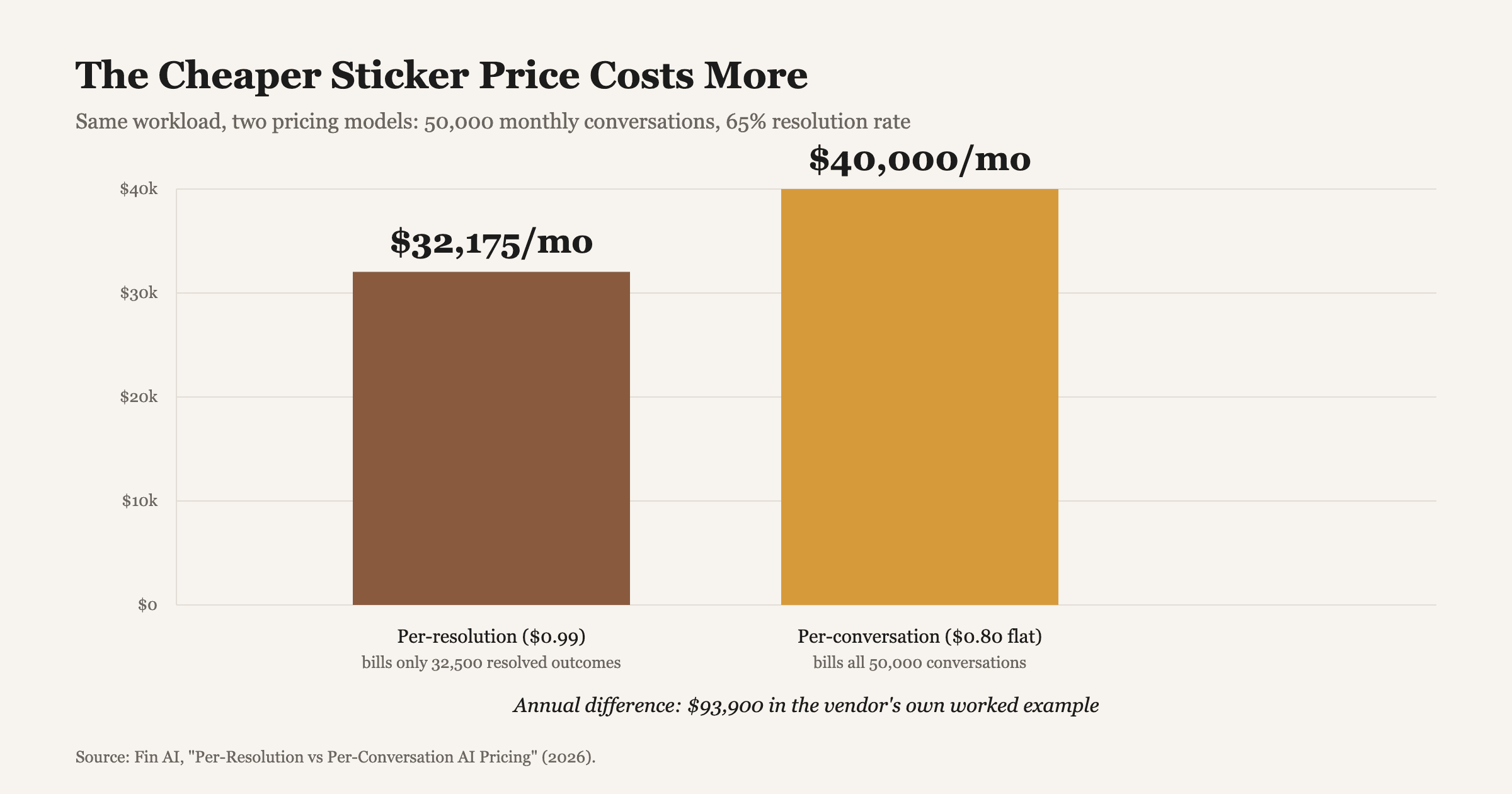
Run the actual numbers instead of comparing sticker prices. At 50,000 monthly conversations and a 65% resolution rate, a fairly typical mid-maturity range, Fin's own worked example shows per-outcome pricing at $0.99 billing only the 32,500 resolved conversations, for $32,175 a month. Flat per-conversation pricing at $0.80 bills all 50,000 conversations regardless of outcome, for $40,000 a month, a difference of $93,900 a year on paper, favoring the model with the higher per-unit price.
The crossover point matters here: per-conversation pricing only becomes the better deal once resolution rates climb to around 80% or higher. Below that threshold, outcome-based pricing wins outright, no matter how much lower the flat per-conversation rate looks on the invoice.
What resolution rate should you actually expect before trusting either quote?
The 65% figure above isn't a worst case, it's a realistic mid-maturity number for a newly deployed support agent, not a best-case demo result. Before comparing two vendors' per-unit prices, ask each one for their measured resolution rate on a comparable use case and volume, not a headline 'resolves 90% of tickets' claim from a case study with different traffic and intent mix. The per-unit price is meaningless without that number attached to it.
How does this pricing logic map onto your own agent, if you're building instead of buying?
The same math applies whether you're negotiating a vendor contract or architecting your own agent. An agent that auto-resolves above a defined confidence threshold and cleanly escalates below it, the same risk-tiered approval pattern covered elsewhere on this blog, is the only design that lets you actually measure cost per successful outcome instead of cost per attempt. Without that clean resolve-or-escalate boundary, you're stuck averaging cost across a mix of successes and failures the way flat per-conversation pricing forces a buyer to do.
If you're scoping a custom build rather than a vendor contract, our AI agent development cost breakdown covers the engineering side of that same question in more depth.
How AIBOOTSTRAPPER solved this for AI Doctor
For AI Doctor, a Dubai-based digital health startup, the clinic needed to scale patient triage without scaling doctor headcount, and patients were waiting hours for basic guidance. We built a clinically guarded AI assistant with safety guardrails and a bilingual, Arabic-and-English handoff workflow that escalates uncertain cases to a human doctor with a complete, pre-filled summary, cutting consultation prep time by 68% and providing 24/7 triage availability.
That architecture draws exactly the same line an outcome-based pricing model bills against: a clean, structural distinction between a 'resolution' (a triage completed and prep handed off cleanly) and an 'escalation' (a case routed to a human with full context). Getting that boundary right is what makes an agent's true cost, and its true reliability, measurable in the first place. If your own agent can't cleanly tell you which conversations it actually resolved, book a call or see the full build in our case studies.
Want this done for you?
Book a free strategy call and we'll show you how to build and market your business with AI.