A DTC founder is staring at a familiar number: roughly 70% of checkouts on the store end in an abandoned cart. The current fix is a generic email, 'you left something behind, here's 10% off,' sent three hours later to everyone who bailed, regardless of whether they left because of a surprise shipping cost, a sizing question, or just got a phone call mid-checkout. It recovers a sliver of that traffic. An AI agent wired into the same event doesn't wait three hours or guess the reason, it reads what actually happened and responds to that specific cause within minutes.
What actually triggers an AI cart recovery agent, and how is that different from an email flow?
An email flow runs on a timer: wait N hours, send the same template to everyone who abandoned. An agent runs on an event: a webhook fires the instant a cart is created with no completed order within a short window, and the agent reads the structured signals available at that moment, cart contents, whether a shipping cost was shown before drop-off, whether this customer has prior purchase history, time of day, device type, before deciding what intervention actually fits this specific abandonment instead of blasting the same discount code at everyone.
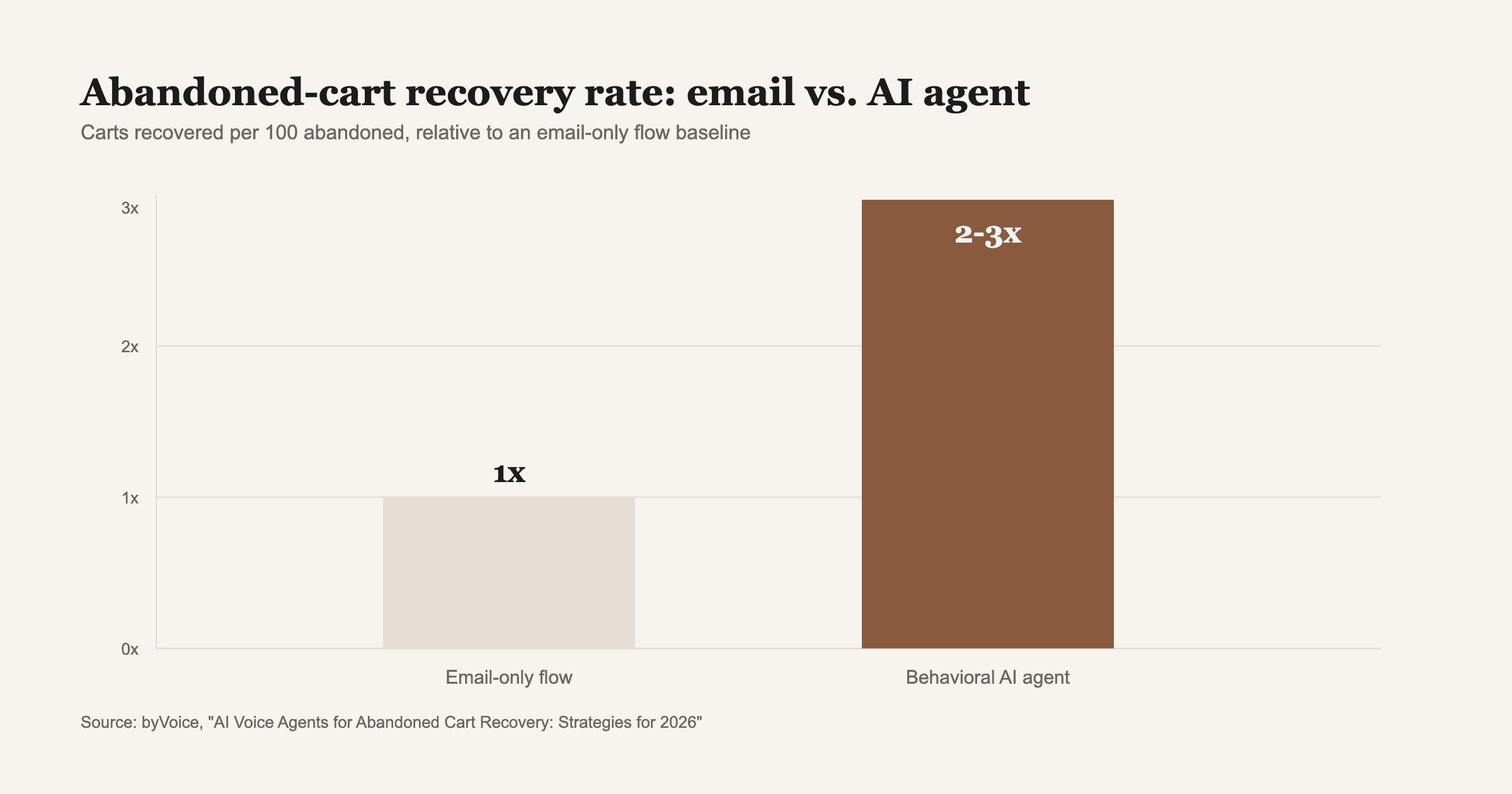
That targeting is what shows up in the recovery numbers. Behavioral AI agents recover 2 to 3 times more abandoned carts than email-only flows, at roughly 12 times lower cost per interaction than routing the same volume through a human live-chat agent, because the agent is responding to the actual likely cause of abandonment rather than a one-size-fits-all nudge sent hours later.
Why does reaching out inside the first 15-30 minutes matter mechanically?
Purchase intent decays fast after checkout abandonment, and a batch email job that fires once an hour or once a day is racing against that decay and losing. An agent wired directly to the abandonment event can reach out within 15 to 30 minutes, while the product is still front of mind, answer a delivery or return-policy question that was the actual blocker, and offer a targeted incentive only where it makes sense, rather than discounting every recovery attempt by default.
It's the same speed-to-response mechanism we've covered for inbound sales leads, applied to a different trigger. The lead-response research shows conversion odds fall off within minutes of a lead going cold; cart abandonment runs on the same clock.
What does the returns and refunds side of the same agent look like?
The mirror-image workflow runs on the back end. When a return is initiated, the agent checks the request against policy, is the item inside the return window, does the stated reason match an eligible category, then generates a return label and processes the refund automatically once a carrier scan or return confirmation comes back, compressing what's normally a multi-day manual queue into minutes for the straightforward cases.
The agent isn't built to resolve every case itself. Damaged goods, disputed charges, and anything outside a clean policy match get routed to a human with the full context attached rather than auto-approved or auto-denied, the same resolve-or-escalate design pattern that makes any customer-facing agent trustworthy enough to run unsupervised on the cases it is confident about.
What's the realistic cost and revenue case for building this as an agent instead of a rules-based email tool?
Broader e-commerce benchmarks report companies deploying AI agents seeing 40 to 60% reductions in support costs and roughly 30% higher revenue than competitors, but treat that revenue figure as a directional industry signal rather than a guaranteed outcome for any single store, it's an aggregate benchmark, not a controlled result tied to one implementation. The number worth anchoring a business case to is the narrower, better-documented one: 2 to 3 times the recovery rate of an email-only flow, at a fraction of the per-interaction cost of a human agent handling the same volume.
How AIBOOTSTRAPPER helps
None of AIBOOTSTRAPPER's published case studies are a direct DTC or e-commerce build, so rather than force a fit, here's the straight version: this trigger-decide-act pattern, an event fires, an agent reads the actual state of the situation, decides the right response, and escalates what it isn't confident about, is exactly the architecture behind our AI automation work on lead capture, follow-ups, support and reporting for other clients. The mechanics are the same regardless of whether the trigger is an abandoned cart, a cold lead, or a support ticket.
If you're running an online store and the only thing standing between an abandoned cart and a recovered sale is a generic email three hours too late, book a call and we'll map what an agent-driven version of that flow would actually look like for your stack.
Want this done for you?
Book a free strategy call and we'll show you how to build and market your business with AI.